


Political observers yesterday offered contrasting opinions about Taiwan’s “exit strategy” for its diplomatic row with the Philippines over the death of a Taiwanese fisherman.
Former presidential adviser Koo Kwang-ming (辜寬敏), who runs a fishing business in the Marshall Islands and is familiar with Taiwan’s fisheries issues, in response to media queries, advised President Ma Ying-jeou’s (馬英九) administration to push the envelope by asserting Taiwan’s rights within its 200 nautical mile (370km) exclusive economic zone (EEZ).
Since Manila refused to recognize Taiwan’s EEZ because of its “one China” policy, Koo said, Taiwan should send vessels to protect Taiwanese fishing boats, block Philippine fishing boats from entering the EEZ and detain those Filipino fishermen who enter the EEZ to force Manila agree to negotiate a fisheries agreement, which the Philippines has been refusing to do for decades.
Extra pressure is needed, Koo said, to resolve the bilateral dispute over the death of 65-year-old Hung Shih-cheng (洪石成), who was shot by Philippine Coast Guard personnel on May 9.
Escalation of the dispute and an increase in animosity between both sides is unwelcome and it is not too late to open another round of negotiation after Taiwan bungled the first round of talks, National Taipei Medical University professor Chang Kuo-cheng (張國城) said.
Resorting to military measures simply because of Taiwan’s overwhelming advantage in military capability would “likely give the impression that Taiwan is prepared to bully its Asian neighbors like China does,” Chang said.
Ma’s hardline position would not be helpful in clearing up the shooting incident and sanctions imposed by Taipei are unlikely to cause major inconvenience for Manila, Chang added.
He urged the government to do its best to re-open bilateral talks with Manila about fishing and be creative with a possibly mutually beneficial arrangement, such as special fishing arrangements for fishermen from Pingtung County’s Siaoliouchio (小琉球) and the Philippines’ Batan Islands.
Meanwhile, Chang Jung-feng (張榮豐), a former National Security Council deputy secretary-general, wrote on his Facebook page that the biggest mistakes made by the Ma administration were its advance announcement of planned sanctions, making a military exercise in the Bashi Channel a non-live fire drill and shutting down communication channels by recalling its representative to Manila and expelling Antonio Basilio, Manila Economic and Cultural Office (MECO) director and MECO Chairman Amadeo Perez, Philippine President Benigno Aquino III’s personal envoy.
Taiwan’s decision to issue a 72-hour “ultimatum” rather than adopting a brinkmanship strategy was in question, he added, and the worse decision was letting the Philippines know what the consequences would be after the deadline, which was why Manila was not intimidated by the sanctions.
A better strategy would have been to impose punitive measures without advance notice, according to the progress of negotiations, he said.

FUKUOKA SITUATION: Japanese media reported that the pathogen is expected to be identified by the summer, while the CDC downplayed the idea that it was hMPV A “mysterious cold-like illness” reported in Japan’s Fukuoka Prefecture does not seem to be a new disease, but Japanese authorities have been asked about the situation, the Centers for Disease Control (CDC) said yesterday. The Fukuoka Prefectural Medical Association on Wednesday told a news conference that a “mystery cold” that has become a hot topic on social media is “highly likely to be caused by some kind of viral infection,” Japan’s KBC News reported. “Many people are experiencing symptoms starting with a sore throat, followed by a runny nose, phlegm and a severe cough,” KBC News reported, citing association officials. Health authorities are

Nvidia Corp CEO Jensen Huang (黃仁勳) arrived in Taiwan yesterday ahead of upcoming AI and technology events, saying he plans to meet with clients and Taiwan Semiconductor Manufacturing Co Chairman C.C. Wei (魏哲家) during his visit. After landing at Taipei Songshan Airport, Huang posed for photos with fans and handed out Yakult drinks to reporters and supporters waiting at the scene, saying he has “a lot to do” during the trip. Asked about reports that Nvidia’s planned headquarters site in Taipei’s Beitou Shilin Technology Park could break ground on May 27, Huang said that if the company holds an event, he would

The Ministry of Finance this afternoon announced the winning numbers for the March-April uniform invoice lottery. The winning number for the NT$10 million (US$318,060) special prize is 19531471, and the winning number for the NT$2 million grand prize is 85941329. Three numbers were drawn for the NT$200,000 first prize: 07225810, 20231230 and 83518781. Those with receipts matching the last seven digits of any of the first-prize numbers will win the NT$40,000 second prize, while those matching the last six digits will win the NT$10,000 third prize. Those whose receipts match the last five digits of the first-prize numbers can claim the NT$4,000 fourth prize,
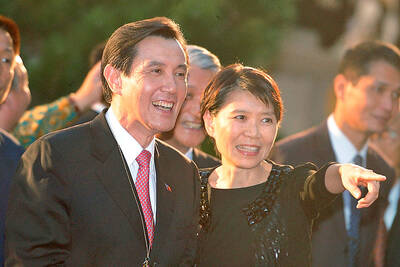
Former president Ma Ying-jeou (馬英九) yesterday expressed “shock and regret” over a statement issued by his wife without his consent, and rejected her assertion that his eldest sister, Ma Yi-nan (馬以南), would manage his medical care or act as his spokesperson amid an ongoing embezzlement probe into his foundation. Ma Ying-jeou in a statement said he was shocked by a statement by his wife, Chou Mei-ching (周美青), regarding his affairs. Ma Yi-nan “must not” be in charge of his healthcare and other personal affairs, nor can she be allowed to represent the Ma family, the former president said. He said he was also


 RSS
RSS