

Acute coronary syndrome (ACS), which is typically associated with hypertension, hyperlipidemia and hyperglycemia, is being increasingly reported in young people due to factors such as stress, staying up late, smoking and drug abuse, the Taiwan Society of Cardiology said.
ACS, the umbrella term for conditions whereby the heart’s blood supply is suddenly blocked, includes the more commonly known conditions of heart attacks and angina.
The organization, which is holding its annual convention this weekend, also said that patients who have experienced myocardial infarctions, or heart attacks, no matter what the cause, would require long-term anti-platelet therapy, which has seen major breakthroughs with new, faster-acting drugs leading to fewer deaths from heart attacks.
Taiwan Society of Cardiology secretary-general Yin Wei-hsian (殷偉賢) said that 60 percent of patients who suffer strokes and heart attacks are exposed to similar risk factors, and those with a first-degree male relative who has suffered a heart attack before the age of 55, or a first-degree female relative having one before the age of 65 are also at high risk of developing heart disease.
People in these high-risk groups should regularly have their blood pressure and blood lipid levels checked, Yin said.
Cardiologists are also reporting an increase in cases of coronary artery spasm, a kind of myocardial infarction, with a particularly high incidence rate in middle-aged women, the society said.
“The causes of heart attacks or coronary artery spasms in comparatively young people are very different from typical cases of myocardial infarction,” said attending physician Chen Jaw-wen (陳肇文) of the Cardiology Division at Taipei Veterans General Hospital.
“Constant stimulation from stress, long-term sleep deprivation, smoking and alcohol and drug abuse can result in a sudden narrowing of one of the coronary arteries,” Chen added.
Yin said that patients who have experienced a heart attack, be it caused by the “three highs” — hypertension, hyperlipidemia and hyperglycemia — or by artery spasms, require anti-platelet medications to prevent blood clots.
“The new drug ticagrelor has been found to work more consistently across a variety of groups. Treatment with clopidogrel, the previous drug used, has no effect on 30 percent of patients. Reduced metabolism of clopidogrel, for example, is common in Asian people,” said Andrew Wilson, associate professor of the department of Cardiology at the University of Melbourne, who was a speaker at the conference.
“The new drug will be available and covered by National Health Insurance from next month,” Yin said.
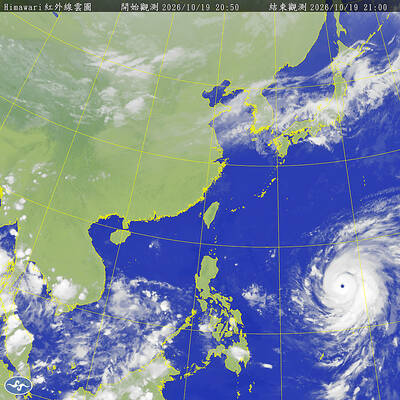
Typhoon Champi is forecast to turn northward earlier than previously expected, sparing Taiwan a direct hit but still bringing heavy rain to the north of the country on Friday and Saturday, the Central Weather Administration (CWA) said yesterday. Typhoon Champi had strengthened and increased in size over the past 12 hours, and as of yesterday afternoon, was packing sustained winds of 198kph near its center, CWA forecaster Cheng Chieh-jen (鄭傑仁) said. However, due to the weakening of a Pacific high-pressure system the storm is now expected to turn northward earlier than initially forecast, likely around Japan’s Ishigaki Island, Cheng said. As Champi brushes
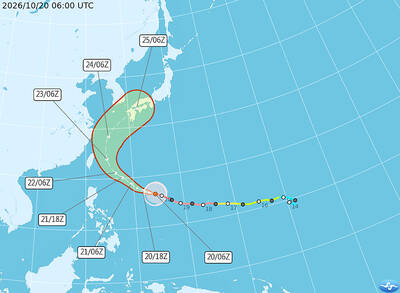
A sea warning for Typhoon Champi might be issued tonight, while the storm’s trajectory would determine whether a land warning is to be issued tomorrow night, the Central Weather Administration (CWA) said yesterday. As of 2pm yesterday, Champi was about 1,536km east-southeast of Taiwan proper’s southernmost point, Oluanpi (鵝鑾鼻), packing maximum sustained winds of 198kph, CWA forecaster Tseng Chao-cheng (曾昭誠) said. The storm was moving west-northwest at 23kph and was expected to strengthen over the next 24 hours before weakening slightly as it approaches cooler waters east of Taiwan, Tseng said. Champi is expected to turn north tomorrow, with the angle of the
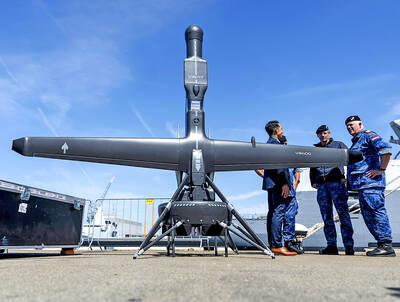
DEFENSE PROCUREMENT: Taiwan could become the largest operator of V-BAT drones outside the US if the contract is finalized, the Ministry of National Defense said The navy and the coast guard reportedly plan to acquire 292 units of MQ-35A V-BAT vertical takeoff and landing (VTOL) surveillance drones. If the contract is awarded and finalized, it would make Taiwan one of the largest buyers of the uncrewed aerial vehicle (UAV) developed by the US-based defense technology company Shield AI. The Coast Guard Administration budgeted NT$1.2 billion (US$37.1 million) to buy 12 drones, which have been delivered, Shield AI said in a report on Oct 13. The navy is planning to spend NT$36 billion under a four-year program code-named Project Yuan Hsiao (遠鴞) to acquire 280 V-BAT drones,
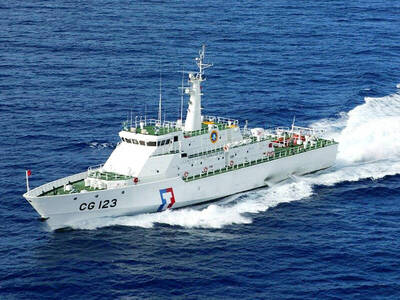
A patrol vessel donated by the Coast Guard Administration (CGA) to the Philippines would not be used in waters near Taiwan or areas where Taiwanese fishing vessels operate, Premier Cho Jung-tai (卓榮泰) said yesterday. The vessel, formerly the CGA's 500-tonne-class Kinmen (金門), was commissioned into the Philippine Coast Guard on Oct. 2. Speaking at the Legislative Yuan, Cho said the Philippines had pledged during the donation process that the vessel would be used only for designated missions and would not operate in waters related to Taiwan. The vessel could even provide assistance to Taiwan if needed, he added. Responding to questions from Chinese


 RSS