


More than 1,000 people from across the country took to the streets in Taipei yesterday, calling on the government to halt the construction of a Mass Rapid Transit (MRT) maintenance depot on the site of the partially demolished Losheng (Happy Life) Sanatorium, and to rebuild the sanatorium complex.
During the protest, a group of 120 people wearing white T-shirts and yellow headbands that read “Defend Losheng” walked in time with each drum beat and, at the sound of a cymbal, knelt down and touched the ground with their foreheads.
It was not a group of ascetic monks, but rather a group of Lo- sheng Sanatorium preservation activists who were trying to attract public attention for their cause.
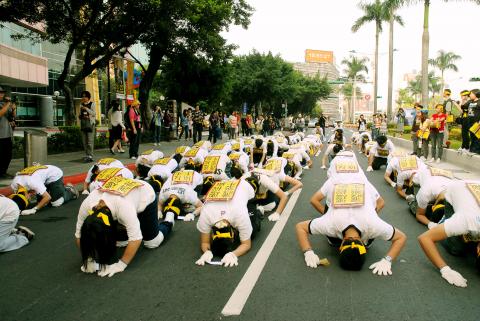
Photo: Wu Liang-yi, Taipei Times
The sanatorium in Sinjhuang District (新莊), New Taipei City (新北市), was built in the 1930s to house people with Hansen’s disease (also known as leprosy), a disease at the time believed to be highly contagious and incurable.
Decades after its completion, residents who lived in the complex were forced to move as the Taipei City Department of Rapid Transit Systems (DORTS) planned to demolish the sanatorium complex and build a maintenance depot for the Sinjhuang MRT line.
The plan was met with strong opposition from Losheng residents and preservation activists.
However, the government decided to continue the construction after proposing an adjusted plan in 2007 that would preserve a small part of the complex while demolishing the rest.
In 2010, the preservation movement was revived after a series of landslides near the construction site — which the preservationists had already warned on — which led several times to the suspension of construction.
Although DORTS is yet to propose a plan to solve the landslide issue, construction was resumed earlier this month after being suspended for about a year, causing concerns among activists and residents that the hill on which the sanatorium is built may collapse.
“I was indifferent to the issue years ago when activists campaigned for the preservation of Losheng Sanatorium, but when I had a chance to learn more about the issue, I became upset at myself for not realizing the importance at the time,” said Lin Kun-chang, a Sinjhuang resident taking part in the parade group. “I volunteered to join the ascetic group to make up for my past ignorance, and I hope that more people who are as indifferent as I was will become aware.”
Following the group was a large flag with the logo of the sanatorium held up by a dozen demonstrators, Losheng residents in wheelchairs, members of civic and student groups, as well as participants from all over the nation.
“In 2010, the [maintenance depot] construction was suspended because of a landslide. A year later, DORTS said they were better prepared and resumed the construction. However, within six months, the construction had to be halted again because of another landslide,” said Wang Wei-min (王偉民), a civil engineer and a long-time supporter of the preservation movement. “The same thing has happened over and over again. We no longer trust DORTS.”
“When you make enough mistakes, your boss may simply fire you — as masters of the nation, we certainly have the right to tell DORTS to stop,” he added.
When the parade reached the DORTS headquarters, the crowd shouted: “Face the mistakes, move the depot” and stuck hundreds of stickers that read “DORTS lies” onto the plaque bearing the agency’s name outside the building.
After arriving at Ketagalan Boulevard, the crowd chanted slogans and sang songs asking the government to take its responsibility and halt the construction.
On behalf of his peers, Losheng resident Tang Hsiang-ming (湯祥明) thanked the participants for their support along the way.
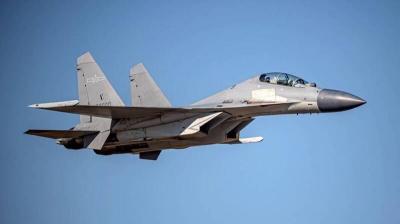
Eight Chinese naval vessels and 24 military aircraft were detected crossing the median line of the Taiwan Strait between 6am yesterday and 6am today, the Ministry of National Defense said this morning. The aircraft entered Taiwan’s northern, central, southwestern and eastern air defense identification zones, the ministry said. The armed forces responded with mission aircraft, naval vessels and shore-based missile systems to closely monitor the situation, it added. Eight naval vessels, one official ship and 36 aircraft sorties were spotted in total, the ministry said.
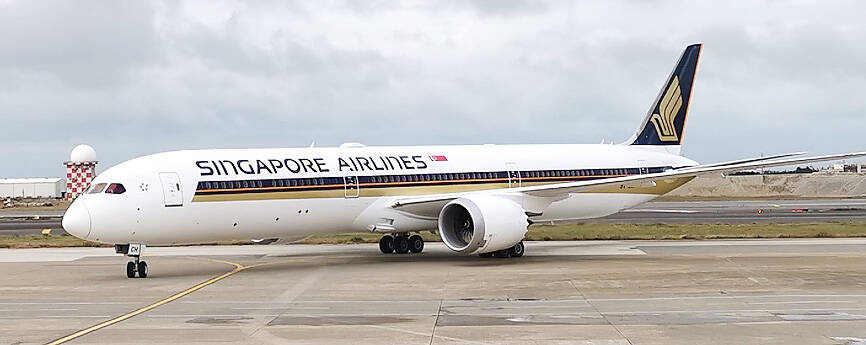
INCREASED CAPACITY: The flights on Mondays, Wednesdays, Fridays and Sundays would leave Singapore in the morning and Taipei in the afternoon Singapore Airlines is adding four supplementary flights to Taipei per week until May to meet increased tourist and business travel demand, the carrier said on Friday. The addition would raise the number of weekly flights it operates to Taipei to 18, Singapore Airlines Taiwan general manager Timothy Ouyang (歐陽漢源) said. The airline has recorded a steady rise in tourist and business travel to and from Taipei, and aims to provide more flexible travel arrangements for passengers, said Ouyang, who assumed the post in July last year. From now until Saturday next week, four additional flights would depart from Singapore on Monday, Wednesday, Friday
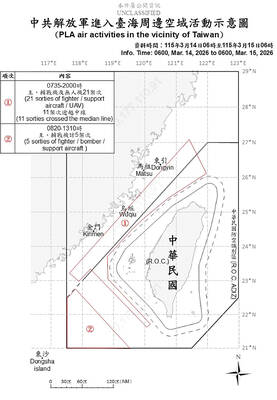
The Ministry of National Defense yesterday reported the return of large-scale Chinese air force activities after their unexplained absence for more than two weeks, which had prompted speculation regarding Beijing’s motives. China usually sends fighter jets, drones and other military aircraft around the nation on a daily basis. Interruptions to such routine are generally caused by bad weather. The Ministry of National Defense said it had detected 26 Chinese military aircraft in the Taiwan Strait over the previous 24 hours. It last reported that many aircraft on Feb. 25, when it spotted 30 aircraft, saying Beijing was carrying out another “joint combat

Taiwan successfully defended its women’s 540 kilogram title and won its first-ever men’s 640 kg title at the 2026 World Indoor Tug of War Championships in Taipei yesterday. In the women’s event, Taiwan’s eight-person squad reached the final following a round-robin preliminary round and semifinals featuring teams from Ukraine, Japan, Thailand, Vietnam, the Basque Country and South Korea. In the finals, they swept the Basque team 2-0, giving the team composed mainly of National Taiwan Normal University students and graduates its second championship in a row, and its fourth in five years. Team captain


 RSS
RSS