


Former vice president Annette Lu (呂秀蓮) yesterday submitted a proposal that aims to prevent fuel rods from being installed at the Fourth Nuclear Power Plant to the New Taipei City (新北市) government.
Along with the proposal, Lu submitted 51,353 letters and a list of reasons why the fuel rods should not be installed to the city’s election committee.
Lu was received by New Taipei City Government Secretary-General Chen Shen-hsien (陳伸賢), but was unhappy that New Taipei City Mayor Eric Chu (朱立倫) was not there. Lu said Chu’s absence showed his contempt for the initiative and disregard for the safety of the city’s 3.9 million residents.
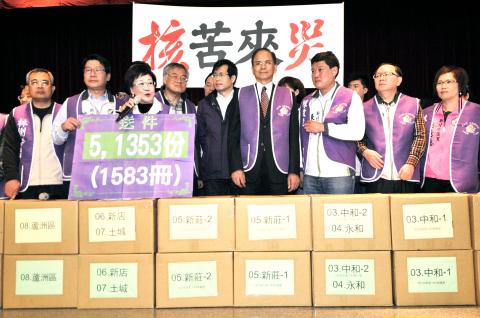
Photo: Chen Chih-chu, Taipei Times
The former vice president launched a similar petition in July last year to put the loading of fuel rods — as well as eventual operation of the nuclear power plant — to a local vote.
The initiative won support from the Democratic Progressive Party and the Taiwan Solidarity Union. However, the utility and legitimacy of holding a local referendum was thrown into doubt when Premier Jiang Yi-huah (江宜樺) last week proposed a plan to hold a national referendum on the construction of the Fourth Nuclear Power Plant.
Jiang and the Chinese Nationalist Party (KMT) said the plant’s construction is a matter of national energy policy and power generation, and should therefore be decided with a national referendum rather than a local one.
Lu responded that holding a local referendum on the matter was authorized by the Act Governing New Taipei Referendums (新北市公民投票自治條例), passed by the New Taipei City Council in June last year, and was a local matter.
Article 11 of the Act on Sites for Establishment of Low Level Radioactive Waste Final Disposal Facility (低放射性廢棄物最終處置設施場址設置條例) stipulates that a local referendum be held in the city where a site is located within 30 days of it being publicly announced, and is not subject to the provisions of Article 2 of the Referendum Act, (公民投票法) Lu added.
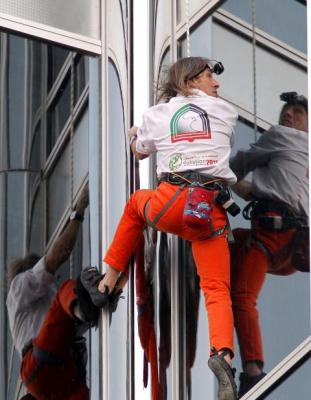
Alain Robert, known as the "French Spider-Man," praised Alex Honnold as exceptionally well-prepared after the US climber completed a free solo ascent of Taipei 101 yesterday. Robert said Honnold's ascent of the 508m-tall skyscraper in just more than one-and-a-half hours without using safety ropes or equipment was a remarkable achievement. "This is my life," he said in an interview conducted in French, adding that he liked the feeling of being "on the edge of danger." The 63-year-old Frenchman climbed Taipei 101 using ropes in December 2004, taking about four hours to reach the top. On a one-to-10 scale of difficulty, Robert said Taipei 101
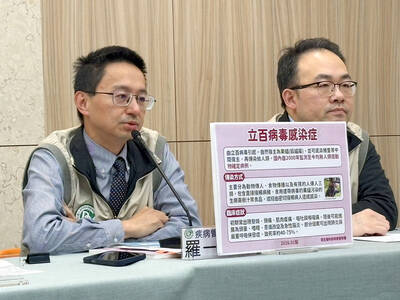
Nipah virus infection is to be officially listed as a category 5 notifiable infectious disease in Taiwan in March, while clinical treatment guidelines are being formulated, the Centers for Disease Control (CDC) said yesterday. With Nipah infections being reported in other countries and considering its relatively high fatality rate, the centers on Jan. 16 announced that it would be listed as a notifiable infectious disease to bolster the nation’s systematic early warning system and increase public awareness, the CDC said. Bangladesh reported four fatal cases last year in separate districts, with three linked to raw date palm sap consumption, CDC Epidemic Intelligence
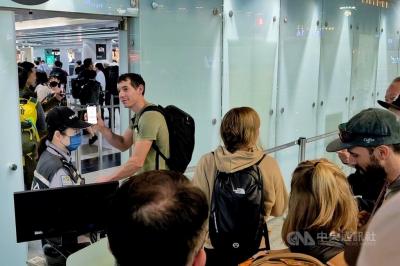
US climber Alex Honnold left Taiwan this morning a day after completing a free-solo ascent of Taipei 101, a feat that drew cheers from onlookers and gained widespread international attention. Honnold yesterday scaled the 101-story skyscraper without a rope or safety harness. The climb — the highest urban free-solo ascent ever attempted — took just more than 90 minutes and was streamed live on Netflix. It was covered by major international news outlets including CNN, the New York Times, the Guardian and the Wall Street Journal. As Honnold prepared to leave Taiwan today, he attracted a crowd when he and his wife, Sanni,
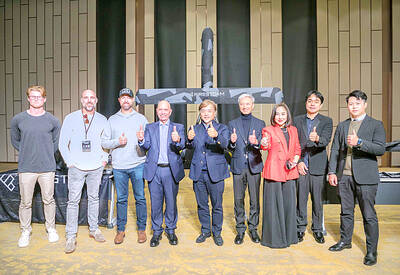
Taiwanese and US defense groups are collaborating to introduce deployable, semi-autonomous manufacturing systems for drones and components in a boost to the nation’s supply chain resilience. Taiwan’s G-Tech Optroelectronics Corp subsidiary GTOC and the US’ Aerkomm Inc on Friday announced an agreement with fellow US-based Firestorm Lab to adopt the latter’s xCell, a technology featuring 3D printers fitted in 6.1m container units. The systems enable aerial platforms and parts to be produced in high volumes from dispersed nodes capable of rapid redeployment, to minimize the risk of enemy strikes and to meet field requirements, they said. Firestorm chief technology officer Ian Muceus said


 RSS
RSS