


A Hong Kong film company has been ordered to return a government subsidy, with interest, over the controversy surrounding the 2008 movie Miao Miao (渺渺).
The teen romance movie was directed by Cheng Hsiao-tse (程孝澤), a young up-and-coming Taiwanese director, and was made in collaboration with Hong Kong-based Jet Tone Films. It starred Alice Ko (柯佳嬿) and Chang Yung-yung (張榕容).
Under an incentive program from the now-defunct Government Information Office (GIO) to help develop the domestic film industry, Jet Tone Films received a NT$4 million (US$134,934) subsidy for the production.
The government body revoked the subsidy and demanded the return of the money after the film was entered in the 2009 Melbourne International Film Festival as a Hong Kong, rather than Taiwanese, production.
Miao Miao was later pulled from the film festival along with films from China and Hong Kong to protest the festival’s screening of a documentary about exiled Uighur leader Rebiya Kadeer.
As the Miao Miao project had received government funding, the decision to pull out of the film festival sparked outrage in Taiwan.
Jet Tone Films argued that the movie was withdrawn to avoid it being entangled in political disputes.
Under the GIO’s subsidy program, a GIO spokesperson said Jet Tone Films signed a contract on Dec. 30, 2005, supporting filmmaking in Taiwan.
“The contract stated that upon the completion of the movie, Miao Miao shall enter international film festivals as a Taiwanese production. If not, the subsidy shall be returned,” the spokesperson said.
He said the film company had violated the contract, by listing Miao Miao as a Hong Kong entry, and also withdrew from the festival in conjunction with Chinese films, and therefore has no grounds for keeping the subsidy.
A representative from Jet Tone Films said the contract did not cover the Melbourne International Film Festival, adding that the GIO should not misinterpret the conditions of the contract.
Also, as Miao Miao was withdrawn prior to the opening of the film festival, the film actually did not participate in the event, the representative said.
“Therefore the GIO should not ask for a return of the subsidy because of the political circumstances,” he said.
The Supreme Court said the film company had clearly violated the terms of the contract and must return the NT$4 million plus accrued interest.
In a press release on Thursday, the studio said it regretted the court’s decision, but would not give up its efforts to make movies in Taiwan and to discover talented actors.
Additional reporting by Tsou Nien-tsu

More than half of the bamboo vipers captured in Tainan in the past few years were found in the city’s Sinhua District (新化), while other districts had smaller catches or none at all. Every year, Tainan captures about 6,000 snakes which have made their way into people’s homes. Of the six major venomous snakes in Taiwan, the cobra, the many-banded krait, the brown-spotted pit viper and the bamboo viper are the most frequently captured. The high concentration of bamboo vipers captured in Sinhua District is puzzling. Tainan Agriculture Bureau Forestry and Nature Conservation Division head Chu Chien-ming (朱健明) earlier this week said that the

Kenting National Park service technician Yang Jien-fon (楊政峰) won a silver award in World Grand Prix Photography Awards Spring Season for his photograph of two male rat snakes intertwined in combat. Yang’s colleagues at Kenting National Park said he is a master of nature photography who has been held back by his job in civil service. The awards accept entries in all four seasons across six categories: architectural and urban photography, black-and-white and fine art photography, commercial and fashion photography, documentary and people photography, nature and experimental photography, and mobile photography. Awards are ranked according to scores and divided into platinum, gold and
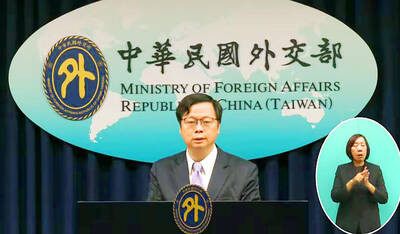
NAMING SPAT: The foreign ministry called on Denmark to propose an acceptable solution to the erroneous nationality used for Taiwanese on residence permits Taiwan has revoked some privileges for Danish diplomatic staff over a Danish permit that lists “Taiwan” as “China,” Eric Huang (黃鈞耀), head of the Ministry of Foreign Affairs’ Department of European Affairs, told a news conference in Taipei yesterday. Reporters asked Huang whether the Danish government had responded to the ministry’s request that it correct the nationality on Danish residence permits of Taiwanese, which has been listed as “China” since 2024. Taiwan’s representative office in Denmark continues to communicate with the Danish government, and the ministry has revoked some privileges previously granted to Danish representatives in Taiwan and would continue to review
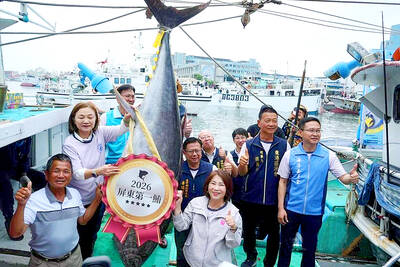
The first bluefin tuna of the season, brought to shore in Pingtung County and weighing 190kg, was yesterday auctioned for NT$10,600 (US$333.5) per kilogram, setting a record high for the local market. The auction was held at the fish market in Donggang Fishing Harbor, where the Siaoliouciou Island-registered fishing vessel Fu Yu Ching No. 2 delivered the “Pingtung First Tuna” it had caught for bidding. Bidding was intense, and the tuna was ultimately jointly purchased by a local restaurant and a local company for NT$10,600 per kilogram — NT$300 ,more than last year — for a total of NT$2.014 million. The 67-year-old skipper


 RSS
RSS