


Mandatory local referendums would be crucial in protecting people’s lives, which is the No. 1 priority in discussing the dispute over construction of the Fourth Nuclear Power Plant in New Taipei City (新北市), the Taiwan Solidarity Union (TSU) said yesterday.
“This is why the TSU would propose to amend the Nuclear Reactor Facilities Control Act (核子反應器設施管制法) by authorizing a mandatory local referendum to be held in a 50km radius evacuation zone from any installation of nuclear reactors, fuel rods and nuclear power plant operations,” TSU Chairman Huang Kun-huei (黃昆輝) told a press conference.
As political parties have engaged in heated debates over the high threshold of the current Referendum Act (公民投票法), Huang said, the amendment would help the policy debate move forward.
If the regulation was amended, a local referendum in Taipei City, New Taipei City, Keelung City and Yilan County — the four administrative zones that face a direct impact if a nuclear disaster occurred — would be held with the outcome of the referendum determined by simple plurality, Huang said.
The Democratic Progressive Party’s (DPP) proposal to lower the unusually high threshold stated in the referendum act would be time-consuming and likely be vetoed by the Chinese Nationalist Party (KMT) in the legislature, he added.
Taiwan Environmental Protection Union (TEPU) founder and former chairman Shih Hsin-min (施信民) said people who live within a 50km radius of a nuclear power plant are those most entitled to have a say about the plant, and this was a common practice in other countries.
If people who live on the outlying islands could vote in local referendums to determine whether a casino resort would be built and whether they would accept the storage of nuclear waste, the people in northern Taiwan should also be able to have their voices heard on the issue of a nuclear power plant, Shih said.
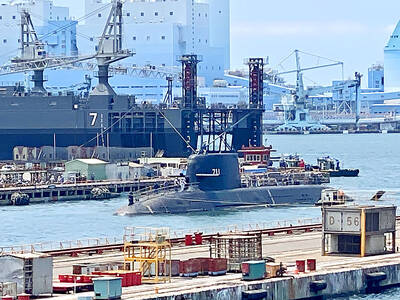
AGING: While Japan has 22 submarines, Taiwan only operates four, two of which were commissioned by the US in 1945 and 1946, and transferred to Taiwan in 1973 Taiwan would need at least 12 submarines to reach modern fleet capabilities, CSBC Corp, Taiwan chairman Chen Cheng-hung (陳政宏) said in an interview broadcast on Friday, citing a US assessment. CSBC is testing the nation’s first indigenous defense submarine, the Hai Kun (海鯤, Narwhal), which is scheduled to be delivered to the navy next month or in July. The Hai Kun has completed torpedo-firing tests and is scheduled to undergo overnight sea trials, Chen said on an SET TV military affairs program. Taiwan would require at least 12 submarines to establish a modern submarine force after assessing the nation’s operational environment and defense
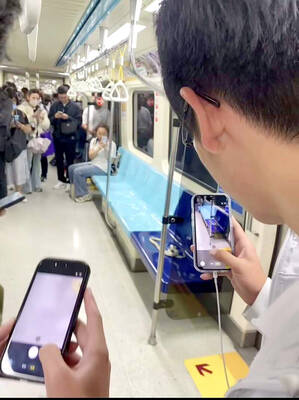
A white king snake that frightened passengers and caused a stir on a Taipei MRT train on Friday evening has been claimed by its owner, who would be fined, Taipei Rapid Transit Corp (TRTC) said yesterday. A person on Threads posted that he thought he was lucky to find an empty row of seats on Friday after boarding a train on the Bannan (Blue) Line, only to spot a white snake with black stripes after sitting down. Startled, he jumped up, he wrote, describing the encounter as “terrifying.” “Taipei’s rat control plan: Release snakes on the metro,” one person wrote in reply, referring
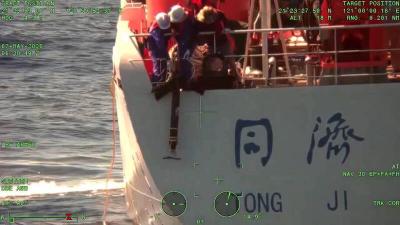
The coast guard today said that it had disrupted "illegal" operations by a Chinese research ship in waters close to the nation and driven it away, part of what Taipei sees a provocative pattern of China's stepped up maritime activities. The coast guard said that it on Thursday last week detected the Chinese ship Tongji (同濟號), which was commissioned only last year, 29 nautical miles (54km) southeast of the southern tip of Taiwan, although just outside restricted waters. The ship was observed lowering ropes into the water, suspected to be the deployment of scientific instruments for "illegal" survey operations, and the coast
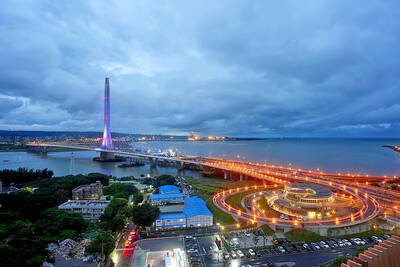
An inauguration ceremony was held yesterday for the Danjiang Bridge, the world’s longest single-mast asymmetric cable-stayed bridge, ahead of its official opening to traffic on Tuesday, marking a major milestone after nearly three decades of planning and construction. At the ceremony in New Taipei City attended by President William Lai (賴清德), Premier Cho Jung-tai (卓榮泰), Minister of Transportation and Communications Chen Shih-kai (陳世凱) and New Taipei City Mayor Hou Yu-ih (侯友宜), the bridge was hailed as both an engineering landmark and a long-awaited regional transport link connecting Tamsui (淡水) and Bali (八里)


 RSS
RSS