

The Keelung City Government is hoping to boost tourism and revive the local economy by building a casino resort, officials said, adding that the best location would be a nearby island.
Such a plan would require major investment and city officials are inviting Hon Hai Group chairman Terry Gou (郭台銘) to become a part of the project, which aims to establish a casino on Keelung Islet (基隆嶼), which is 4.9km to the northeast of the northern coastal city.
City officials are planning a floating casino by building breakwater jetties and docking a decommissioned cruise ship on the islet.
“The casino will be the closest venue for people in northern Taiwan and can be built in a short time,” a city official said. “If Terry Gou agrees to invest in the project, construction of the casino can be completed in three years.”
Keelung City Councilor Lu Mei-ling (呂美玲) of the Chinese Nationalist Party (KMT) supported the proposal, saying that if Gou collaborates on the project, it would be a major boost for the city’s tourism sector.
However, some other councilors said that Keelung Islet does not have enough land available for further development, so the planning phase of the project would require careful thought.
Last week, Gou had suggested that a casino complex should be built in Tamsui (淡水), New Taipei City (新北市).
However, government regulations only permit gaming resorts to be sited on outlying islands. As such, officials at the Keelung City Transportation and Tourism Bureau said that Keelung Islet is the most suitable site for exploring collaborative development of an offshore casino.
Deputy head of the bureau Wang Ying-che (王英哲) said that Keelung Islet has only a small harbor and so breakwater jetties would need to be built.
“The designated area will be rezoned as an ‘International Tourism and Vacation Sector’ to allow docking of a decommissioned cruise ship. We know that such vessels are usually equipped with guest accommodation, recreational facilities, venue space for meetings, shopping centers and also a casino,” Wang said.
“Therefore the floating casino proposal conforms to current regulations on offshore casino locations and would also not face problems regarding public safety,” he said.
Wang said the relevant land on Keelung Islet is under the administration of the Keelung City Government.
“The site has existing buildings and other constructions which are legally approved, and thus no amendment to the law is required,” he said.
“To develop the islet for the casino does not require any changes to city revitalization plans. So there are no legal problems and the project can be completed quickly with a minimum of investment,” Wang added.
The islet covers 22 hectares. It was once a military training zone with civilian access prohibited. It was opened up in 2001, allowing people to reach it by boat, and the islet was turned into a tourist park in 2002.
There are public ferry services to the islet, with the journey taking between 20 and 30 minutes. Services depart from Keelung Harbor’s yacht docks and also from the Bisha (碧砂) fishing port.
Former Democratic Progressive Party (DPP) chairperson Tsai Ing-wen (蔡英文), who was in Keelung on Thursday to attend ceremonies at several temples, said that under the Chinese Nationalist Party (KMT) government’s administration there have been almost no major construction or development projects in Keelung in recent years.
“If the central government only wants to rely on setting up special zones for casino resorts to stimulate the economy and local development, then it is not realistic. These kind of projects are also not the best choice for Keelung,” Tsai said.
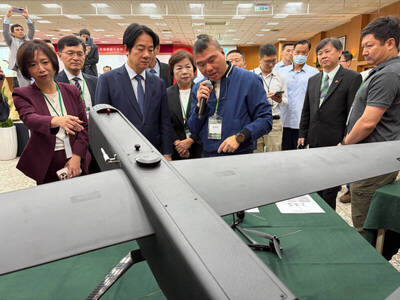
Two executives of drone supplier Jiin Ming Industry Co (錦明實業) have been detained and held incommunicado over the company's alleged use of prohibited China-made chips and camera lenses in drones supplied under recent military contracts, the Taoyuan District Prosecutors' Office said today. In a statement, prosecutors said they raided the offices of Jiin Ming — headquartered in Taoyuan — as well as those of its subsidiaries and its suppliers on Thursday last week. The raids followed a report that the company had breached its procurement contracts by putting the prohibited components into drones delivered to the military. During the raids, prosecutors summoned
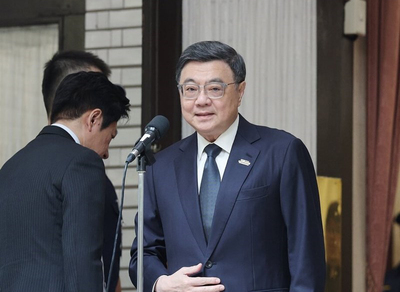
The government would continue monitoring online rumors that a pneumonic plague outbreak has spread from Russia into China and could enhance existing quarantine measures, Premier Cho Jung-tai (卓榮泰) said today. During a legislative meeting, Democratic Progressive Party Legislator Wang Ting-yu (王定宇) said rumors were circulating that the disease had spread across several Chinese provinces. He asked Cho whether the government was prepared to prevent the disease from spreading to Taiwan, given the frequent exchanges between Taiwan and China, and how concerned the government was about the alleged outbreak. The Ministry of Health and Welfare implemented border quarantine measures after briefing the Executive Yuan

South Korean boy band BigBang drew 120,000 fans to three concerts at Taipei Dome from Friday through yesterday, as the band thanked them for their support over their 20-year career. The Taipei Dome concerts were part of BigBang's "2026-2027 World Tour XX: Cosmos." Friday's concert was BigBang's first performance in Taiwan in 11 years. During the encore, group leader G-Dragon (GD) shouted "I love you" in Chinese and said he was especially happy to perform in Taiwan with bandmates Taeyang and Daesung. "Taipei, I'm very grateful to you all," GD said in Chinese, asking fans to wait for the band's return. Daesung thanked
A Chinese People's Liberation Army (PLA) Navy aircraft carrier group was being monitored after entering the western Pacific, the Ministry of National Defense said today, after Beijing yesterday criticized Taiwan for using a water cannon against a Chinese fishing boat near the Pratas Islands (Dongsha Islands, 東沙群島). A Chinese naval task group led by the aircraft carrier Liaoning (遼寧) yesterday sailed to the western Pacific for training, Chinese state-run Xinhua news agency quoted the PLA Navy as saying. “The drill is part of the annual routine training plan aimed at testing and improving the troops’ combat readiness and enhancing their ability to


 RSS
RSS