


President Ma Ying-jeou (馬英九) should learn from his mentor, late president Chiang Ching-kuo (蔣經國), and make the voice of the people his top priority and suspend construction of the Fourth Nuclear Power Plant, a lawmaker and anti-nuclear activists said yesterday.
Despite being an authoritarian, Chiang, who ruled Taiwan from 1978 to 1988, ordered the suspension of plans to build the nuclear power plant in 1985 “because people still had concerns about nuclear power,” Democratic Progressive Party (DPP) Legislator Tien Chiu-chin (田秋堇) told a press conference.
Citing a copy of the Chinese-language United Daily News published on May 3, 1985, as proof, Tien said if Ma really saw Chiang as his role model, he should “have the guts” to order the third construction suspension in the plant’s 30-year history because “that is what Taiwanese want.”
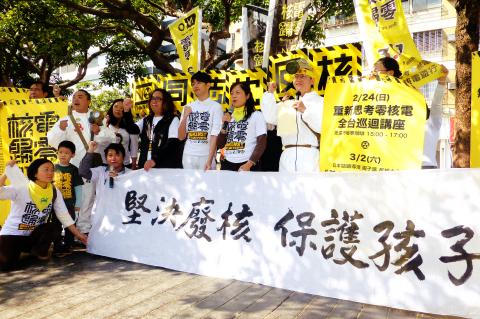
Photo: Liao Yao-tung, Taipei Times
After construction eventually began in the late 1990s, the second suspension was ordered by former president Chen Shui-bian (陳水扁) in 2000.
The controversy over the plant, located in Gongliao (貢寮), New Taipei City (新北市), has been hotly discussed across the country as the opposition, anti-nuclear activists and several Chinese Nationalist Party (KMT) members have called for the construction to be suspended, blocking an additional budget allocation for the project and stopping the plant from becoming operational.
While Ma and the KMT have said their eventual goal is a nuclear-free homeland, Ma has insisted on completing the construction and leaving the question of whether the plant should become operational for future deliberation.
Supporters who back the nuclear power plant project, which has cost more than NT$300 billion (US$10.1 billion), said a suspension would result in a huge contract breach penalty, which would have to be paid by the government and Taiwan Power Co (Taipower) and which would push up the price of electricity.
Tien said that suspending the construction now would cost less than retiring the plant, as a Taipower report in 2000 showed that the total cost of a suspension would be between NT$67.4 billion and NT$88.7 billion.
“The construction was resumed after Chen Shui-bian’s failed attempt and what we now know is that the project has cost an additional budget of more than NT$200 billion,” she said.
The lawmaker rejected Ma’s pledge to invite international experts to evaluate nuclear safety at the plant once the construction is completed.
Citing a document provided by Atomic Energy Council Minister Tsai Chuen-horng (蔡春鴻), Tien said that no international expert or organization would endorse nuclear safety for another country.
The decision Ma would have to make would be a political one rather than technological, said political analyst Yang Hsien-hung (楊憲宏), who witnessed Chiang’s surprising policy change as a reporter.
“If Chiang was president today, I think he would have made the same decision,” Yang said.
Nuclear activists also offered arguments to counter nuclear power supporters’ claims of rising electricity prices once the nation’s nuclear power plants are phased out.
Global nuclear power output has been staying at about the same level since the Chernobyl disaster in 1986 and statistics show that the number of retired nuclear reactors rose in two peaks — after the Chernobyl accident and after the Fukushima Dai-ichi nuclear power plant accident in Japan in 2011, Green Party Taiwan convener Pan Han-sheng (潘翰聲) said.
Green Consumers Foundation chairman Jay Fang (方儉) said Taipower had overestimated the cost of electricity production per megawatt-hour for natural gas and underestimated that for nuclear power, adding that electricity output in Taiwan has been twice that of demand.
“I would say that the electricity price would not increase as Taipower claims, even if operations at all four nuclear power plants are suspended,” he said.
DPP Legislator Chen Ou-po (陳歐珀) told a separate press conference that he plans to propose an amendment to the Atomic Energy Act (原子能法) which stipulates that new nuclear reactors cannot be made operational before a regional referendum of residents in a 50km radius of the reactor eligible to vote has been held to vote on the issue.
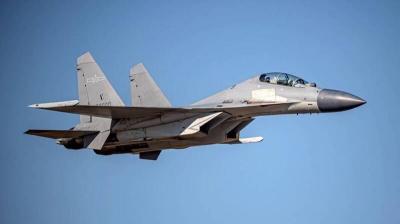
Eight Chinese naval vessels and 24 military aircraft were detected crossing the median line of the Taiwan Strait between 6am yesterday and 6am today, the Ministry of National Defense said this morning. The aircraft entered Taiwan’s northern, central, southwestern and eastern air defense identification zones, the ministry said. The armed forces responded with mission aircraft, naval vessels and shore-based missile systems to closely monitor the situation, it added. Eight naval vessels, one official ship and 36 aircraft sorties were spotted in total, the ministry said.
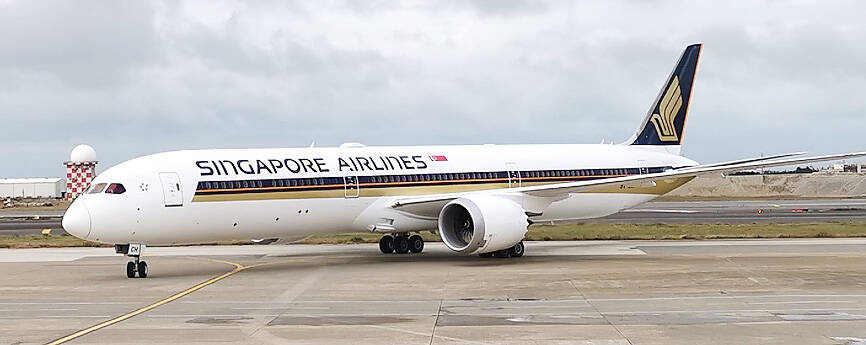
INCREASED CAPACITY: The flights on Mondays, Wednesdays, Fridays and Sundays would leave Singapore in the morning and Taipei in the afternoon Singapore Airlines is adding four supplementary flights to Taipei per week until May to meet increased tourist and business travel demand, the carrier said on Friday. The addition would raise the number of weekly flights it operates to Taipei to 18, Singapore Airlines Taiwan general manager Timothy Ouyang (歐陽漢源) said. The airline has recorded a steady rise in tourist and business travel to and from Taipei, and aims to provide more flexible travel arrangements for passengers, said Ouyang, who assumed the post in July last year. From now until Saturday next week, four additional flights would depart from Singapore on Monday, Wednesday, Friday
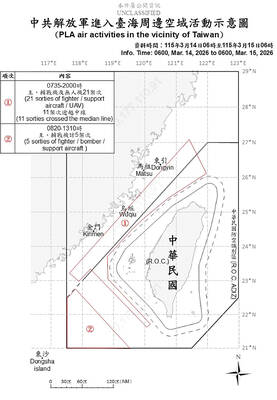
The Ministry of National Defense yesterday reported the return of large-scale Chinese air force activities after their unexplained absence for more than two weeks, which had prompted speculation regarding Beijing’s motives. China usually sends fighter jets, drones and other military aircraft around the nation on a daily basis. Interruptions to such routine are generally caused by bad weather. The Ministry of National Defense said it had detected 26 Chinese military aircraft in the Taiwan Strait over the previous 24 hours. It last reported that many aircraft on Feb. 25, when it spotted 30 aircraft, saying Beijing was carrying out another “joint combat

Taiwan successfully defended its women’s 540 kilogram title and won its first-ever men’s 640 kg title at the 2026 World Indoor Tug of War Championships in Taipei yesterday. In the women’s event, Taiwan’s eight-person squad reached the final following a round-robin preliminary round and semifinals featuring teams from Ukraine, Japan, Thailand, Vietnam, the Basque Country and South Korea. In the finals, they swept the Basque team 2-0, giving the team composed mainly of National Taiwan Normal University students and graduates its second championship in a row, and its fourth in five years. Team captain


 RSS
RSS