


Environmental protection groups, a global natural cosmetics company and an Asian entertainment company yesterday launched a campaign calling on Taiwanese to stop eating shark’s fin to save sharks and the ocean’s ecosystem.
The group launched the “Pledge No to Shark Fin Soup” campaign at the Huashan 1914 Creative Park in Taipei, with wall photographs of Taiwanese celebrities with “I’m FINished with FINS — Protect sharks, I refuse to eat fins” written on them.
British performance artist Alice Newstead was also present, with fish hooks piercing her skin as her body hung in the air.

Photo: CNA
Newstead said although it was painful, she wanted to convey to the public the pain that sharks feel when they are caught just for their fins.
Shark Savers Organization director Sue Chen said: “Sharks keep the ocean and seafood healthy, because they eat sea creatures that are diseased, dying or dead. They’ve been doing that for almost 450 million years.”
“We have a big problem today because of one dish — shark fin,” she said.

Photo: Liao Chen-huei, Taipei Times
Sharks are dying out fast because of overfishing and because they cannot reproduce quickly, but everyone can help fix the problem by saying no to shark’s fin soup, Chen said.
“Overfishing of sharks is are happening in distant waters, where most people can’t see [it] and do not know the serious consequences,” said John Lu (呂子柏), the organization’s Asia area director, adding that most people would care if they knew because people protect what they love.
Overfishing is not only threatening the survival of the species, but also the marine ecology.
If the ocean ecosystem is destroyed, there will no future for human beings either, he added.
The groups said up to 73 million sharks are killed annually and shark fin soup — a dish eaten by millions of people at weddings, business dinners and banquets — is causing the destruction of the world’s sharks.
The Life Conservationist Association said that longline fishing — the method used by most Taiwanese vessels for catching sharks — is a cruel fishing technique, because it leaves the captured prey bleeding to death in the water and often bycatch other untargeted species.
Lu said more than 20 celebrities in Taiwan have agreed to join the campaign, willing to help raise public awareness and encourage people to stop eating shark fin.
For more information about the anti-shark fin campaign, visit the organization’s Web site: www.sharksavers.org.

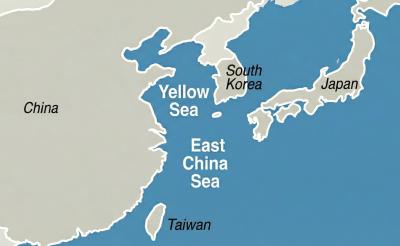
China has reserved offshore airspace in the Yellow Sea and East China Sea from March 27 to May 6, issuing alerts usually used to warn of military exercises, although no such exercises have been announced, the Wall Street Journal (WSJ) reported yesterday. Reserving such a large area for 40 days without explanation is an “unusual step,” as military exercises normally only last a few days, the paper said. These alerts, known as Notice to Air Missions (Notams), “are intended to inform pilots and aviation authorities of temporary airspace hazards or restrictions,” the article said. The airspace reserved in the alert is

South Korea is planning to revise its controversial electronic arrival card, a step Taiwanese officials said prompted them to hold off on planned retaliatory measures, a South Korean media report said yesterday. A Yonhap News Agency report said that the South Korean Ministry of Foreign Affairs is planning to remove the “previous departure place” and “next destination” fields from its e-arrival card system. The plan, reached after interagency consultations, is under review and aims to simplify entry procedures and align the electronic form with the paper version, a South Korean ministry official said. The fields — which appeared only on the electronic form

A bipartisan group of US senators has introduced a bill to enhance cooperation with Taiwan on drone development and to reduce reliance on supply chains linked to China. The proposed Blue Skies for Taiwan Act of 2026 was introduced by Republican US senators Ted Cruz and John Curtis, and Democratic US senators Jeff Merkley and Andy Kim. The legislation seeks to ease constraints on Taiwan-US cooperation in uncrewed aerial systems (UAS), including dependence on China-sourced components, limited access to capital and regulatory barriers under US export controls, a news release issued by Cruz on Wednesday said. The bill would establish a "Blue UAS

More than 6,000 Taiwanese students have participated in exchange programs in China over the past two years, despite the Mainland Affairs Council’s (MAC) “orange light” travel advisory, government records showed. The MAC’s publicly available registry showed that Taiwanese college and university students who went on exchange programs across the Strait numbered 3,592 and 2,966 people respectively. The National Immigration Agency data revealed that 2,296 and 2,551 Chinese students visited Taiwan for study in the same two years. A review of the Web sites of publicly-run universities and colleges showed that Taiwanese higher education institutions continued to recruit students for Chinese educational programs without


 RSS
RSS