


In a move to strengthen their anti-nuclear efforts, film directors Ko I-chen (柯一正) and Wu Yi-feng (吳乙峰) are considering inviting well-known people from the artistic and entertainment industries to endorse their petition against the construction of the nation’s controversy-plagued Fourth Nuclear Power Plant in Gongliao (貢寮), New Taipei City (新北市).
In a statement jointly authored by Ko and Wu, which they said would be published on their Facebook pages in the near future, the pair called on heavyweights from the artistic and cultural sectors to weigh in on their anti-nuclear bid.
“We will spare no effort in inviting Taiwanese ‘living national treasures’ to join our cause, such as globally acclaimed director Hou Hsiao-hsien (侯孝賢) and Cloud Gate founder Lin Hwai-min (林懷民),” Ko said.
The statement also urged the government to scrap a budget proposal to invest several billion NT dollars more in the contentious plant, “for the sake of offering peace of mind to the many parents in the country and their offspring.”
“Granting the additional budget to the nuclear power plant not only is tantamount to [throwing money into] a bottomless pit, but could also signal the onset of a major, irreversible catastrophe,” the pair said in the statement.
However, if President Ma Ying-jeou (馬英九) came forward and headed off the tragedy, it could become the “greatest contribution he has ever made to Taiwanese society,” they said, adding that now was the critical moment for Ma to create a historical legacy.
The statement came after a flash mob initiated by Ko and several other directors on May 28 last year on Ketagalan Boulevard in front of the Presidential Office, in which about 60 people formed the Chinese character ren (人, human being) for 30 seconds while shouting “I am a human being, I oppose nuclear power.”
“As using nuclear power would inevitably leave behind waste for future generations, the artistic and cultural industries are obliged to issue a warning against such an unjust action and prevent the Fourth Nuclear Power Plant from asking for more funding,” Ko said.
Ko said that since directors were not always good with words, voicing their opposition to nuclear power via creative approaches seemed more appropriate than using verbal tirades or acts of violence.
“We aspire to express our anti-nuclear stance in the simplest manner possible, one that every like-minded individual can easily emulate at home,” Ko said, as he took out a huge white umbrella that was covered by signatures and featured the slogan “stopping the Fourth Nuclear Power Plant for the next generation.”
If an adequate number of such anti-nuclear umbrellas are collected, they could also be used for a public art installation, Ko added.
Echoing Ko’s proposal, Wu said veteran television hostess Chang Hsiao-yen (張小燕) and comedian Chu Ko Liang (豬哥亮) were on his shortlist of big-name entertainers they would like to back their bid.
Describing the Fourth Nuclear Power Plant as a “terrifying assembled vehicle” that used Japanese-manufactured equipment, but was built based on the design concept of a US-based firm, Wu said a small and densely populated island such as Taiwan could not afford to take even the slightest risk of a nuclear disaster.
“How could anyone still be reluctant to end construction of the plant? If our failure to stop the project now is to result in a catastrophe 50 years later, we will be held accountable for the misery imposed on future generations,” Wu said.
Wu said that while the anti-nuclear issue had long been politicized, their bid carried no specific political affiliation and they hoped it would not become a maneuvering tool of the pan-blue and pan-green camps.
“After all, radiation leakage would occur regardless of which political party is in charge of the country,” Wu said, adding that Taiwanese must transcend politics on the issue of nuclear power, particularly in the wake of Japan’s Fukushima Dai-ichi nuclear disaster on March 11, 2011.
“Perhaps putting an end to the plant’s construction will become the first step toward conciliation between the pan-blue and pan-green camps,” Wu added.


UPGRADE: The Kang Ding-class frigate is replacing its Chaparall missiles with Tien Chien II and Hua Yang VLS, which would provide it with long-range, 360° air defense Taiwan plans to produce 1,200 to 1,376 Hai Chien II missiles (海劍二, Sea Sword II) — also known as TC-2N — to serve as the standard air defense system of the navy’s surface combatant fleet, a source said yesterday. Last week, the Hai Chien II, the naval version of the Tien Kung II missile (天劍二, Sky Sword II), completed a live-fire test in waters off the National Chungshan Institute of Science and Technology’s Jiupeng facility (九鵬) in Pingtung County’s Manjhou Township (滿州). The MIM72 Chaparral and other dated air defense missiles that currently arm Taiwanese ships have inadequate range to combat Chinese

REASONS FOR TRAVEL: An assistant professor said that proposed amendments to penalize drivers if they used drugs overseas would not deter people from traveling People who operate a motor vehicle under the influence of marijuana would have their driver’s license revoked, even if they used the substance while overseas, the Ministry of Transportation and Communications said yesterday, citing proposed amendments to the Road Traffic Management and Penalty Act (道路交通管理處罰條例). The amendments would also authorize the government to revoke the licenses of people determined to have used Category 1 or Category 2 narcotics, even if they were not operating a vehicle while under the influence of drugs, as well as ban them from taking the license test for three years, the ministry said. People aged 18 or
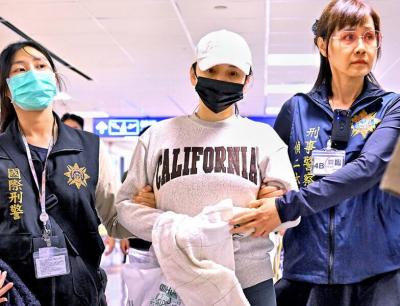
Johanne Liou (劉喬安), a Taiwanese woman who shot to unwanted fame during the Sunflower movement protests in 2014, returned to Taiwan last night after being deported from the US. She is to stand trial in Taiwan for charges involving embezzlement, fraud and drug crimes. The Criminal Investigation Bureau (CIB) said it took her into custody at Taiwan Taoyuan International Airport and would first question her before transferring her to the New Taipei District Prosecutors’ Office. She was arrested upon disembarking a flight from San Francisco that landed shortly before 7pm. Liou absconded to the US in 2019 after jumping bail
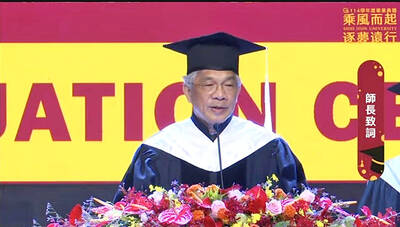
Shih Hsin University President Chen Ching-he (陳清河) yesterday issued a public apology for comments made in his commencement speech last week, stating that he has asked the school to suspend his duties and halt his wages for two months as a show of contrition. At the commencement ceremony on May 30, Chen said, “If you don’t manage your time well, or your own emotions, or your health, then I am telling every one of you — put a quick end to ‘you,’ because the world has no need for ‘you.’” The comments have sparked significant controversy online, and Chen through an open


 RSS
RSS