


A meeting of the legislature’s Education and Culture Committee yesterday to hear a report by the Atomic Energy Council on comprehensive safety checks at the Fourth Nuclear Power Plant in New Taipei City’s (新北市) Gongliao District (貢寮) was postponed after legislators quarreled over whether members of the public should be allowed to attend the meeting.
The committee chair for the session, Democratic Progressive Party (DPP) Legislator Cheng Li-chiun (鄭麗君), had invited Gongliao residents and members of anti-nuclear energy groups to attend the session, but the move drew objections from Chinese Nationalist Party (KMT) legislators Chen Shu-hui (陳淑慧) and Kung Wen-chi (孔文吉).
Fearing a repeat of an incident involving National Tsing Hua University student Chen Wei-ting (陳為廷), a co-convener of the Youth Alliance Against Media Monsters — who attended a committee meeting earlier this month and caused controversy by using strong language while addressing Minister of Education Chiang Wei-ling (蔣偉寧) — Chen Shu-hui stepped up to the inquiry podium at the beginning of the meeting and asked the committee chair to vet the participants before opening the meeting.
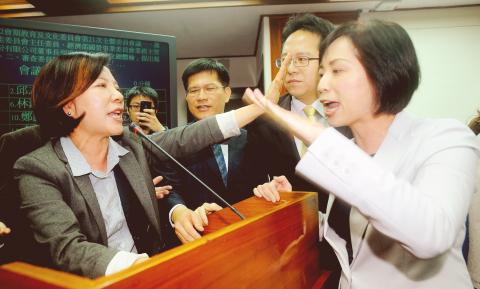
Photo: Lin Cheng-kung, Taipei Times
Chen Shu-hui’s request prompted DPP legislators to question the constitutionality of identifying the participants and the dispute devolved into a quarrel between KMT and DPP legislators, culminating with Chen Shu-hui and DPP Legislator Ho Hsin-chun (何欣純) shouting loudly at each another and banging on the podium.
“None of us legislators want to see these incidences of violence in the committee” and “We only want to know who these participants are,” Chen Shu-hui shouted as he was surrounded by several legislators from both parties, adding that the meeting should not be allowed to proceed.
Cheng said the members of the public were only registered to listen to the meeting and will not speak at the podium, and stressed that the Legislative Yuan should not seal itself from the public, which would be a setback of democracy.
After the meeting was suspended, one of the participants from the civic sector, Yenliao Anti-Nuclear Self-Help Association secretary-general Yang Mu-huo (楊木火), asked if it was possible for those who live near the Fourth Nuclear Power Plant to be present when matters directly affecting their livelihoods and health are discussed.
“Can’t we even listen to the meeting?” Yang asked.

Yangmingshan National Park authorities yesterday urged visitors to respect public spaces and obey the law after a couple was caught on a camera livestream having sex at the park’s Qingtiangang (擎天崗) earlier in the day. The Shilin Police Precinct in Taipei said it has identified a suspect and his vehicle registration number, and would summon him for questioning. The case would be handled in accordance with public indecency charges, it added. The couple entered the park at about 11pm on Thursday and began fooling around by 1am yesterday, the police said, adding that the two were unaware of the park’s all-day live
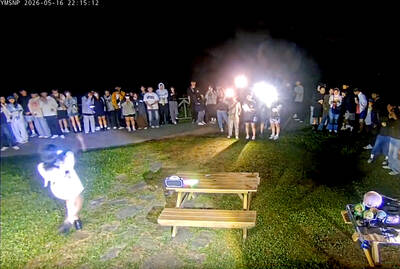
Yangmingshan National Park’s Qingtiangang (擎天崗) nature area has gone viral after a park livestream camera observed a couple in the throes of intimate congress, which was broadcast live on YouTube, drawing large late-night crowds and sparking a backlash over noise, bright lights and disruption to wildlife habitat. The area’s livestream footage appeared to show a couple engaging in sexual activity on a picnic table in the park on Friday last week, with the uncensored footage streamed publicly online. The footage quickly spread across social media, prompting a tide of visitors to travel to the site to “check in” and recreate the
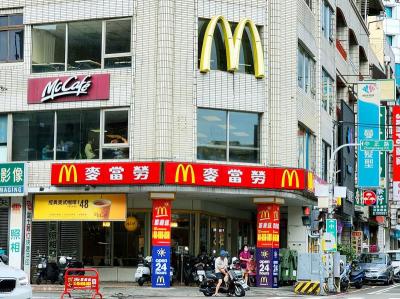
Fast food chain McDonald's is to raise prices by up to NT$5 on some products at its restaurants across Taiwan, starting on Wednesday next week, the company announced today. The prices of all extra value meals and sharing boxes are to increase by NT$5, while breakfast combos and creamy corn soup would go up by NT$3, the company said in a statement. The price of the main items of those meals, if ordered individually, would remain the same. Meanwhile, the price of a medium-sized lemon iced tea and hot cappuccino would rise by NT$3, extra dipping sauces for chicken nuggets would go up

Minister of Digital Affairs Lin Yi-ching (林宜敬) yesterday cited regulatory issues and national security concerns as an expert said that Taiwan is among the few Asian regions without Starlink. Lin made the remarks on Facebook after funP Innovation Group chief executive officer Nathan Chiu (邱繼弘) on Friday said Taiwan and four other countries in Asia — China, North Korea, Afghanistan and Syria — have no access to Starlink. Starlink has become available in 166 countries worldwide, including Ukraine, Malaysia, the Philippines and Vietnam, in the six years since it became commercial, he said. While China and North Korea block Starlink, Syria is not


 RSS
RSS