


The legislature’s Transportation Committee yesterday dismissed its morning session again because of the absence of Minister Without Portfolio Simon Chang (張善政).
The committee was to hear briefings on Thursday last week from the National Communications Commission (NCC) on its plan to issue mobile broadband business licenses.
Chang was invited to attend the meeting, but did not show up.
Since lawmakers on the committee said they wanted to consult with Chang on some policy issues, the committee decided to dismiss the meeting and reschedule.
The committee also passed a resolution condemning Chang for contempt of the legislature.
Democratic Progressive Party (DPP) legislators Yeh Yi-jin (葉宜津) and Lee Kun-tse (李昆澤) said Chang was in charge of the nation’s scientific and technological affairs and can dictate the policies for mobile communications and cloud-computing technologies, while the commission and the ministry simply executed what the Cabinet said. Yet the officials from the commission and Ministry of Transportation and Communications arrived for the meeting yesterday, and Chang did not.
Chinese Nationalist Party (KMT) Legislator Lee Hung-chun (李鴻鈞) said that Legislative Speaker Wang Jin-pyng (王金平) would soon convene a bipartisan negotiation session to determine whether ministers without portfolio should be present at the committee meeting.
The committee then decided to dismiss meeting at 10am.
Meanwhile, NCC Chairman Howard Shyr (石世豪) said new NCC commissioners should assume office in March.
The Executive Yuan nominated former television anchorwoman Wang Yung-ho (汪用和) and NCC adviser Chiang Yu-fen (江幽芬) to be the new NCC commissioners.
Wang’s appointment was interpreted as the returning of a political favor because she is the wife of former KMT legislator Justin Chou (周守訓).
In response, Shyr said Wang’s experience as television news reporter is relevant to her job as NCC commissioner. She has been devoted to a lot of community service lately and knows how to communicate with the public, he said.
Chiang is a very experienced civil servant and has participated in the amending of three major broadcasting acts, Shyr said.
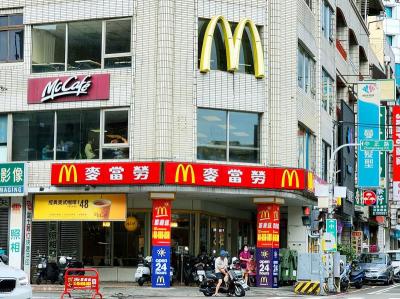
Fast food chain McDonald's is to raise prices by up to NT$5 on some products at its restaurants across Taiwan, starting on Wednesday next week, the company announced today. The prices of all extra value meals and sharing boxes are to increase by NT$5, while breakfast combos and creamy corn soup would go up by NT$3, the company said in a statement. The price of the main items of those meals, if ordered individually, would remain the same. Meanwhile, the price of a medium-sized lemon iced tea and hot cappuccino would rise by NT$3, extra dipping sauces for chicken nuggets would go up

Nvidia Corp CEO Jensen Huang (黃仁勳) arrived in Taiwan yesterday ahead of upcoming AI and technology events, saying he plans to meet with clients and Taiwan Semiconductor Manufacturing Co Chairman C.C. Wei (魏哲家) during his visit. After landing at Taipei Songshan Airport, Huang posed for photos with fans and handed out Yakult drinks to reporters and supporters waiting at the scene, saying he has “a lot to do” during the trip. Asked about reports that Nvidia’s planned headquarters site in Taipei’s Beitou Shilin Technology Park could break ground on May 27, Huang said that if the company holds an event, he would

FUKUOKA SITUATION: Japanese media reported that the pathogen is expected to be identified by the summer, while the CDC downplayed the idea that it was hMPV A “mysterious cold-like illness” reported in Japan’s Fukuoka Prefecture does not seem to be a new disease, but Japanese authorities have been asked about the situation, the Centers for Disease Control (CDC) said yesterday. The Fukuoka Prefectural Medical Association on Wednesday told a news conference that a “mystery cold” that has become a hot topic on social media is “highly likely to be caused by some kind of viral infection,” Japan’s KBC News reported. “Many people are experiencing symptoms starting with a sore throat, followed by a runny nose, phlegm and a severe cough,” KBC News reported, citing association officials. Health authorities are

Carrefour Taiwan is to begin using a new name from the start of July, but it cannot divulge the name until then, the chairman of the supermarket chain's parent company said today. President Chain Store Co chairman Lo Chih-hsien (羅智先) was asked by reporters after a shareholders' meeting to confirm whether the company has settled on a new name for the supermarket brand. In March, the government-registered name of two Carrefour Taiwan branches was quietly changed to "Le Chia Kang" (樂家康) in Chinese, raising speculation that has been selected as the name. Lo said that because of local regulations and contractual obligations, the


 RSS
RSS