


The US’ Asia-Pacific policy aims to “create a proper balance” to ensure that “there is not one entity here that has too much influence in the region,” US representative Rob Wittman, a member of the US House Armed Services Committee, said in Taipei yesterday.
Wittman made the remarks when he was asked to offer his views on how he assesses the Chinese military threat against Taiwan under Chinese Vice President and new Chinese Communist Party General Secretary Xi Jinping (習近平) before he attended a dinner banquet hosted by Deputy Minister of Foreign Affairs Tung Kuo-yu (董國猷) at the ministry.
“When we look at our relationships with Taiwan, we look at them in the context [of our relationships] with all the other partner nations in the Asia-Pacific [region]. We visited Japan; we also visited the Republic of Korea [South Korea] and others to make sure that we renew the importance of these relationships in their minds,” Wittman said.
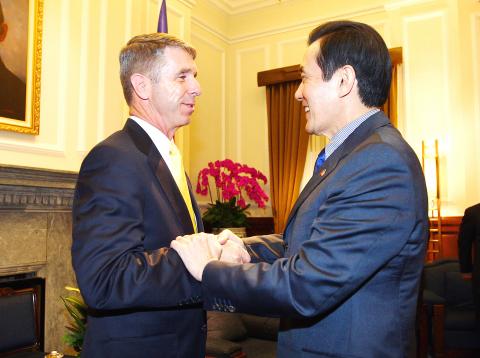
Photo: CNA
The most strategic element of the US-Taiwan relationship, as well as of partnerships between the nations in the region, is to make sure that “we understand that jointly, the US, along with its Asia-Pacific partners here, create a proper balance to make sure that there is not one entity here that has too much influence in the region,” he said.
Wittman was leading a US congressional delegation on a three-day visit to Taiwan starting on Monday. They met President Ma Ying-jeou (馬英九) and Minister of Foreign Affairs David Lin (林永樂) yesterday, and also visited the nation’s naval facilities.
The delegation of eight people includes US representatives Madeleine Bordallo, David Cicilline and Bill Flores.
During their meeting with Ma, the disputes surrounding the Diaoyutai Islands (釣魚台), which Wittman called the “Senkaku Islands” — the Japanese name for the islets — and issues related to the nation’s policy on ractopamine residues in imports of US beef and pork products were discussed, Wittman said.
“We are happy to learn that the issue with US beef and pork has been taken up here. That’s quite good news for us — that we can continue our agricultural trade,” he said.
Deputy Minister of National Defense Andrew Yang (楊念祖) and Chinese Nationalist Party (KMT) Legislator Hsieh Kuo-liang (謝國樑) were also invited to join the dinner.

SPACE VETERAN: Kjell N. Lindgren, who helps lead NASA’s human spaceflight missions, has been on two expeditions on the ISS and has spent 311 days in space Taiwan-born US astronaut Kjell N. Lindgren is to visit Taiwan to promote technological partnerships through one of the programs organized by the US for its 250th national anniversary. Lindgren would be in Taiwan from Tuesday to Saturday next week as part of the US Bureau of Educational and Cultural Affairs’ US Speaker Program, organized to celebrate the 250th anniversary of the signing of the Declaration of Independence, the American Institute in Taiwan (AIT) said in a statement yesterday. Lindgren plans to engage with key leaders across the nation “to advance cutting-edge technological partnerships and inspire the next generation of scientists and engineers,”

UNREASONABLE SURVEILLANCE: A camera targeted on an road by a neighbor captured a man’s habitual unsignaled turn into home, netting him dozens of tickets The Taichung High Administrative Court has canceled all 45 tickets given to a man for failing to use a turn signal while driving, as it considered long-term surveillance of his privacy more problematic than the traffic violations. The man, surnamed Tseng (曾), lives in Changhua County and was reported 45 times within a month for failing to signal while driving when he turned into the alley where his residence is. The reports were filed by his neighbor, who set up security cameras that constantly monitored not only the alley but also the door and yard of Tseng’s house. The surveillance occurred from July
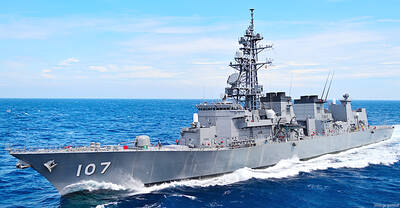
A Japan Self-Defense Forces vessel entered the Taiwan Strait yesterday, Japanese media reported. After passing through the Taiwan Strait, the Ikazuchi was to proceed to the South China Sea to take part in a joint military exercise with the US and the Philippines, the reports said. Japan Self-Defense Force vessels were first reported to have passed through the strait in September, 2024, with two further transits taking place in February and June last year, the Asahi Shimbun reported. Yesterday’s transit also marked the first time since Japanese Prime Minister Sanae Takaichi took office that a Japanese warship has been sent through the Taiwan
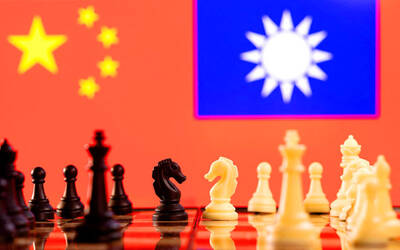
‘SAME OLD TRICK’: Even if Beijing resumes individual travel to Taiwan, it would only benefit Chinese tourism companies, the Economic Democracy Union convener said China’s 10 new “incentives” are “sugar-coated poison,” an official said yesterday, adding that Taiwanese businesses see them clearly for what they are, but that Beijing would inevitably find some local collaborators to try to drums up support. The official, speaking on condition of anonymity, made the remark ahead of a news conference the General Chamber of Commerce is to hold today. The event, titled “Industry Perspectives on China’s Recent Pro-Taiwan Policies,” is expected to include representatives from industry associations — such as those in travel, hotels, food and agriculture — to request the government cooperate with China’s new measures, people familiar with


 RSS
RSS