


The world’s first-ever pink florescent Pterophyllum scalare, commonly known as the angelfish, were showcased in an exhibit on Wednesday prior to the Taiwan International Aquarium Expo, which opens today.
Lin Yu-ho (林育禾), president of Jy Lin Trading Co — the company that cooperated with National Ocean University and Academia Sinica on developing the fish — said this was the first time the world had seen a pink angelfish since the fish was discovered in the Amazon.
Despite the 32 colors developed worldwide for the angelfish, the fish lacked the cells to create any color resembling pink, Lin said, adding that the company had accomplished the endeavor after three years of research with the university and Academia Sinica.
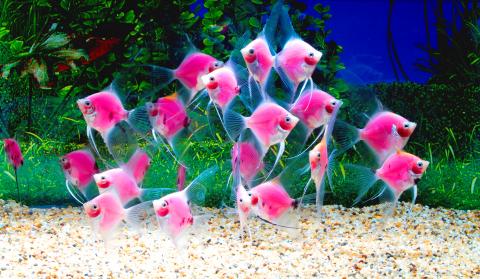
Photo courtesy of National Taiwan Ocean University
Lin said the florescent proteins that would be able to display a “pinkish” color were discovered by National Kaohsiung Marine University associate professor Chen Ming-chyuan (陳鳴泉) on acropora corals growing near Taiwan.
National Ocean University assistant professor Gong Hong-yi (龔紘毅) discovered that the fish would be born pink if micro-transfusion methods were used to transfuse the protein into angelfish eggs.
The research group at Academia Sinica, which consisted of researcher Wu Chin-lieh (吳金洌) and associate research fellow Chen Chih-yi (陳志毅), collaborated to inject the proteins into the eggs.
The research team said that the micro-transfusion process had been very difficult due to the fragility of the angelfish eggs, adding that on average they had been able to successfully transfuse the proteins into only one egg per 10,000 at first.
The team said they were able to raise the success rate to 1 percent after three years of research.
Despite the first appearance causing quite an uproar, with one foreign buyer even offering NT$100,000 for one of the genetically modified fish, the company was forced to decline until the species passes safety assessments in field tests.
Jy Lin general manager Ou Mei-ju (歐梅如) said the only florescent fish currently on the market is the zebrafish, which mostly features green and pink colors.
However, Ou said the florescent colors of the zebrafish can only be observed at night, while the florescent lighting of the company’s angelfish can be seen even in broad daylight.
Additional reporting by Chen Yi-ching and Yu Chao-fu
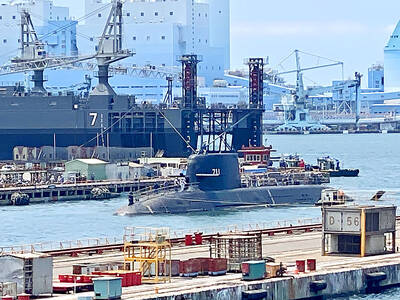
AGING: While Japan has 22 submarines, Taiwan only operates four, two of which were commissioned by the US in 1945 and 1946, and transferred to Taiwan in 1973 Taiwan would need at least 12 submarines to reach modern fleet capabilities, CSBC Corp, Taiwan chairman Chen Cheng-hung (陳政宏) said in an interview broadcast on Friday, citing a US assessment. CSBC is testing the nation’s first indigenous defense submarine, the Hai Kun (海鯤, Narwhal), which is scheduled to be delivered to the navy next month or in July. The Hai Kun has completed torpedo-firing tests and is scheduled to undergo overnight sea trials, Chen said on an SET TV military affairs program. Taiwan would require at least 12 submarines to establish a modern submarine force after assessing the nation’s operational environment and defense

A white king snake that frightened passengers and caused a stir on a Taipei MRT train on Friday evening has been claimed by its owner, who would be fined, Taipei Rapid Transit Corp (TRTC) said yesterday. A person on Threads posted that he thought he was lucky to find an empty row of seats on Friday after boarding a train on the Bannan (Blue) Line, only to spot a white snake with black stripes after sitting down. Startled, he jumped up, he wrote, describing the encounter as “terrifying.” “Taipei’s rat control plan: Release snakes on the metro,” one person wrote in reply, referring
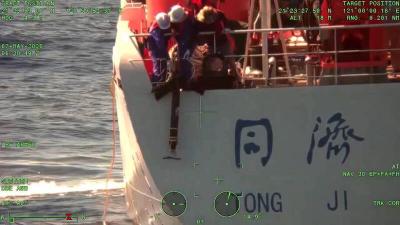
The coast guard today said that it had disrupted "illegal" operations by a Chinese research ship in waters close to the nation and driven it away, part of what Taipei sees a provocative pattern of China's stepped up maritime activities. The coast guard said that it on Thursday last week detected the Chinese ship Tongji (同濟號), which was commissioned only last year, 29 nautical miles (54km) southeast of the southern tip of Taiwan, although just outside restricted waters. The ship was observed lowering ropes into the water, suspected to be the deployment of scientific instruments for "illegal" survey operations, and the coast
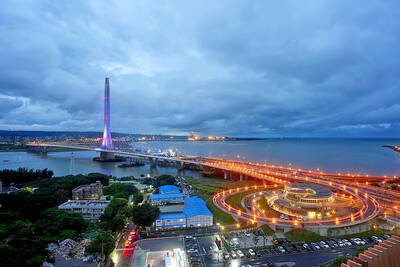
An inauguration ceremony was held yesterday for the Danjiang Bridge, the world’s longest single-mast asymmetric cable-stayed bridge, ahead of its official opening to traffic on Tuesday, marking a major milestone after nearly three decades of planning and construction. At the ceremony in New Taipei City attended by President William Lai (賴清德), Premier Cho Jung-tai (卓榮泰), Minister of Transportation and Communications Chen Shih-kai (陳世凱) and New Taipei City Mayor Hou Yu-ih (侯友宜), the bridge was hailed as both an engineering landmark and a long-awaited regional transport link connecting Tamsui (淡水) and Bali (八里)


 RSS
RSS