


The National Communications Commission (NCC) yesterday said it would hold a public hearing on Tuesday next week on setting more reasonable cable TV service fees.
The Executive Yuan has set the goal of raising the penetration rate of digital cable television service to 100 percent by 2014. This year, the commission has begun implementing a policy that allows cable television service providers to offer nationwide service or branch out into other service areas, on the condition that they offer only digital service.
NCC spokesperson Wei Shyue-wen (魏學文) said it was about time the commission began considering what constitutes a reasonable service fee in the digital service age.
“We want to hold a public hearing to hear what different parties think about things such as the basic channels in the cable television service and what should be charged for them,” Wei said. “I cannot say for sure that the commission will definitely come to a conclusion on the matter by the end of this year, but we are under pressure to reach a decision quickly as there are two cable television service operators have already applied to branch out into other service areas.”
Earlier this week, several other local governments announced that they would lower the subscription fee for cable television service. The Taipei City Government, for example, announced that the cable television subscription fee in the city will be dropped to below NT$500 per month.
Article 51 of Cable Radio and Television Act (有線廣播電視法) requires cable system operators to report subscription fees to the county or city governments by Aug. 1 each year.
Local governments may establish a fee review committee in charge of approving the aforementioned subscription fees. For those that choose not to establish such a committee, the central regulatory agency will be in charge of approving the fees.
Though the commission said it respected the decisions made by these local governments, it called on them to set more reasonable service rates.
“Cable TV service operators have greater power than channel operators,” Wei said. “If we keep lowering the subscription fee, it would shrink cable television operators’ profits. It would also affect the amount of money that the cable service operators pay to television channel operators, which could affect the quality of the content presented to audiences. It would be a vicious circle.”
Wei also said that he thinks that the key to solving the cable service fees issue is to completely digitize the cable television service.
“The number of television channels that could be included in the cable television service would be greatly expanded,” Wei said. “The cable TV system’s fair treatment of all channels would no longer be a controversial issue. Viewers can select which channels they want and pay only for those.”


China has reserved offshore airspace in the Yellow Sea and East China Sea from March 27 to May 6, issuing alerts usually used to warn of military exercises, although no such exercises have been announced, the Wall Street Journal (WSJ) reported yesterday. Reserving such a large area for 40 days without explanation is an “unusual step,” as military exercises normally only last a few days, the paper said. These alerts, known as Notice to Air Missions (Notams), “are intended to inform pilots and aviation authorities of temporary airspace hazards or restrictions,” the article said. The airspace reserved in the alert is
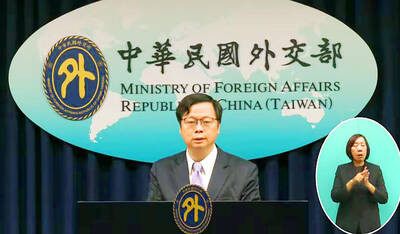
NAMING SPAT: The foreign ministry called on Denmark to propose an acceptable solution to the erroneous nationality used for Taiwanese on residence permits Taiwan has revoked some privileges for Danish diplomatic staff over a Danish permit that lists “Taiwan” as “China,” Eric Huang (黃鈞耀), head of the Ministry of Foreign Affairs’ Department of European Affairs, told a news conference in Taipei yesterday. Reporters asked Huang whether the Danish government had responded to the ministry’s request that it correct the nationality on Danish residence permits of Taiwanese, which has been listed as “China” since 2024. Taiwan’s representative office in Denmark continues to communicate with the Danish government, and the ministry has revoked some privileges previously granted to Danish representatives in Taiwan and would continue to review

More than 6,000 Taiwanese students have participated in exchange programs in China over the past two years, despite the Mainland Affairs Council’s (MAC) “orange light” travel advisory, government records showed. The MAC’s publicly available registry showed that Taiwanese college and university students who went on exchange programs across the Strait numbered 3,592 and 2,966 people respectively. The National Immigration Agency data revealed that 2,296 and 2,551 Chinese students visited Taiwan for study in the same two years. A review of the Web sites of publicly-run universities and colleges showed that Taiwanese higher education institutions continued to recruit students for Chinese educational programs without

China has reserved offshore airspace over the Yellow Sea and East China Sea from March 27 to May 6, issuing alerts that are usually used to warn of military exercises, although no such exercises have been announced, the Wall Street Journal (WSJ) reported on Sunday. Reserving such a large area for 40 days without explanation is an “unusual step,” as military exercises normally only last a few days, the paper said. The alerts, known as notice to air missions (NOTAMs), “are intended to inform pilots and aviation authorities of temporary airspace hazards or restrictions,” the article said. The airspace reserved in the alert


 RSS
RSS