


While young workers often need to work long hours for low incomes, navigation officers are keeping their sights on the sea, where starting salaries are twice and sometimes even three times higher than average incomes for young people.
The Ministry of Transportation and Communications (MOTC) yesterday released the names of those who had passed the seafarers’ examination.
Previously, the exam was hosted by the Ministry of Examination and students in navigation and marine engineering who were still at school were barred from taking the exam.
This year, the exam was held by the MOTC, which lifted those restrictions. The results showed that 94 of the 385 examinees passed the exam. Among the successful entrants were 22 women.
Students still in school excelled in the exam this year, accounting for 75 percent of those who passed the exam for first-deck officer and 36 percent of those who passed the exam for first-class engineer officer.
Chi Wen-jong (祁文中), director-general of MOTC’s Department of Aviation and Navigation, said students who are in school can now take the seafarers’ exam as long as they finish the basic training as laid down by rules set out in the Standards of Training, Certification and Watchkeeping (STCW) Convention.
The exam would allow those studying navigation or marine engineering to enter the job market for seafarers right away, Chi said.
Chi said the ministry was considering offering postgraduate degrees for those who had not studied navigation or relevant subjects while they were in school, but were interested in working at sea.
According to the National Chinese Seamen’s Union, those passing the exam can start working as third-deck officers or third engineering officers with ocean-going shipping lines, where the starting wage ranges from NT$96,000 to NT$146,000 per month.
The union added that new industry entrants can climb up the career ladder to second or first-deck officer or second or first engineering officer with a simultaneous monthly increase as well.
A captain’s monthly salary could range from between NT$246,000 to NT$265,000.
To follow the labor standards set out by the international STCW convention, seafarers are banned from working overtime, the union said.
Despite higher wages and better working conditions, the union said marine transport services were still about 6,000 workers short.
Maritime and Port Bureau Director General Li Juel-der (黎瑞德), who worked on a shipping line between 1977 and 1982, said he was promoted from third-deck officer to second-deck officer within one-and-a-half years. The money he earned during this period helped him buy his first house.
“If I had not switched my career to the public sector, I might have continued working on a ship and eventually become a captain,” Li said. “I kind of missed the time working on a ship. The only thing was that it was a bit lonely.”
For those eager to earn their first pot of gold after graduation, Li said that working on a ship may be one of the fastest ways to do so.
Jeng Yi (鄭怡), a captain at Yang Ming Marine Transport Corp, has been in the marine transport service since 1997. He said he has forgotten how much he made per month as a beginner.
“What I do remember is that I was on a ship for only one month, and the money I made during that month helped support my family for about four to six months,” he said.
Cheng said those who pass the seafarers’ exam can earn a starting wage of about NT$120,000 — much more than most college graduates are likely to make, adding that people working on a ship have a relatively stable and long career.
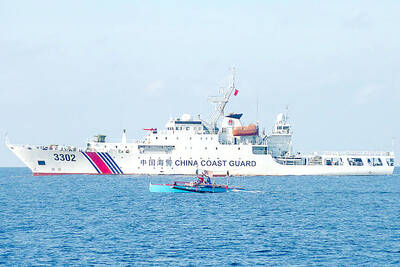
EXPANSIONIST: China deploys an average of 40 to 50 warships and coast guard vessels daily in the South China Sea, despite pledges not to militarize the region, an official said China is attempting to expand its influence across the First Island Chain and increase pressure on Japan by sending coast guard vessels into waters off of Taiwan under the pretext of maritime negotiations with Japan and the Philippines, a national security official said yesterday. China’s recent actions in the waters east of Taiwan and Japan and the Philippines’ exclusive economic zones (EEZ) are attempts to establish dominance in First Island Chain waters, said the official who declined to be named, adding that this is “expansion disguised as law enforcement.” Framing China’s actions solely as a cross-strait issue is a serious misjudgment that
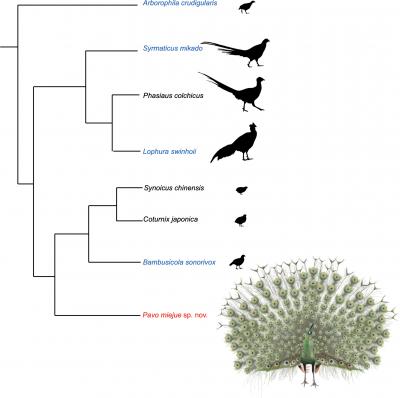
Through analyzing fossil evidence, a research team at National Taiwan University (NTU) discovered the largest endemic bird to have lived in Taiwan, naming it Pavo miejue, or extinct peafowl (滅絕孔雀). The Mikado pheasant, which is printed on the back of the NT$1,000 bank note, was previously believed to be the biggest endemic bird to Taiwan. The research team’s findings suggest that Pavo miejue lived during the Pleistocene epoch tens of thousands of years ago. It is the first endemic extinct bird species discovered and formally named in Taiwan. The study was coauthored by NTU Institute of Ecology and Evolutionary Biology professor Tsai Cheng-hsiu (蔡政修),
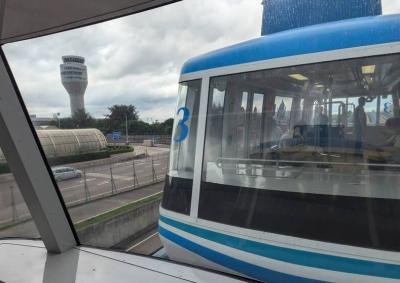
Taiwan Taoyuan International Airport is to suspend its automated Skytrain service connecting Terminal 1 and Terminal 2 starting on July 1 to facilitate connection works for the upcoming Terminal 3, the airport operator said today. Passengers and staff who need to travel between the two terminals after the suspension can instead use the Taoyuan MRT or the airport's 24-hour shuttle bus service, Taoyuan International Airport Corp said. The Taoyuan MRT Airport Line directly links the two terminals, while the shuttle buses are to operate around the clock, the company added. The Skytrain provides free transportation between the airport’s two terminals for travelers and
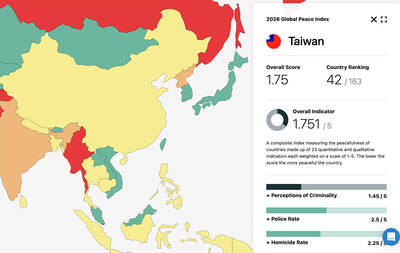
Taiwan ranked 42nd in terms of peacefulness among 163 countries, down five places from last year, according to this year’s Global Peace Index. With an overall score of 1.751, Taiwan dropped from 37th last year, the report published by the global Institute for Economics and Peace showed. The overall score measures a country’s level of peacefulness using 23 quantitative and qualitative indicators across three domains — ongoing domestic and international conflict, societal safety and security, and militarization. While Taiwan ranked 42nd worldwide, it was listed in ninth place among the 19 Asian-Pacific countries in the report, after New Zealand, Singapore, Japan, Malaysia,


 RSS
RSS