


Duplicates of rock formations named “Leopard (金錢豹)” and “Cute Princess Rock (俏皮公主)” were installed at the renowned tourist site of Yehliu Geopark (野柳地質公園) in New Taipei City (新北市) on Wednesday in an effort to attract more visitors.
Yehliu Geopark deputy general manager Tang Chin-hui (湯錦惠) said most people know about the iconic “Queen’s Head (女王頭)” rock formation at the park, but relatively few know about the “Leopard” rock formation.
“Due to tidal fluctuations, this [“Leopard”] unique feature was visible for only 18 days in a year,” she said, adding that it could usually be viewed on the first three days and also on the 15th to 17th days of the third, fourth and fifth months of the lunar calendar.
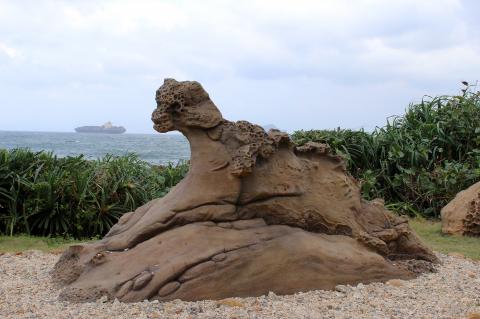
Photo: Yu Chao-fu, Taipei Times
However, the Leopard rock formation collapsed amid pounding waves during a typhoon in 2010, she said, adding that the park management therefore decided to build a replica, along with a reproduction of the “Cute Princess” rock formation.
According to Tang, building the replicas was not a easy job, as workers had to carry computer equipment weighing more than 100kg along the seashore to the edge of the cape in order to perform laser scanning of the collapsed remnants of the Leopard rock. The data was then compiled to enable the construction of a 3D digital image, used to make polyurethane mouldings, she said.
These mouldings were then processed via a computer numerical control machine to produce a one-to-one replica of the original, which was augmented on the exterior with fiber reinforced plastic.
The replica then underwent a final treatment by craftsmen that included fine detailed finishing, paint coloring and imitation sandstone surface polishing, she said
Last year, the park also had a duplicate of the “Queen’s Head” made, Tang said, adding that it has proven to be popular with tourists, who like to have their pictures taken with it.

NATIONAL SECURITY: Authorities are working to confirm the identities of the military personnel involved and investigating possible illegal conduct and regulatory violations Authorities are probing possible national security implications after Kinmen police and immigration officers on Sunday found a Chinese woman allegedly posing as a tourist while engaging in prostitution involving more than 10 military personnel. The woman, surnamed Chen (陳), has since been deported, authorities said, adding that investigators are still working to confirm the identities of those implicated, as the records only listed code names and aliases. The case stemmed from a report received by the Kinmen District Prosecutors’ Office on Friday last week from the Jinhu Precinct of the Kinmen County Police Bureau. On Sunday, police, along with the National Immigration

GLOBALGIVING: ‘ Caving to external pressure is not acceptable for an organization that has cultivated justice reform and human rights for 30 years,’ one NGO said A slew of non-government organizations (NGOs) have withdrawn from the GlobalGiving fundraising platform after it announced it would use “Chinese Taipei” instead of “Taiwan” from next month. The Taiwan Good Rice Association wrote on Facebook on Friday that it was informed on April 28 via a teleconference call of the change, which was made because the platform wanted to operate in China. Taiwan Good Rice is to terminate all cooperative relationships with GlobalGiving in response to the platform’s “unilateral and non-negotiable” decision to remove references to Taiwan, the NGO said. “Taiwan is in the official name of Taiwan Good Rice Association and the
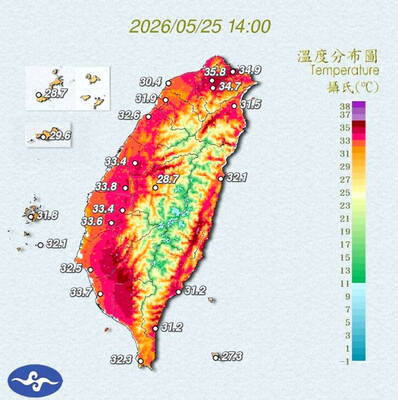
STAY COOL: The HPA recommended that people stay hydrated, use air-conditioning or fans while indoors, wear loose-fitting clothes and walk in the shade while outdoors Employers must implement measures such as installing cooling equipment, and providing drinking water and rest breaks for outdoor workers starting from Monday next week, the Taipei Department of Labor said on Sunday. Employers who fail to comply could face fines of NT$30,000 to NT$300,000 under the Occupational Safety and Health Act (職業安全衛生法), the department said. Businesses in Taipei employing fewer than 100 workers, as well as registered self-employed workers with labor insurance coverage, could receive on-site assessments and guidance from occupational safety consultants to help them apply for central government subsidies to implement or improve heat-protection measures, it said. Under the Ministry of

Chinese Nationalist Party (KMT) Chairwoman Cheng Li-wun (鄭麗文) yesterday briefed her party’s Central Standing Committee regarding her scheduled visit to the US between Monday next week and June 16, saying that her purpose would be to persuade the US that the Republic of China (ROC) Constitution was a “one China” constitution that would foster stable and peaceful cross-strait relations. The ROC Constitution is the most important defense for all Taiwanese citizens, as it upholds our democracy and has contributed to our robust economy, which aligns with international and US interests, she said. “We would not be troublemakers and drag the US under,”


 RSS
RSS