

Legislators yesterday urged the government to restrict the broadcast of junk food commercials on children’s TV channels, as well as at hours when children’s programs are aired on other channels.
A study by the Child Welfare League Foundation showed that children in Taiwan are exposed to an average of 8,325 junk-food commercials a year. On average, each child sees a junk-food ad every 6.6 minutes when watching TV.
The frequency of junk-food ads increases during times when meals are usually eaten — 1.6 the number of times they are aired during other hours.

Photo: Chien Jung-fong, Taipei Times
The foundation’s research and development director Chiu Ching-hui (邱靖惠) said that even adults would be tempted by the ads to buy junk food, let alone young children.
The foundation’s study also found that many fast-food chains encourage parents to purchase their food by giving out free toys with meals.
Chinese Nationalist Party (KMT) Legislator Alicia Wang (王育敏) said New York has banned the sale of sugary drinks in containers larger than 470ml in restaurants and other venues. Denmark and France, for their part, have taxed saturated fats and soda, respectively. Both the UK and Sweden have banned the broadcast of junk-food ads in hours when children’s programs are aired.
Wang said she would propose similar measures during the current legislative session.
In response, the Food and Drug Administration said it has proposed an amendment to the the Act Governing Food Sanitation (食品衛生管理法) which would restrict ads for food that could lead to chronic diseases or are inappropriate for long-term consumption by children.
Wu Hsi-wen (吳希文), a section chief at the administration, added that the amendment would also include articles governing the suspension of broadcasts of such ads and penalties. Advertisers violating the regulations could face a penalty of up to NT$200,000 and would be fined per violation. Advertisers could also be asked to correct the content of the ad if it is deemed a serious violation and they could also be fined up to NT$600,000 if they refuse to stop airing the ads.
Jason Ho (何吉森), director of the National Communications Commission’s communication content department, said that the commission has added regulations pertaining to junk-food ads to its amendment to the Satellite Broadcasting Act (衛星廣播電視法), which is being reviewed by the legislature.
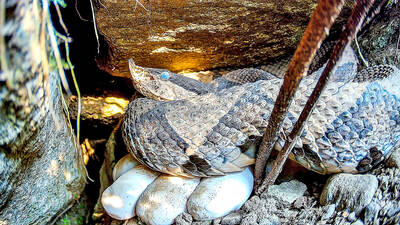
NATURE TAKES ITS COURSE: The agency’s head said he felt a sense of loss watching red-banded snakes eat the babies, as they had decided on non-intervention The Forestry and Nature Conservation Agency yesterday released a documentary on a hundred-pace viper that had incubated 16 eggs, all of which hatched, but only a baby viper escaped after they were attacked by red-banded snakes. The agency’s Taichung branch last year launched the viper reproduction monitoring project soon after forest rangers Lin Chun-yu (林俊佑) and Chou Chia-cheng (周家成) spotted a pregnant hundred-pace viper in a grass-covered burrow near a parking lot in Tbulan Village (松鶴部落). The Atayal village, in Taichung’s Heping District (和平), is headed by Ecyang Yapu, who was positive about the project and assisted in access control and power
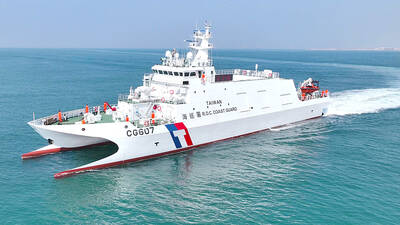
The Coast Guard Administration (CGA) yesterday said that it had deployed vessels to “monitor” Chinese ships operating in waters off the east coast. The CGA said it dispatched vessels in response to a China Coast Guard announcement that it had carried out another “routine law-enforcement patrol” in waters off the east coast. “The CGA firmly rejects China’s cognitive warfare campaign of ‘law enforcement in name, jurisdictional expansion in practice,’” it said on X. As of 11am yesterday, two China Coast Guard ships were “loitering and drifting” about 105 nautical miles (195km) and 74 nautical miles east of Green Island (綠島) respectively, it said. It
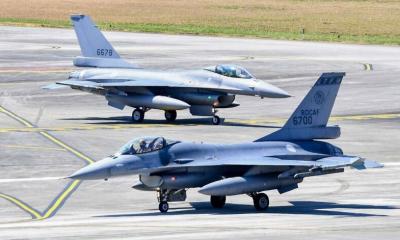
The first two F-16V Block 70 jets Taiwan purchased from the US were spotted unexpectedly turning back after departing from Hawaii yesterday, potentially further delaying delivery of the aircraft. Taiwan has purchased 66 of the F-16 C/D Block 70 jets to be deployed at Chihhang Air Base (志航基地) in Taitung County and operated by the air force's 7th Tactical Fighter Wing to defend Taiwan’s eastern region. Two single-seat jets, bearing serial No. 6727 and 6728, were spotted taking off from Hickam Field in Hawaii yesterday, observers said. Based on the precedent set during the delivery of Taiwan's older F-16 Block 20s, the new
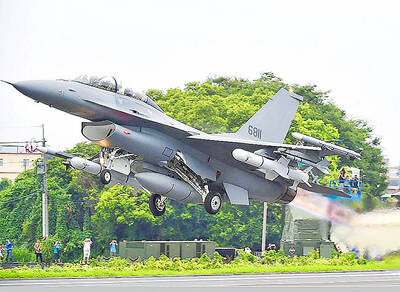
A sharp rise in compensation to be paid by air force officers who leave before completing their required service could indicate an increase in pilots leaving the military early, an analyst said on Friday, warning that the trend could worsen a shortage of experienced personnel. Chieh Chung (揭仲), a researcher at the Association for Strategic Foresight, issued the warning even though the number of volunteer military personnel is expected to increase next year. The planned headcount for volunteer military personnel, covering officers, noncommissioned officers (NCO) and enlisted soldiers, is 158,223 for next year, up 4,258 from 153,965 this year, Chieh said. The increase


 RSS
RSS