


The Straits Exchange Foundation (SEF) board’s decision to make its chairman a paid position showed the appointment of Lin Join-sane (林中森) was a “political reward,” DPP lawmakers said yesterday.
A SEF board meeting yesterday confirmed the appointment of Lin and amended its organizational regulations, changing the position without remuneration to a paid position, DPP Legislator Hsiao Bi-khim (蕭美琴), who serves as a board member of the foundation, told a press conference.
Former SEF chairpeople, including outgoing Chiang Pin-kung (江丙坤), worked for the foundation, which functioned as a negotiation institution for cross-strait affairs, without pay.
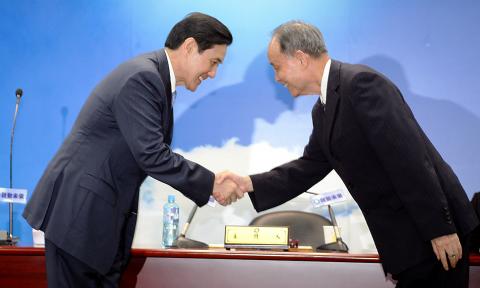
Photo: CNA
Hsiao said the amendment was likely a tailor-made decision for Lin, who made NT$200,000 (US$6,800) per month in his previous job as Chinese Nationalist Party (KMT) secretary-general.
Since SEF Vice Chairman Kao Koong-lian (高孔廉) is paid NT$235,000 a month, Lin could earn about NT$300,000 per month, DPP Legislator Pasuya Yao (姚文智) said.
DPP Legislator Chen Chi-mai (陳其邁) quoted a previous comment by Chiang, who described his job as “simply signing your name on the dotted line and reading prepared speeches,” as saying that the honorary position “is not worthy of NT$300,000 a month.”
Chen added the DPP caucus would overrule the amendment in the legislature.
Chiang cited the fact that he did not make a penny from the position as the reason for his refusal to report to the legislature and be questioned by lawmakers.
DPP Legislator Lee Chun-yi (李俊俋) said Lin could be paid if he can accomplish five tasks: ensure Beijing notifies Taiwan of any detention of a Taiwanese national within 24 hours, resolving all trade disputes, acquiring compensation for the 2008 Chinese milk scandal, bringing all fugitives in China back to Taiwan and having China remove all missiles targeted at Taiwan.
Separately yesterday at the KMT secretary-general handover ceremony, Lin acknowledged his lack of knowledge and experience on cross-strait affairs before taking over the post and pledged to devote himself to maintaining peace across the Strait.
President Ma Ying-jeou (馬英九), who is KMT chairman, yesterday defended the appointment of Lin, saying expected Lin to strengthen cross-strait exchanges in the future.
“Lin is unfamiliar with handling cross-strait affairs, but as a former Executive Yuan secretary-general and KMT secretary-general, he is very familiar with administrative affairs and has excellent communication skills. I believe he will further promote cross-strait exchanges,” he said.
Chiang, who tendered his resignation last week prior to the announcement of the personnel reshuffle, formally stepped down yesterday.
In a farewell luncheon, he thanked Ma for giving him the opportunity to “make history” by presiding over the eight rounds of cross-strait negotiations and completing the signing of 18 cross-strait agreements, including the Economic Cooperation Framework Agreement (ECFA).

NATIONAL SECURITY: Authorities are working to confirm the identities of the military personnel involved and investigating possible illegal conduct and regulatory violations Authorities are probing possible national security implications after Kinmen police and immigration officers on Sunday found a Chinese woman allegedly posing as a tourist while engaging in prostitution involving more than 10 military personnel. The woman, surnamed Chen (陳), has since been deported, authorities said, adding that investigators are still working to confirm the identities of those implicated, as the records only listed code names and aliases. The case stemmed from a report received by the Kinmen District Prosecutors’ Office on Friday last week from the Jinhu Precinct of the Kinmen County Police Bureau. On Sunday, police, along with the National Immigration

REASONS FOR TRAVEL: An assistant professor said that proposed amendments to penalize drivers if they used drugs overseas would not deter people from traveling People who operate a motor vehicle under the influence of marijuana would have their driver’s license revoked, even if they used the substance while overseas, the Ministry of Transportation and Communications said yesterday, citing proposed amendments to the Road Traffic Management and Penalty Act (道路交通管理處罰條例). The amendments would also authorize the government to revoke the licenses of people determined to have used Category 1 or Category 2 narcotics, even if they were not operating a vehicle while under the influence of drugs, as well as ban them from taking the license test for three years, the ministry said. People aged 18 or

GLOBALGIVING: ‘ Caving to external pressure is not acceptable for an organization that has cultivated justice reform and human rights for 30 years,’ one NGO said A slew of non-government organizations (NGOs) have withdrawn from the GlobalGiving fundraising platform after it announced it would use “Chinese Taipei” instead of “Taiwan” from next month. The Taiwan Good Rice Association wrote on Facebook on Friday that it was informed on April 28 via a teleconference call of the change, which was made because the platform wanted to operate in China. Taiwan Good Rice is to terminate all cooperative relationships with GlobalGiving in response to the platform’s “unilateral and non-negotiable” decision to remove references to Taiwan, the NGO said. “Taiwan is in the official name of Taiwan Good Rice Association and the

HEAVY WEATHER: Typhoon Jangmi is due to crash straight into the Ryukyus as airlines look to shift flights to larger aircraft or cancel flights to Okinawa entirely Taiwan’s international air carriers announced flight adjustments over the weekend as Typhoon Jangmi is forecast to hit the Ryukyu Islands today and tomorrow. The Central Weather Administration (CWA) upgraded Jangmi from a tropical storm to a typhoon at 8am yesterday, with the eye located 580km south of Naha city. It was moving north at 19kph. Today, China Airlines’ CI-120, CI-121, CI-122 and CI-123 flights between Taoyuan and Naha, Okinawa, have been canceled as well as CI-132 and CI-133 between Kaohsiung and Naha. EVA Air’s BR-112, BR-113, BR-186 and BR-185 flights between Taoyuan and Naha are also canceled. Low-cost carrier Tigerair Taiwan canceled IT-230,


 RSS
RSS