


Opposition lawmakers have dismissed President Ma Ying-jeou’s (馬英九) trip to Pengjia Islet (彭佳嶼) yesterday, with some of them proposing a voyage to the Diaoyutai Islands (釣魚台) to better lay claim to the territory.
The People First Party (PFP) yesterday suggested that lawmakers sail to the Diaoyutai Islands — as was seen in 2005 when Legislative Speaker Wang Jin-pyng (王金平) along with 15 lawmakers and then-defense minister Lee Jye (李傑), among others — traveled aboard a naval vessel to assert Taiwanese sovereignty over the islets.
“We hope that the Coast Guard Administration and the navy do not turn down the idea. We should follow the [2005] precedent,” PFP legislative caucus whip Thomas Lee (李桐豪) told a press conference.
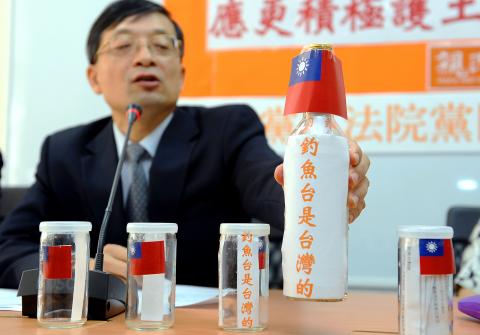
Photo: Chang Chia-ming, Taipei Times
Since Ma was not able to safeguard the nation’s sovereignty over the Diaoyutai Islands himself, “let lawmakers of the Republic of China do it,” Lee said.
PFP Legislator Chang Show-foong (張曉風), the only opposition lawmaker who has signed up for the trip to Pengjia Islet, changed her mind and instead demanded that the Ma administration “take a much more active role” in asserting its sovereignty.
The trip to Pengjia Islet should be a “start” in laying claim to the Diaoyutai Islands, “not an end,” Lee said.
“If that is not so, it would be perceived as a concession of sovereignty because it is no different from saying that we do not own the Diaoyutai Islands,” he said.
Lee said that the party would put forward a motion for discussion in the legislature’s plenary session that lawmakers sail for the Diaoyutai Islands on Sept. 19.
On June 21, 2005, at the request of the pan-blue camp, the Ministry of National Defense sent the Knox-class frigate Feng Yang, a 3,855-tonne patrol vessel, carrying Wang and 15 lawmakers from across party lines to an area near the Diaoyutai Islands.
The move was aimed to stake a claim for Taiwanese fishermen and to show that they have the rights to operate around the region amid a series of cases in which Taiwanese fishermen have been detained by Japanese maritime forces.
Asked to comment, Wang chose not to express his views.
“It needs more consideration. We are in a different situation than we were in the past,” Wang said.
The Presidential Office invited several Democratic Progressive Party (DPP) lawmakers to join Ma on his trip to Pengjia Islet, but none of them chose to participate.
The Ma administration should spend the resources used on the trip instead in helping people who are facing financial hardship, DPP caucus whip Tsai Chi-chang (蔡其昌) said.
Tsai urged Ma to look back at Taiwan when he was on Pengjia.
“The country is in dire need of a viable economic strategy with the unemployment rate for young people at 13 percent — three times higher than national average. Meanwhile the government significantly slashed budgets for vocational training and business start-ups,” he said.
DPP Legislator Cheng Li-chiun (鄭麗君) said the trip to Pengjia was arranged to cover up incompetence within the Ma administration in dealing with economic problems.
Since Ma took office in 2008, he has paid little attention to fishing rights issues, she said.
Since 2008 there has been only one round of negotiations with Japan over fishing rights and that was scheduled before he took office, she said, compared with five rounds of negotiations when former president Lee Teng-hui (李登輝) was in power and ten rounds under the DPP government.
Separately yesterday, former DPP chairperson Tsai Ing-wen (蔡英文) said Ma’s visit to Pengjia Islet is not the most effective way for him to assert Taiwan’s claim to the Diaoyutais.
As the head of state, Ma should better safeguard the country’s territory and sovereignty, she said, adding that it is disappointing that Ma has not clearly declared the Tiaoyutais to be Taiwan’s territory and not that of China.
Additional reporting by CNA

Considering that most countries issue more than five denominations of banknotes, the central bank has decided to redesign all five denominations, the bank said as it prepares for the first major overhaul of the banknotes in more than 24 years. Central bank Governor Yang Chin-lung (楊金龍) is expected to report to the Legislative Yuan today on the bank’s operations and the redesign’s progress. The bank in a report sent to the legislature ahead of today’s meeting said it had commissioned a survey on the public’s preferences. Survey results showed that NT$100 and NT$1,000 banknotes are the most commonly used, while NT$200 and NT$2,000

The Centers for Disease Control (CDC) yesterday reported the first case of a new COVID-19 subvariant — BA.3.2 — in a 10-year-old Singaporean girl who had a fever upon arrival in Taiwan and tested positive for the disease. The girl left Taiwan on March 20 and the case did not have a direct impact on the local community, it said. The WHO added the BA.3.2 strain to its list of Variants Under Monitoring in December last year, but this was the first imported case of the COVID-19 variant in Taiwan, CDC Deputy Director-General Lin Ming-cheng (林明誠) said. The girl arrived in Taiwan on

South Korea is planning to revise its controversial electronic arrival card, a step Taiwanese officials said prompted them to hold off on planned retaliatory measures, a South Korean media report said yesterday. A Yonhap News Agency report said that the South Korean Ministry of Foreign Affairs is planning to remove the “previous departure place” and “next destination” fields from its e-arrival card system. The plan, reached after interagency consultations, is under review and aims to simplify entry procedures and align the electronic form with the paper version, a South Korean ministry official said. The fields — which appeared only on the electronic form

The Ministry of Foreign Affairs (MOFA) is suspending retaliation measures against South Korea that were set to take effect tomorrow, after Seoul said it is updating its e-arrival system, MOFA said today. The measures were to be a new round of retaliation after Taiwan on March 1 changed South Korea's designation on government-issued alien resident certificates held by South Korean nationals to "South Korea” from the "Republic of Korea," the country’s official name. The move came after months of protests to Seoul over its listing of Taiwan as "China (Taiwan)" in dropdown menus on its new online immigration entry system. MOFA last week


 RSS
RSS