


Taiwan is determined to become a peacemaker in the disputed South China Sea, National Security Council (NSC) Secretary-General Hu Wei-jen (胡為真) said on Friday during a visit to Taiping Island (太平島).
“With 60 years of experience in administering Taiping Island, we can serve as a humanitarian aid provider, anti-global warming practitioner and peacemaker in the region,” Hu said.
Hu and several other senior officials visited Taiping Island — the largest isle of the Spratly Islands (Nansha Islands, 南沙群島) in the South China Sea — on Friday to reinforce the country’s claim to the vast ocean area and the chain of islands there amid an escalating territorial dispute among neighboring countries.
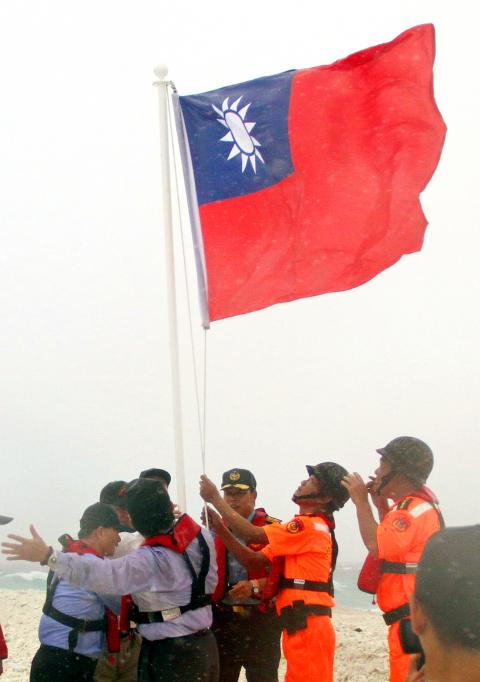
Photo: AFP
In addition to extending President Ma Ying-jeou’s (馬英九) concern for coast guard, navy and air force officers stationed on Taiping Island, the group of officials also landed on Chungchou Reef located 3.1 nautical miles (5.7km) east of Taiping Island, where they hoisted a Republic of China flag, the NSC said in a press statement.
The flag-raising ceremony signified the government’s determination to defend its sovereignty over the region, the statement said.
Hu was quoted as having reaffirmed at the occasion that Taiwan’s sovereignty is indisputable, but that disputes can be solved as long as all claimants work together peacefully to explore resources for mutual benefit.
He also urged all neighboring countries to respond to Ma’s East China Sea peace initiative by putting aside territorial disputes, replacing confrontation with dialogue, settling spats through communications and jointly prospecting for South China Sea resources to make the ocean peaceful and prosperous.
Taiwan has set up a hospital on Taiping Island so it can provide emergency medical treatment, Hu said, adding that Taiwan can serve as the region’s provider of “humanitarian aid.”
Taiwan has opened a solar power facility on Taiping Island to help cut carbon emissions and fulfill its international duty of working to combat global warming, he added.
Most important, Hu said, Taiwan is more than willing to share its decades-long experience in managing the Spratly’s largest islet and partner with neighboring countries to protect freedom of navigation and promote maritime ecological conservation in the area.
The South China Sea and its archipelagos, thought to be rich in oil deposits and marine biodiversity, are claimed either entirely or in part by Taiwan, China, Vietnam, the Philippines, Malaysia and Brunei.
Covering an area of 0.49km2, Taiping Island lies about 1,600 km southwest of Kaohsiung in southern Taiwan.
On Aug. 20, the Ministry of Foreign Affairs said Taiwan had informed its regional neighbors that it planned to conduct a live-fire training exercise on Taiping Island set to begin yesterday and run until the 5th of the month.
“The countries were informed so they will be able to warn their ships to avoid the waters near Taiping Island during the routine exercise,” ministry spokesman Steve Hsia (夏季昌) said.
In an effort to beef up regional defenses, the Ministry of National Defense delivered a shipment of 40-mm anti-aircraft guns and 120-mm mortars to Taiping Island early last month.

The military has spotted two Chinese warships operating in waters near Penghu County in the Taiwan Strait and sent its own naval and air forces to monitor the vessels, the Ministry of National Defense (MND) said. Beijing sends warships and warplanes into the waters and skies around Taiwan on an almost daily basis, drawing condemnation from Taipei. While the ministry offers daily updates on the locations of Chinese military aircraft, it only rarely gives details of where Chinese warships are operating, generally only when it detects aircraft carriers, as happened last week. A Chinese destroyer and a frigate entered waters to the southwest
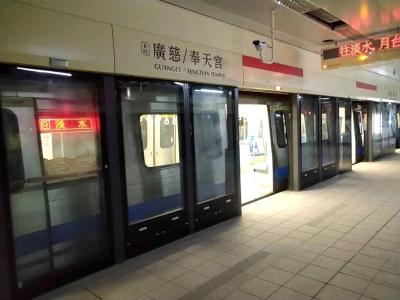
The eastern extension of the Taipei MRT Red Line could begin operations as early as late June, the Taipei Department of Rapid Transit Systems said yesterday. Taipei Rapid Transit Corp said it is considering offering one month of free rides on the new section to mark its opening. Construction progress on the 1.4km extension, which is to run from the current terminal Xiangshan Station to a new eastern terminal, Guangci/Fengtian Temple Station, was 90.6 percent complete by the end of last month, the department said in a report to the Taipei City Council's Transportation Committee. While construction began in October 2016 with an
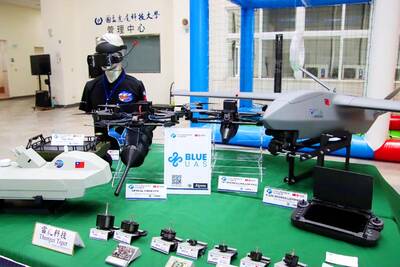
NON-RED SUPPLY: Boosting the nation’s drone industry is becoming increasingly urgent as China’s UAV dominance could become an issue in a crisis, an analyst said Taiwan’s drone exports to Europe grew 41.7-fold from 2024 to last year, with demand from Ukraine’s fight against Russian aggression the most likely driver of growth, a study showed. The Institute for Democracy, Society and Emerging Technology (DSET) in a statement on Wednesday said it found that many of Taiwan’s uncrewed aerial vehicle (UAV) sales were from Poland and the Czech Republic. These countries likely transferred the drones to Ukraine to aid it in its fight against the Russian invasion that started in 2022, it said. Despite the gains, Taiwan is not the dominant drone exporter to these markets, ranking second and fourth

Japanese Prime Minister Sanae Takaichi’s comment last year on Tokyo’s potential reaction to a Taiwan-China conflict has forced Beijing to rewrite its invasion plans, a retired Japanese general said. Takaichi told the Diet on Nov. 7 last year that a Chinese naval blockade or military attack on Taiwan could constitute a “survival-threatening situation” for Japan, potentially allowing Tokyo to exercise its right to collective self-defense. Former Japan Ground Self-Defense Force general Kiyofumi Ogawa said in a recent speech that the remark has been interpreted as meaning Japan could intervene in the early stages of a Taiwan Strait conflict, undermining China’s previous assumptions


 RSS
RSS