


Before there were trendy toys such as Barbie dolls or games consoles, whipping tops were among the most popular toys in Taiwan. While few youngsters play with the twirling devices nowadays, a Taiwanese craftsman from Taoyuan County’s Dasi Township (大溪) keeps the traditional craft alive.
Yang Chin-fu (楊金福), 73, is among a small number of craftsmen in Taiwan who still handcrafts wooden spinning tops. He has run a small business producing these tops for nearly 30 years.
Centuries ago, many carpenters in Dasi taught their children how to make whipping tops — this is how the craft was kept alive in the township in northern Taiwan.
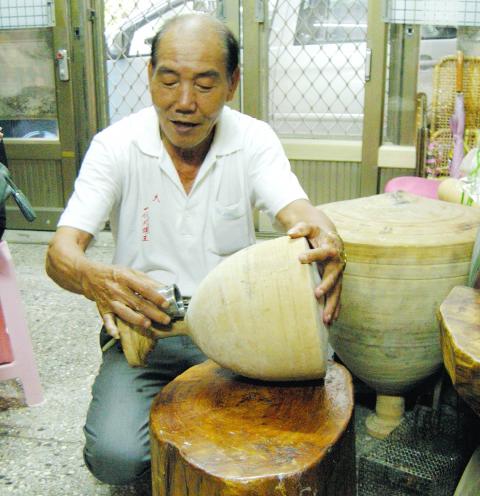
Photo: CNA
Unlike many other places in Taiwan, residents in Dasi have continued to play with these toys. The preservation of “an old-town atmosphere in Dasi” makes it possible for the residents to maintain the centuries-old activity, local culture historian Huang Chien-yi (黃建義) said.
Unlike in Japan, where spinning tops are made from wood and iron, Taiwanese craftsmen produce tops made solely of wood, according to experts.
As a child, Yang carved small chunks of wood into whipping tops to play with. Later he became a taxi driver, but still made tops as a side job.
Yang said he is a self-taught spinning top carver. Over the years, he has made tops in a variety of sizes, ranging from tops as small as a fist, to large ones which weigh up to 70kg.
“It’s an interesting craft,” Yang said, adding he has obtained a sense of achievement from people recognizing the quality of his products.
At the age of 45, he turned his hobby into a side business.
Yang, also a master of spinning the tops, said he was encouraged to begin the business by friends who would gather to play with the ones he had made.
“They said the tops I made were quite good to play with,” Yang added.
The key to making a whipping top, Yang said, is to first find the central point of each piece of wood. This is to ensure the balance of the top so that it will spin steadily, he said.
Yang can produce tops with diameters ranging from 10cm to 60cm.
It is difficult to make tops from big chunks of wood and create a beautiful shape, according to Huang.
“However, Yang can do it,” said Huang, who has also been playing with whipping tops since his childhood.
He said the craftsman has played an integral part in “preserving the art of making spinning tops.”
Yang’s works can be found in some stores on the old street in Dasi, a tourist attraction famed for its Baroque-style architecture dating from when Taiwan was a Japanese colony from 1895 to 1945.
The old street is where local residents gather to play with the tops, Huang said.
Meanwhile, Yang’s products have been distributed around Taiwan, with some exported to Japan and the US.
His customers range from university students in southern Taiwan to schools in Dasi. For example, Mei-Hwa Elementary School has bought a number of tops to teach students how use these toys, as part of efforts to preserve local folk culture.
About five years ago, a Japanese television crew traveled to Dasi to visit Yang.
Besides making whipping tops for the Japanese team, Yang, who can also spin tops in various sizes, said he taught them how to use the toys.
Neither a whipping top smaller than a thumb nor a top weighing more than 40kg is too hard for Yang to spin.
However, orders for whipping tops have decreased in recent years. Sometimes Yang has to wait a couple of months to get an order, he said.
However, his passion for the traditional handcraft has not been dampened.
“When I receive an order, I will do it,” Yang said.
The craftsman also expressed regret over the fact that very few Taiwanese children play with spinning tops nowadays. They go for computer games instead, he added.
“I’ve encouraged children in Dasi to play with spinning tops,” Yang said. “Some have listened to my words.”

NATIONAL SECURITY: Authorities are working to confirm the identities of the military personnel involved and investigating possible illegal conduct and regulatory violations Authorities are probing possible national security implications after Kinmen police and immigration officers on Sunday found a Chinese woman allegedly posing as a tourist while engaging in prostitution involving more than 10 military personnel. The woman, surnamed Chen (陳), has since been deported, authorities said, adding that investigators are still working to confirm the identities of those implicated, as the records only listed code names and aliases. The case stemmed from a report received by the Kinmen District Prosecutors’ Office on Friday last week from the Jinhu Precinct of the Kinmen County Police Bureau. On Sunday, police, along with the National Immigration

GLOBALGIVING: ‘ Caving to external pressure is not acceptable for an organization that has cultivated justice reform and human rights for 30 years,’ one NGO said A slew of non-government organizations (NGOs) have withdrawn from the GlobalGiving fundraising platform after it announced it would use “Chinese Taipei” instead of “Taiwan” from next month. The Taiwan Good Rice Association wrote on Facebook on Friday that it was informed on April 28 via a teleconference call of the change, which was made because the platform wanted to operate in China. Taiwan Good Rice is to terminate all cooperative relationships with GlobalGiving in response to the platform’s “unilateral and non-negotiable” decision to remove references to Taiwan, the NGO said. “Taiwan is in the official name of Taiwan Good Rice Association and the

HEAVY WEATHER: Typhoon Jangmi is due to crash straight into the Ryukyus as airlines look to shift flights to larger aircraft or cancel flights to Okinawa entirely Taiwan’s international air carriers announced flight adjustments over the weekend as Typhoon Jangmi is forecast to hit the Ryukyu Islands today and tomorrow. The Central Weather Administration (CWA) upgraded Jangmi from a tropical storm to a typhoon at 8am yesterday, with the eye located 580km south of Naha city. It was moving north at 19kph. Today, China Airlines’ CI-120, CI-121, CI-122 and CI-123 flights between Taoyuan and Naha, Okinawa, have been canceled as well as CI-132 and CI-133 between Kaohsiung and Naha. EVA Air’s BR-112, BR-113, BR-186 and BR-185 flights between Taoyuan and Naha are also canceled. Low-cost carrier Tigerair Taiwan canceled IT-230,

MULTIPRONGED APPROACH: China has sought to pressure Palau across a number of fronts, but the island nation has staunchly resisted overtures to ditch Taiwan Palau has been firm in backing Taiwan despite Chinese pressure that uses tourism economics, cyberattacks and criminal infiltration as tools to threaten the Pacific ally into renouncing its recognition of Taiwan as a sovereign state. The Presidential Office yesterday announced that Vice President Hsiao Bi-khim (蕭美琴) would visit Palau from Saturday to Wednesday next week at the invitation of Palauan President Surangel Whipps Jr. Whipps in April said in an interview that China had outspokenly asked Palau to “denounce Taiwan.” “And we have said: ‘We have no enemies, but nobody tells us who our friends are,’” he said. Whipps has told reporters multiple times


 RSS
RSS