


Taiwanese activists were yesterday forced to cancel the plan they initiated with Hong Kong activists to assert Chinese ownership over the disputed Diaoyutai Islands (釣魚台), allegedly due to government intervention.
Chinese Association for Protecting the Diaoyutais chairman Hsieh Mang-lin (謝夢麟) called off the plan at 2:10pm after failing to rent the Ta-fa 268, a recreational fishing boat, from Yu Kuo-chao (游國照), the Coast Guard Administration said.
Yin Pi-hsiung (殷必雄), a member of the association, lashed out at the government, which he said thwarted their plan.
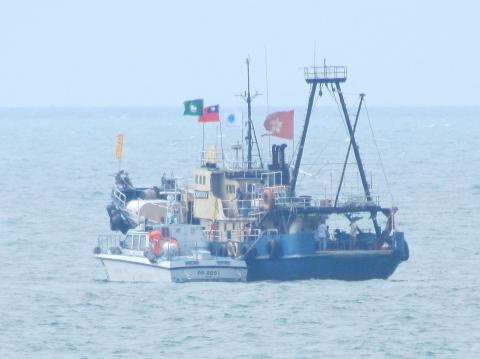
Photo: CNA
At about 1pm, Yin and some other activists were busy loading food supplies onboard the Ta-fa 268 at Gengfang Fishing Harbor in Toucheng Township (頭城), Yilan County, to prepare for departure as planned to rendezvous with the Chinese activists near Pengjia Islet (彭佳嶼) off Taiwan’s northernmost tip.
With the ship flying the association’s flag and the national flag of the Republic of China, Yin was furious when Yu told him that the flags had to be taken down.
Yin claimed that Yu reneged on the deal to rent out the boat after coming under pressure from the government.
The plan was for Yu to take the activists to Pengjia Islet to provide the Chinese activists with food supplies after he declined to sail the vessel to the Diaoyutais, as the activists had initially requested.
Yin said they had been repeatedly turned down by boat owners before they did the deal with Yu.
Coast Guard Administration Deputy Director-General Wang Chung-yi (王崇儀) said Yin’s allegation were “groundless,” adding that Yu made the decision to cancel the trip of his own accord.
Wang said the administration had denied requests by the Chinese activists for their ship, the Bao Diao II, to make anchor in Makung Harbor, in Penghu County, and Taichung Harbor, Greater Taichung, “to avoid the perception” that Taiwan was teaming up with China to defend the sovereignty of the Diaoyutais.
The Hong Kong activists, led by Hong Kong-based Action Committee for Defending the Diaoyu Islands chairman Chan Miu Tak (陳妙德), four crewmembers and two journalists from Phoenix Hong Kong Channel were on a ship flying the Chinese national flag.
Wang said the denial of their requests to replenish their food supplies was in accordance with Article 24 of the Act Governing Relations with Hong Kong and Macau (香港澳門條例), because had permission been granted, it could have endangered national security and caused a disturbance in the public order.
The activists had planned the action in response to a plan by 50 Japanese lawmakers to visit the Diaoyutais on Sunday. Media reports on Monday said the Japanese government put a stop to the visit.
Meanwhile, in response to the activists move to defend the sovereignty of the Diaoyutais, Presidential Office spokesman Fan Chiang Tai-chi (范姜泰基) yesterday said President Ma Ying-jeou (馬英九) said last month that the government would not relinquish the Republic of China’s sovereignty of the islands.
“President Ma has been defending the nation’s sovereignty over the Diaoyutais since taking office and no one should doubt the government’s determination. The government will declare our sovereignty over the Diaoyutais in a feasible and effective way,” he said.
Additional reporting by Mo Yan-chih

SECURITY: Starlink owner Elon Musk has taken pro-Beijing positions, and allowing pro-China companies to control Taiwan’s critical infrastructure is risky, a legislator said Starlink was reluctant to offer services in Taiwan because of the nation’s extremely high penetration rates in 4G and 5G services, the Ministry of Digital Affairs said yesterday. The ministry made the comments at a meeting of the legislature’s Transportation Committee, which reviewed amendments to Article 36 of the Telecommunications Management Act (電信管理法). Article 36 bans foreigners from holding more than 49 percent of shares in public telecommunications networks, while shares foreigners directly and indirectly hold are also capped at 60 percent of the total, unless specified otherwise by law. The amendments, sponsored by Chinese Nationalist Party (KMT) Legislator Ko

The eastern extension of the Taipei MRT Red Line could begin operations as early as late June, the Taipei Department of Rapid Transit Systems said yesterday. Taipei Rapid Transit Corp said it is considering offering one month of free rides on the new section to mark its opening. Construction progress on the 1.4km extension, which is to run from the current terminal Xiangshan Station to a new eastern terminal, Guangci/Fengtian Temple Station, was 90.6 percent complete by the end of last month, the department said in a report to the Taipei City Council's Transportation Committee. While construction began in October 2016 with an

NON-RED SUPPLY: Boosting the nation’s drone industry is becoming increasingly urgent as China’s UAV dominance could become an issue in a crisis, an analyst said Taiwan’s drone exports to Europe grew 41.7-fold from 2024 to last year, with demand from Ukraine’s fight against Russian aggression the most likely driver of growth, a study showed. The Institute for Democracy, Society and Emerging Technology (DSET) in a statement on Wednesday said it found that many of Taiwan’s uncrewed aerial vehicle (UAV) sales were from Poland and the Czech Republic. These countries likely transferred the drones to Ukraine to aid it in its fight against the Russian invasion that started in 2022, it said. Despite the gains, Taiwan is not the dominant drone exporter to these markets, ranking second and fourth
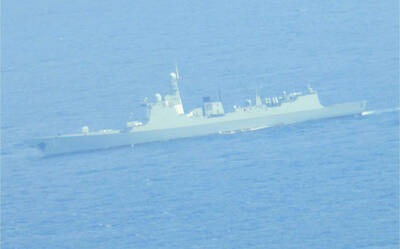
The military has spotted two Chinese warships operating in waters near Penghu County in the Taiwan Strait and sent its own naval and air forces to monitor the vessels, the Ministry of National Defense (MND) said. Beijing sends warships and warplanes into the waters and skies around Taiwan on an almost daily basis, drawing condemnation from Taipei. While the ministry offers daily updates on the locations of Chinese military aircraft, it only rarely gives details of where Chinese warships are operating, generally only when it detects aircraft carriers, as happened last week. A Chinese destroyer and a frigate entered waters to the southwest


 RSS
RSS