


The National Food Safety Association yesterday reaffirmed its opposition to relaxing a ban on imports of meat with residue of the leanness-enhancing livestock feed additive ractopamine.
“Toxic beef is unstoppable, the government is unreliable, the people are on their own to say no to toxic beef” the civic groups called out at the legislature, two days before the start of the extra legislative session to vote on an amendment to the Act Governing Food Sanitation (食品衛生管理法).
Taipei City Wenshan Community College president Cheng Hsiu-chuan (鄭秀娟) said the association remains concerned about the negative health effects from eating meat containing ractopamine residue.
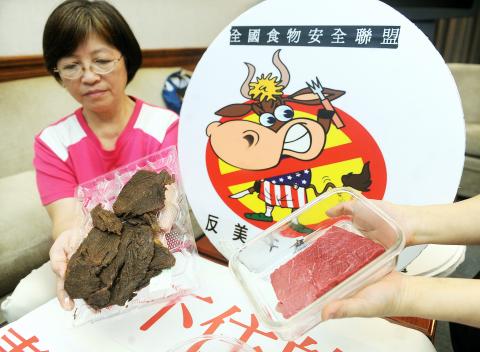
Photo: Liao Chen-huei, Taipei Times
“We disagree with the government’s decision to sacrifice public health, giving in to diplomatic tussles and political negotiations and we don’t believe in the 16-character guideline guaranteed by the government, because there have already been many cases of meat found with ractopamine residue even when it was banned by law,” she said.
Homemakers’ United Foundation secretary-general Lu Mei-luan (呂美鸞) said the adoption of maximum residue levels for ractopamine in beef and pork, made at the Codex Alimentarius Commission’s annual session earlier this month, has caused several legislators to give up their previous opposition, but the public’s concerns are still unanswered.
“We hope mothers can feel safe about the beef they buy from markets, knowing that it is healthy meat,” Lu said, pointing to two pieces of raw beef and a plate of dried beef, explaining that consumers would have no idea how much ractopamine residue is in beef products.
The National Association for the Promotion of Community Universities secretary-general Kao Ju-ping (高茹萍) said that although the commission decided this year to set maximum ractopamine residue levels, many countries which ban the use of ractopamine in meat were standing firm behind their strict regulations.
“If our government’s decision to lift the ban is made for economic and international trade considerations, it should at least tell people the truth, instead of having government agencies promise that the meat is safe,” Citizen Congress Watch executive director Chang Hung-lin (張宏林) said. “Don’t mislead people into thinking that its perfectly safe to eat meat with ractopamine residue.”
Hsu Li-min (許立民), a doctor at National Taiwan University Hospital, said the close result of the vote at the Codex Alimentarius Commission’s session indicated that the health risks of consuming meat with ractopamine residue are still debated around the world.
“It is a pity that the government cannot give reasonable answers to the reasonable concerns and questions brought up by civic groups,” Hsu said, urging people with chronic diseases or children under 36 months, who are more vulnerable to possible health risks, to minimize their beef intake.
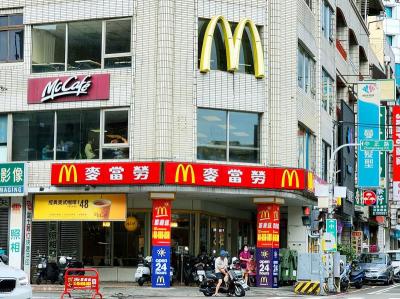
Fast food chain McDonald's is to raise prices by up to NT$5 on some products at its restaurants across Taiwan, starting on Wednesday next week, the company announced today. The prices of all extra value meals and sharing boxes are to increase by NT$5, while breakfast combos and creamy corn soup would go up by NT$3, the company said in a statement. The price of the main items of those meals, if ordered individually, would remain the same. Meanwhile, the price of a medium-sized lemon iced tea and hot cappuccino would rise by NT$3, extra dipping sauces for chicken nuggets would go up

Nvidia Corp CEO Jensen Huang (黃仁勳) arrived in Taiwan yesterday ahead of upcoming AI and technology events, saying he plans to meet with clients and Taiwan Semiconductor Manufacturing Co Chairman C.C. Wei (魏哲家) during his visit. After landing at Taipei Songshan Airport, Huang posed for photos with fans and handed out Yakult drinks to reporters and supporters waiting at the scene, saying he has “a lot to do” during the trip. Asked about reports that Nvidia’s planned headquarters site in Taipei’s Beitou Shilin Technology Park could break ground on May 27, Huang said that if the company holds an event, he would

Carrefour Taiwan is to begin using a new name from the start of July, but it cannot divulge the name until then, the chairman of the supermarket chain's parent company said today. President Chain Store Co chairman Lo Chih-hsien (羅智先) was asked by reporters after a shareholders' meeting to confirm whether the company has settled on a new name for the supermarket brand. In March, the government-registered name of two Carrefour Taiwan branches was quietly changed to "Le Chia Kang" (樂家康) in Chinese, raising speculation that has been selected as the name. Lo said that because of local regulations and contractual obligations, the

FUKUOKA SITUATION: Japanese media reported that the pathogen is expected to be identified by the summer, while the CDC downplayed the idea that it was hMPV A “mysterious cold-like illness” reported in Japan’s Fukuoka Prefecture does not seem to be a new disease, but Japanese authorities have been asked about the situation, the Centers for Disease Control (CDC) said yesterday. The Fukuoka Prefectural Medical Association on Wednesday told a news conference that a “mystery cold” that has become a hot topic on social media is “highly likely to be caused by some kind of viral infection,” Japan’s KBC News reported. “Many people are experiencing symptoms starting with a sore throat, followed by a runny nose, phlegm and a severe cough,” KBC News reported, citing association officials. Health authorities are


 RSS
RSS