


While the majority of teenagers know to respect the “body boundaries” of others, it is worrisome that one out of five would have sex when there is mutual consent, according to a recent survey by the Taiwan Fund for Children and Families (TFCF), which has urged teenagers to avoid having sex in their youth.
The survey into the behavior of youngsters aged 12 to 18 showed 93 percent agreed that “body boundaries” are important and there should not be inappropriate body contact even with one’s girlfriend or boyfriend.
The nationwide survey, released on Thursday, also found that one in five respondents think “as long as there is mutual consent, or when invited, having sex is allowed.”
Meanwhile, 40 percent of the respondents said they were unaware that having sex with people under the age of 14 could result in criminal prosecution, while sex with those aged between 14 and 16 could result in lawsuits.
TFCF deputy executive director Ho Su-chun (何素春) said the results were worrying.
“Apparently, a lot of teenagers are unaware that they could face sexual assault charges if they had sex with people under 16 even when both have consented to having sex,” she added. “Teen pregnancy is also a serious social problem.”
To solve such issues, Ho said, the “correct concepts about sex” should be taught.
“We urge the public to pay more attention to issues related to teenage relationships,” she said. “We should start from establishing correct concepts about sex, teach our children to stop others from violating their bodies, learn to respect those whom they love and not to violate their bodies, so that there wouldn’t be regrettable consequences.”
The group also released a list of “three don’ts” for teenagers, including: “don’t have sex, don’t browse porn Web sites and don’t violate other people’s bodies even with one’s girlfriend or boyfriend.”
Josephine Ho (何春蕤), head of National Central University’s Center for the Study of Sexualities, disagreed with the TFCF and accused the group of promoting the idea of “repression under the disguise of protection.”
“A high percentage of students knowing about respecting others’ ‘body boundaries’ and the fact that a high percentage of students have sex in their teenage years is not contradictory,” she said. “If they know how to respect other people’s ‘body boundaries,’ why can’t they have sex when there’s mutual consent?”
She said it is natural for those attracted to one another to have sexual desires, but that the ideas promoted by the TFCF seek to extinguish those through repression and guilt.

More than half of the bamboo vipers captured in Tainan in the past few years were found in the city’s Sinhua District (新化), while other districts had smaller catches or none at all. Every year, Tainan captures about 6,000 snakes which have made their way into people’s homes. Of the six major venomous snakes in Taiwan, the cobra, the many-banded krait, the brown-spotted pit viper and the bamboo viper are the most frequently captured. The high concentration of bamboo vipers captured in Sinhua District is puzzling. Tainan Agriculture Bureau Forestry and Nature Conservation Division head Chu Chien-ming (朱健明) earlier this week said that the
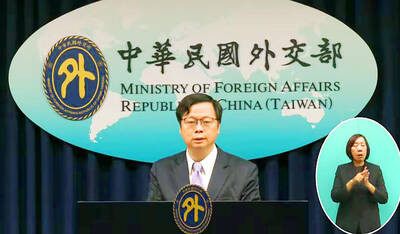
NAMING SPAT: The foreign ministry called on Denmark to propose an acceptable solution to the erroneous nationality used for Taiwanese on residence permits Taiwan has revoked some privileges for Danish diplomatic staff over a Danish permit that lists “Taiwan” as “China,” Eric Huang (黃鈞耀), head of the Ministry of Foreign Affairs’ Department of European Affairs, told a news conference in Taipei yesterday. Reporters asked Huang whether the Danish government had responded to the ministry’s request that it correct the nationality on Danish residence permits of Taiwanese, which has been listed as “China” since 2024. Taiwan’s representative office in Denmark continues to communicate with the Danish government, and the ministry has revoked some privileges previously granted to Danish representatives in Taiwan and would continue to review
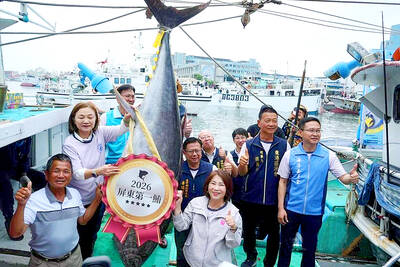
The first bluefin tuna of the season, brought to shore in Pingtung County and weighing 190kg, was yesterday auctioned for NT$10,600 (US$333.5) per kilogram, setting a record high for the local market. The auction was held at the fish market in Donggang Fishing Harbor, where the Siaoliouciou Island-registered fishing vessel Fu Yu Ching No. 2 delivered the “Pingtung First Tuna” it had caught for bidding. Bidding was intense, and the tuna was ultimately jointly purchased by a local restaurant and a local company for NT$10,600 per kilogram — NT$300 ,more than last year — for a total of NT$2.014 million. The 67-year-old skipper
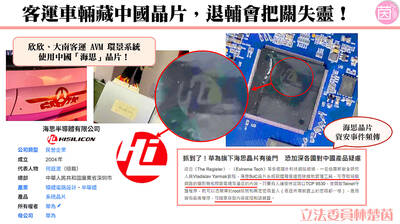
BREACH OF CONTRACT: The bus operators would seek compensation and have demanded that the manufacturer replace the chips with ones that meet regulations Two bus operators found to be using buses with China-made chips are to demand that the original manufacturers replace the systems and provide compensation for breach of contract, the Veterans Affairs Council said yesterday. Democratic Progressive Party Legislator Michelle Lin (林楚茵) yesterday said that Da Nan Bus Co and Shin-Shin Bus Co Ltd have fielded a total of 82 buses that are using Chinese chips. The bus models were made by Tron-E, while the systems provider was CYE Electronics, Lin said. Lin alleged that the buses were using chips manufactured by Huawei subsidiary HiSilicon Co, which presents a national security risk if the


 RSS
RSS