


A coffee shop, hidden down an alleyway off Taishun Street in Taipei’s Da-an District (大安), has been transformed into a shelter for dozens of street cats while also serving as an unofficial headquarters for cat-lovers in the capital. The conversion is all thanks to the compassion of store-keeper, Wu Hsin-ju (吳欣儒).
The Minimal Cafe, which is now home to several felines, is located within Shida Night Market and it is here that patrons can encounter cats of all colors as they laze around the cozy store. While some doze off on the wooden floor others lie against bookshelves and yet more sit above the bar counter gracefully licking their paws.
None of the moggies resting inside the coffee house seem that bothered by the curious glances or presence of the coffee-shop customers — some of the furry creatures even take the liberty of occupying customers’ seats when they get the chance. People who see their tables being “taken over” often opt to simply switch seats rather than shooing away the animals — which are, after all, the chosen ones in this so-called “paradise for cats.”
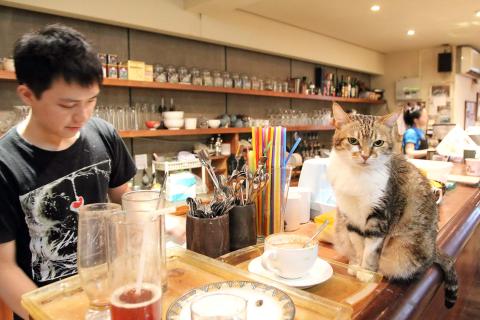
Photo: Weng Yu-huang, Taipei Times
The themed coffee store is not only a draw for Taiwanese ailurophiles, but has even attracted cat-lovers from Japan, some of whom follow the complex instructions in travel magazines to accurately pinpoint the shop’s cryptic location.
Many of the unique cafe’s customers spend an entire afternoon sipping a cup of rich coffee and taking group pictures with their feline neighbors, while gently teasing them before leaving the store seemingly content having spent so much time in cat company.
Shop owner Wu said her coffee store, set up 12 years ago, initially failed to make a profit because of its obscure alleyway location.
“However, the shop was later turned into a ‘halfway house’ for stray cats, because I could not bear the sight of them roaming the streets,” Wu said.
Aside from offering stray animals a warm place to stay, Wu has also helped them pair up with other cat-lovers over the past few years in an effort to find them permanent homes.
“The place used to accommodate as many as 40 cats. Some of them, particularly the younger ones, have been adopted by benevolent pet owners. The 30 older cats now seen in the store are those that have been left behind,” Wu said.
Minimal Cafe store manager Kuo Pei-yun (郭沛芸) said each of the many cats which call the coffee store home has its own name and own group of “loyal fans.”
“Among them the most well-liked is a black-and-white cat nicknamed An-an (安安), while a once-deserted Himalayan cat dubbed A-hsi (阿喜) recently passed away, which saddened many of its fans,” Kuo said.
Seeing the coffeehouse turned into a paradise for cats was something beyond their expectations, Kuo said, who urged pet owners not to get a pet on impulse.
Breeders must shoulder the responsibilities for the living conditions of animals.
“Pets are heart-broken when they are abandoned,” she said.
Translated by Stacy Hsu, staff writer

NATIONAL SECURITY: Authorities are working to confirm the identities of the military personnel involved and investigating possible illegal conduct and regulatory violations Authorities are probing possible national security implications after Kinmen police and immigration officers on Sunday found a Chinese woman allegedly posing as a tourist while engaging in prostitution involving more than 10 military personnel. The woman, surnamed Chen (陳), has since been deported, authorities said, adding that investigators are still working to confirm the identities of those implicated, as the records only listed code names and aliases. The case stemmed from a report received by the Kinmen District Prosecutors’ Office on Friday last week from the Jinhu Precinct of the Kinmen County Police Bureau. On Sunday, police, along with the National Immigration

GLOBALGIVING: ‘ Caving to external pressure is not acceptable for an organization that has cultivated justice reform and human rights for 30 years,’ one NGO said A slew of non-government organizations (NGOs) have withdrawn from the GlobalGiving fundraising platform after it announced it would use “Chinese Taipei” instead of “Taiwan” from next month. The Taiwan Good Rice Association wrote on Facebook on Friday that it was informed on April 28 via a teleconference call of the change, which was made because the platform wanted to operate in China. Taiwan Good Rice is to terminate all cooperative relationships with GlobalGiving in response to the platform’s “unilateral and non-negotiable” decision to remove references to Taiwan, the NGO said. “Taiwan is in the official name of Taiwan Good Rice Association and the

HEAVY WEATHER: Typhoon Jangmi is due to crash straight into the Ryukyus as airlines look to shift flights to larger aircraft or cancel flights to Okinawa entirely Taiwan’s international air carriers announced flight adjustments over the weekend as Typhoon Jangmi is forecast to hit the Ryukyu Islands today and tomorrow. The Central Weather Administration (CWA) upgraded Jangmi from a tropical storm to a typhoon at 8am yesterday, with the eye located 580km south of Naha city. It was moving north at 19kph. Today, China Airlines’ CI-120, CI-121, CI-122 and CI-123 flights between Taoyuan and Naha, Okinawa, have been canceled as well as CI-132 and CI-133 between Kaohsiung and Naha. EVA Air’s BR-112, BR-113, BR-186 and BR-185 flights between Taoyuan and Naha are also canceled. Low-cost carrier Tigerair Taiwan canceled IT-230,

MULTIPRONGED APPROACH: China has sought to pressure Palau across a number of fronts, but the island nation has staunchly resisted overtures to ditch Taiwan Palau has been firm in backing Taiwan despite Chinese pressure that uses tourism economics, cyberattacks and criminal infiltration as tools to threaten the Pacific ally into renouncing its recognition of Taiwan as a sovereign state. The Presidential Office yesterday announced that Vice President Hsiao Bi-khim (蕭美琴) would visit Palau from Saturday to Wednesday next week at the invitation of Palauan President Surangel Whipps Jr. Whipps in April said in an interview that China had outspokenly asked Palau to “denounce Taiwan.” “And we have said: ‘We have no enemies, but nobody tells us who our friends are,’” he said. Whipps has told reporters multiple times


 RSS
RSS