


Halfway up the Rugu Mountain (乳姑山) in Taoyuan County lies a temple that serves as a shrine for a boulder known as Shihtou Gung (石頭公) that has been worshiped by the residents of Lingyun Village (凌雲) for more than a century.
Hsu Jung-chun (徐榮俊), the secretary-general of Longtan Township (龍潭), said the township had conducted a Hakka cultural survey last year and discovered the origins and evolution of the temple.
Hsu added that the township had made a detailed history of the temple so that the townspeople’s descendants would be able to understand their past.
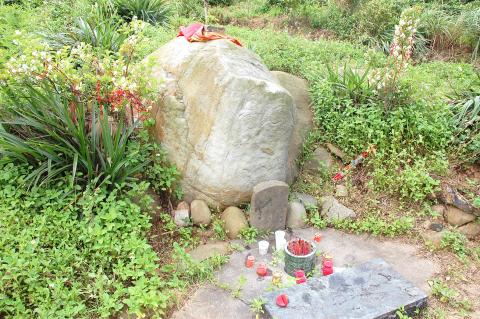
Photo: Shen Chi-chang, Taipei Times
The boulder weighs 5 tonnes and is located on an old path behind a tea field near the village.
Residents said that 100 years ago the path had been an important roadway from Hsinchu County’s Sinpu Township (新埔) and Cyonglin Township (芎林) to Longtan.
Originally the path was just made from pieces of rock stacked up on one another, but later on it was develpoed into a proper road.
The Hakka cultural survey last year showed that in 1839, ethnic Han people were settling in what is now Lingyun when Aborigines attacked them, Hsu said.
With nowhere else to hide, the Han people hid underneath the boulder and when the Aborigines were unable to find them, they hacked at the stone with their blades to vent their frustration and were scared off when the boulder began to bleed, Hsu said.
The Han people who witnessed the event attributed the bleeding to a miracle and after the news spread, all villagers wanted to worship the boulder, Hsu said.
The survey also found that during the Xianfeng (咸豐) era (1851-1861) in the Qing dynasty, a man wrote on the boulder the words wei wei zu cih tong ling (巍巍卒慈同靈), meaning the boulder would protect everyone, and set April 8 and Aug. 15 of the Lunar calendar as days to worship the boulder.
Wen Kuang-hsiu (溫光秀), an elder, said worshiping the boulder was the ancestors’ way of worshiping nature, adding that local beliefs usually placed the Shihtou Gung as the guardian deity of children.
When children cry at night parents usually take them in front of the boulder to pray, Wen said.
Parents also tie a coin, hollowed out in the middle, with a piece of red string to the child’s hand while asking for the Shihtou Gung’s protection, and after passing the coin above incense the parents hang the coin around the child’s neck.
This is said to make the child easier to raise, and parents only take the coin off when the child turns 18.
The boulder is known for its effectiveness at granting prayers and it is also considered the guardian deity of the village, Wen said.
Translated by Jake Chung, staff writer
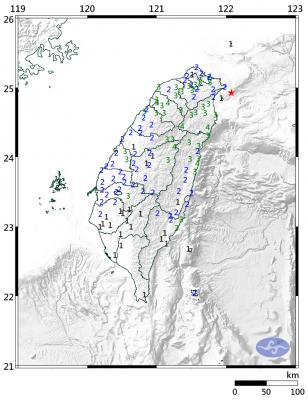
A magnitude 6.1 earthquake struck off the coast of Yilan County at 8:39pm tonight, the Central Weather Administration (CWA) said, with no immediate reports of damage or injuries. The epicenter was 38.7km east-northeast of Yilan County Hall at a focal depth of 98.3km, the CWA’s Seismological Center said. The quake’s maximum intensity, which gauges the actual physical effect of a seismic event, was a level 4 on Taiwan’s 7-tier intensity scale, the center said. That intensity level was recorded in Yilan County’s Nanao Township (南澳), Hsinchu County’s Guansi Township (關西), Nantou County’s Hehuanshan (合歡山) and Hualien County’s Yanliao (鹽寮). An intensity of 3 was
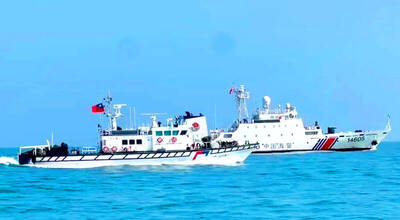
Instead of focusing solely on the threat of a full-scale military invasion, the US and its allies must prepare for a potential Chinese “quarantine” of Taiwan enforced through customs inspections, Stanford University Hoover fellow Eyck Freymann said in a Foreign Affairs article published on Wednesday. China could use various “gray zone” tactics in “reconfiguring the regional and ultimately the global economic order without a war,” said Freymann, who is also a nonresident research fellow at the US Naval War College. China might seize control of Taiwan’s links to the outside world by requiring all flights and ships entering or leaving Taiwan
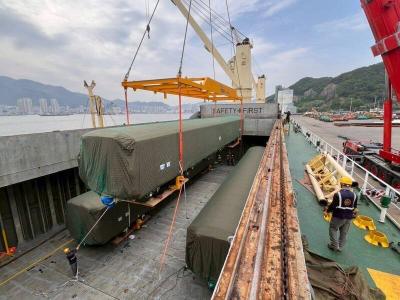
The first of 10 new high-capacity trains purchased from South Korea’s Hyundai Rotem arrived at the Port of Taipei yesterday to meet the demands of an expanding metro network, Taipei Rapid Transit Corp (TRTC) said yesterday. The train completed a three-day, 1,200km voyage from the Port of Masan in South Korea, the company said. Costing NT$590 million (US$18.79 million) each, the new six-carriage trains feature a redesigned interior based on "human-centric" transportation concepts, TRTC said. The design utilizes continuous longitudinal seating to widen the aisles and optimize passenger flow, while also upgrading passenger information displays and driving control systems for a more comfortable
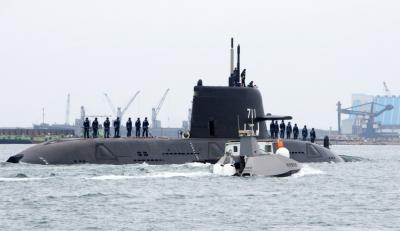
Taiwan's first indigenous defense submarine, the SS-711 Hai Kun (海鯤, or Narwhal), departed for its 13th sea trial at 7am today, marking its seventh submerged test, with delivery to the navy scheduled for July. The outing also marked its first sea deployment since President William Lai (賴清德) boarded the submarine for an inspection on March 19, drawing a crowd of military enthusiasts who gathered to show support. The submarine this morning departed port accompanied by CSBC Corp’s Endeavor Manta (奮進魔鬼魚號) uncrewed surface vessel and a navy M109 assault boat. Amid public interest in key milestones such as torpedo-launching operations and overnight submerged trials,


 RSS
RSS