


The Taiwan High Court was yesterday rebuffed by the legislature over a request to view legislative footage the court says it needs for an investigation into an alleged bribery case involving eight former lawmakers across party lines.
Legislative Speaker Wang Jin-pyng (王金平) said the Taiwan High Court should review the Gazette for information rather than asking the legislature to provide footage.
“Official records of all proceedings are in the Gazette,” he said.
The high court recently sent a letter to the legislature, in which it asked the lawmakers to provide it with legislative footage of two meetings held in 1997 at which the Pharmaceutical Affairs Act (藥事法) was deliberated.
The legislature’s rules for the lending of video footage and audio recordings of proceedings is that the materials cannot leave the legislature without legislative consent, which in turn warrants a review of the request.
At yesterday’s legislative session, lawmakers deferred a discussion of the request to a later date, based on a Democratic Progressive Party (DPP) proposal, which it said was in accordance with established practice.
This was the first time a legislative session dealt with such a request because the legislature’s Procedural Committee has never previously placed similar requests on the agenda.
“This occurred because any decision needs to take into account how granting the request might affect the autonomy of the legislature” Wang said, adding that he would hold a meeting of all parties involved to discuss the matter.
In 2010, the Taiwan High Court found the eight former lawmakers guilty of accepting bribes from the National Chinese Herbal Apothecary Association in 1998, in return for their endorsement of an amendment to Article 103 of the Pharmaceutical Affairs Act (藥事法) that would restore the right of herbalists to issue medical prescriptions.
The lawmakers involved were former Chinese Nationalist Party (KMT) legislators Hsu Shu-po (許舒博), Liao Fu-peng (廖福本) and Cheng Horng-chi (陳鴻基), former DPP legislators Lee Chun-yee (李俊毅), Chiu Chui-chen (邱垂貞), Jao Yung-ching (趙永清) and Lin Kuang-hua (林光華), as well as former People First Party legislator Feng Ting-kuo (馮定國). They were sentenced to prison terms of between seven to 10 years.
The case remains on the docket because the Supreme Court overturned the high court’s ruling and ordered that the case be retried.

FUKUOKA SITUATION: Japanese media reported that the pathogen is expected to be identified by the summer, while the CDC downplayed the idea that it was hMPV A “mysterious cold-like illness” reported in Japan’s Fukuoka Prefecture does not seem to be a new disease, but Japanese authorities have been asked about the situation, the Centers for Disease Control (CDC) said yesterday. The Fukuoka Prefectural Medical Association on Wednesday told a news conference that a “mystery cold” that has become a hot topic on social media is “highly likely to be caused by some kind of viral infection,” Japan’s KBC News reported. “Many people are experiencing symptoms starting with a sore throat, followed by a runny nose, phlegm and a severe cough,” KBC News reported, citing association officials. Health authorities are

Nvidia Corp CEO Jensen Huang (黃仁勳) arrived in Taiwan yesterday ahead of upcoming AI and technology events, saying he plans to meet with clients and Taiwan Semiconductor Manufacturing Co Chairman C.C. Wei (魏哲家) during his visit. After landing at Taipei Songshan Airport, Huang posed for photos with fans and handed out Yakult drinks to reporters and supporters waiting at the scene, saying he has “a lot to do” during the trip. Asked about reports that Nvidia’s planned headquarters site in Taipei’s Beitou Shilin Technology Park could break ground on May 27, Huang said that if the company holds an event, he would

The Ministry of Finance this afternoon announced the winning numbers for the March-April uniform invoice lottery. The winning number for the NT$10 million (US$318,060) special prize is 19531471, and the winning number for the NT$2 million grand prize is 85941329. Three numbers were drawn for the NT$200,000 first prize: 07225810, 20231230 and 83518781. Those with receipts matching the last seven digits of any of the first-prize numbers will win the NT$40,000 second prize, while those matching the last six digits will win the NT$10,000 third prize. Those whose receipts match the last five digits of the first-prize numbers can claim the NT$4,000 fourth prize,
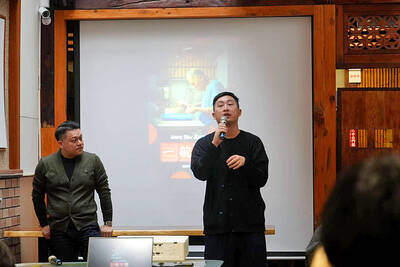
Taiwan Travelogue (臺灣漫遊錄), which earlier this week became the first Taiwanese novel to win the International Booker Prize, is to be adapted into a television series through a Taiwan-Japan coproduction, producer Chang Chen-yu (張辰漁) said yesterday. Chang, a producer at World Softest Production Film Co, wrote on Facebook that the company had been searching for projects with international appeal that retain a strong Taiwanese identity after colleagues and Japanese partners strongly recommended the novel. After reading the book, Chang said he immediately decided to pursue the screen rights. “A great story has the power to transcend time and borders, and connect countless people,”


 RSS
RSS