


The Council of Agriculture yesterday maintained it did not cover up and defer the notifications of several H5N2 bird-flu outbreaks in the past two years, despite heavy criticism from lawmakers.
Challenged by a number of lawmakers in the legislature’s Economics Committee, Council of Agriculture Minister Chen Bao-ji (陳保基) repeatedly sidestepped questions on whether or not the council reported a highly pathogenic H5N2 avian flu outbreak in 2010 to the World Organization for Animal Health (OIE) as low-risk outbreak.
Council officials were grilled by lawmakers across party lines yesterday over the announcement on Saturday that 57,500 chickens had been culled in areas around Greater Tainan and Changhua County because of an outbreak of the H5N2 avian influenza strain.
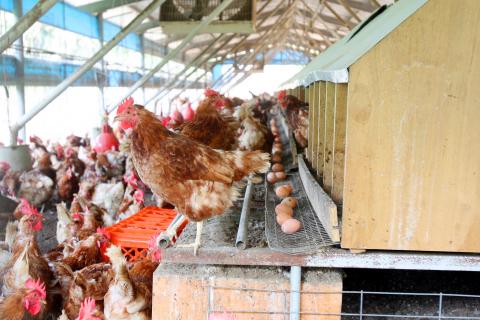
Photo: CNA
Democratic Progressive Party lawmakers Tsai Chi-chang (蔡其昌), Kuan Bi-ling (管碧玲) and Chen Chi-mai (陳其邁) said the council had notified the OIE of a low-risk avian influenza in 2010, even though it had already received a Intravenous Pathogenicity Index (IVPI) test’s results which showed readings above 1.2 — an indicator that the strain was highly pathogenic.
Readings greater than 1.2 in an IVPI test on a six-week-old chicken indicate a highly pathogenic strain.
Taiwan’s credibility would be in jeopardy if it had intentionally lied to the OIE, Kuan said.
In response, Chen Bao-ji said the notification was a “mistake,” but he refused to say whether it was a cover-up or comment on former Council of Agriculture minister Chen Wu-hsiung’s (陳武雄) handling of the outbreak.
He also sidestepped a question posed by Chinese Nationalist Party (KMT) Legislator Lee Ching-hua (李慶華), who asked if the council had covered up or deferred reporting any avian flu outbreak, by promising to shorten the 28-day evaluation period adopted by the OIE on avian flu assessments to better prepare for future outbreaks.
Lawmakers and council officials spent a majority of the committee session debating the standard operational procedures when assessing the pathogenicity of bird-flu outbreaks, with Chen Bao-ji and Bureau of Animal and Plant Health Inspection and Quarantine Deputy Director-General Huang Kwo-ching (黃國青) saying that multiple factors, including the IVPI index, clinical observations, pathological changes, as well as further laboratory tests, were considered when the council makes an assessment.
Lawmakers said that an IVPI reading above 1.2 should be “the golden and only rule,” according to council regulations established in 2003, adding that the council’s “comprehensive assessment process” created a “grey area” in its assessments.
Taiwan Solidarity Union Legislator Hsu Chung-hsin (許忠信) questioned the timing of the announcement of the latest H5N2 outbreak, saying it could have been a tactic to shift public attentions away from the government’s other hotly-debated policy of allowing US beef imports that contain traces of the animal feed additive ractopamine.
Kevin H. J. Lee (李惠仁), the freelance journalist who exposed the latest outbreaks and who accused the council of covering them up and deferring its notifications to the OIE, agreed, saying the council had placed “administrative concerns” over its professionalism and obligations.
Lee, who was invited to testify before the committee, spent more than six years investigating avian influenza outbreaks while shooting a documentary entitled A Secret That Can’t Be Exposed (不能戳的秘密), and reported a possible lethal case of H5N2 in Fangyuan Township (芳苑), Changhua County, to the council in December last year.
Lee said the council concealed the truth about the Changhua outbreak for more than 70 days, in much the same way as it had with the case in 2010.
The committee proposed establishing a panel to conduct a further investigation into possible malfeasance and demanded that the council submit all avian flu-related documents dated after December 2008 and that it review its standard operating procedures on the identification and notification of bird-flu outbreaks.

More than half of the bamboo vipers captured in Tainan in the past few years were found in the city’s Sinhua District (新化), while other districts had smaller catches or none at all. Every year, Tainan captures about 6,000 snakes which have made their way into people’s homes. Of the six major venomous snakes in Taiwan, the cobra, the many-banded krait, the brown-spotted pit viper and the bamboo viper are the most frequently captured. The high concentration of bamboo vipers captured in Sinhua District is puzzling. Tainan Agriculture Bureau Forestry and Nature Conservation Division head Chu Chien-ming (朱健明) earlier this week said that the
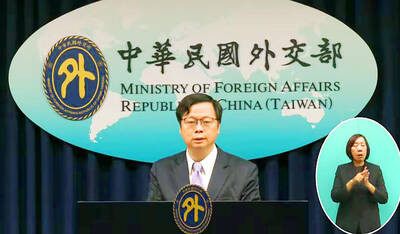
NAMING SPAT: The foreign ministry called on Denmark to propose an acceptable solution to the erroneous nationality used for Taiwanese on residence permits Taiwan has revoked some privileges for Danish diplomatic staff over a Danish permit that lists “Taiwan” as “China,” Eric Huang (黃鈞耀), head of the Ministry of Foreign Affairs’ Department of European Affairs, told a news conference in Taipei yesterday. Reporters asked Huang whether the Danish government had responded to the ministry’s request that it correct the nationality on Danish residence permits of Taiwanese, which has been listed as “China” since 2024. Taiwan’s representative office in Denmark continues to communicate with the Danish government, and the ministry has revoked some privileges previously granted to Danish representatives in Taiwan and would continue to review
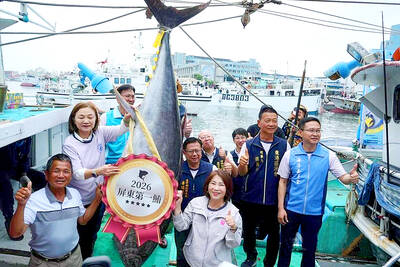
The first bluefin tuna of the season, brought to shore in Pingtung County and weighing 190kg, was yesterday auctioned for NT$10,600 (US$333.5) per kilogram, setting a record high for the local market. The auction was held at the fish market in Donggang Fishing Harbor, where the Siaoliouciou Island-registered fishing vessel Fu Yu Ching No. 2 delivered the “Pingtung First Tuna” it had caught for bidding. Bidding was intense, and the tuna was ultimately jointly purchased by a local restaurant and a local company for NT$10,600 per kilogram — NT$300 ,more than last year — for a total of NT$2.014 million. The 67-year-old skipper
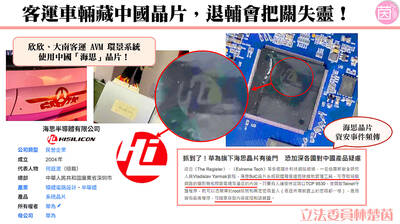
BREACH OF CONTRACT: The bus operators would seek compensation and have demanded that the manufacturer replace the chips with ones that meet regulations Two bus operators found to be using buses with China-made chips are to demand that the original manufacturers replace the systems and provide compensation for breach of contract, the Veterans Affairs Council said yesterday. Democratic Progressive Party Legislator Michelle Lin (林楚茵) yesterday said that Da Nan Bus Co and Shin-Shin Bus Co Ltd have fielded a total of 82 buses that are using Chinese chips. The bus models were made by Tron-E, while the systems provider was CYE Electronics, Lin said. Lin alleged that the buses were using chips manufactured by Huawei subsidiary HiSilicon Co, which presents a national security risk if the


 RSS
RSS