


Local experts in hygiene and veterinary medicine have urged the US to squarely face the challenges posed by the scientific evidence on which it has based its contention that US beef containing the lean meat-enhancing feed additive ractopamine is safe for human consumption, before it presses Taiwan to handle the issue scientifically.
In a rare address to local media, the American Institute in Taiwan (AIT) on Feb. 22 issued a communique to counter published “misinformation” which called into question the US’ argument that levels of ractopamine residue in meat permitted in other countries were safe for human consumption.
The statement was followed by a second one released on Thursday, in which it was argued that the feed additive is not only safe, but also necessary to “boost production to meet growing world demand for meat, while keeping consumer prices at reasonable levels.”
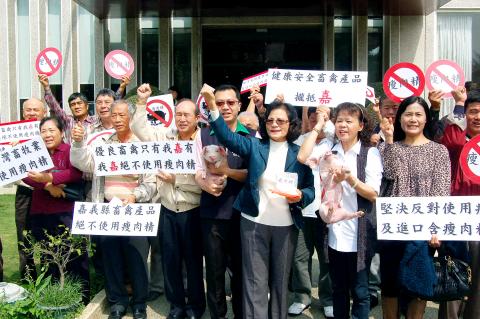
Photo: Hsieh Yin-chung, Taipei Times
Drawing mainly on the study by the Joint Expert Committee on Food Additives (JECFA), which serves as a scientific advisory body to the UN’s Food and Agriculture Organization, the WHO and the Codex Alimentarius Commission — the international food standards body — the AIT said it wished that the Taiwanese media could do justice to US beef.
The AIT also wished the media to note that the EU and China were mostly influenced by “non-scientific factors” when they opposed the use of ractopamine and that Taiwan has its own assessment of ractopamine, done in 2007, which found ractopamine was safe for use.
However, Chan Chang-chuan (詹長權), a professor at National Taiwan University’s Institute of Occupational Medicine and Industrial Hygiene, rejected the US’ arguments after reviewing the AIT communiques.
“When it comes to science, only one truth will prevail,” Chan said in an interview with the Taipei Times.
International opinion, based on analyses of scientific papers on the effects of ractopamine on humans, remains divided, he said.
“Given the situation, how could the AIT use one-sided statements to bamboozle Taiwanese into thinking that ractopamine in US beef poses no health risk?” he asked.
The AIT says that the EU did not adopt a scientific approach because it banned the use of beta-agonists, the class of drug to which ractopamine belongs, long before ractopamine was introduced to the market.
“The EU did not conduct any studies on ractopamine prior to adding it to the list of already-banned beta-agonists,” the communique said.
Chan disagreed with the “non-scientific” label attached to the EU’s viewpoint.
It is true the EU did not conduct its own risk assessment of ractopamine, Chan said.
“This is because the EU generally prohibits the use of beta-agonists, and with that the EU did not consider that it was obliged to do a risk assessment. However, the EU ordered the formation of a task force to provide scientific opinions on the safety of ractopamine,” he said.
The EU then raised many scientific grounds for concern over the safety of ractopamine, based on the 52-page report presented by the task force — the Panel on Additives and Products or Substances used in Animal Feed (FEEDAP) — in 2009, Chan said.
“It’s OK that the US disagreed with the EU, but the US can’t say the EU cited ‘non-scientific factors’ as the basis for its opposition to ractopamine,” he said.
In 2004, the JECFA established an accepted daily intake (ADI) of 300g of muscle, 100g of liver, 50g of kidney and 50g of fat, and recommended maximum residue levels (MRLs) of ractopamine of 10 parts per billion (ppb) in muscle and fatty tissues, 40ppb in livers and 90ppb in kidneys in cattle and pigs for consideration by the Codex Committee Commission.
The recommendations have been stuck at the final stage in the Codex process since they were proposed in 2008.
The FEEDAP report raised several technical questions on the JECFA study, which concluded that a dose of 5mg of ractopamine, the lowest administered dose in its human study, could be considered a no-effect dose, as it did not cause any cardiovascular response.
“The human study cannot be taken as a basis to arrive at an ADI and consequently no proposal for MRLs could be made,” the FEEDAP report concluded.
Among the findings in the FEEDAP analysis were: The available human data was pivotal to assess consumer safety, because data from laboratory animals gives a wide range of susceptibility of various animals to ractopamine; and the sample size of six subjects in the human study did not provide sufficient statistical power to detect a clinically relevant response that would be statistically significant.
The FEEDAP also said that the use of the data obtained from the JECFA’s human study “exposes experimental weaknesses and uncertainties,” because it was originally designed to establish dose-effect responses to enable suitable doses to be selected for a larger study and not to define a no-effect level, and thus “limits the conclusiveness of the study.”
It was of concern to the panel that the safety factor applied by JECFA to arrive at the ADI did not sufficiently take into account population subsets at higher risk.
“Those are all important questions. The US should let people know how they answer these questions. Taiwan should also reference EU studies,” Chan said.
Chou Chin-cheng (周晉澄), dean and chairman of the Institute of Veterinary Clinical Science at National Taiwan University’s School of Veterinary Medicine, shared Chan’s view, saying the JECFA scientific evidence provided by the US remained insufficient and unconvincing.
“In principle, scientific theories, unlike beliefs, are subject to question and development or refutation by the accretion of evidence,” Chou said.
The JECFA argument remains weak and relatively unproven, because the FEEDAP has pointed out fatal flaws in the research, but over the years, when the issue was debated at Codex meetings, both the JECFA and the US avoided the issue, he said.
For example, the JECFA could have carried out an experiment to measure ractopamine residue in lungs in response to China’s concerns, but it just downplayed the issue, he said.
China proposed three residue depletion studies on ractopamine in pig tissue in 2009 and an experimental study on ractopamine residue in pig tissue in 2010 over concerns that residue levels in lung, stomach, heart, large and small intestine, which are important cuts in the diet of Asian consumers, were left out of consideration by the JECFA.
In line with its findings that the residue in lungs, the stomach, and the large and small intestines is at a high level, China concluded that the ADI recommended by the JECFA was not acceptable.
In 2010, the JECFA deferred recommending an MRL for lung tissue and suggested that further study regarding the consumption of lung tissue might be warranted.
As for other animal organs of concern to China, the JECFA said they were safe for human consumption, as its assessment that substituted other organ data in the model diet found that the resulting dietary intakes were below the upper boundaries of the ADI.
In response to the AIT’s suggestion that Taiwan should revise its zero-tolerance policy on ractopamine in line with its own 2007 risk assessment, both Chan and Chou said the paper is “of little value” as a reference.
The eight-page paper was just “a first step of a complete risk assessment,” they said.
According to the two experts, the local study did not include an experimental study and the research was not comprehensive.
It was fraught with flaws. For instance, it drew on census statistics produced in 1982 and it failed to take into account subpopulations which might be at a higher risk for adverse drug events caused by ractopamine, they said.
In the AIT communique, it cited “ethical reasons” to reject the criticism over the small sample size of six subjects in the JECFA’s human study, to which Chan responded by saying: “Were there any adverse event, would it be more ethical?”
The EU said the minimum acceptable sample size should be 60, Chan said.
Chan gave two examples to emphasize the importance of sample size.
“Before the indigenous vaccine invented to prevent the spread of the A(H1N1) influenza virus was put into use in 2009, there were 300 people involved in a human study. Even the recently published ractopamine experiments on pigs conducted by the Animal Technology Institute Taiwan had a sample size of 64,” Chan said.
“How could a sample size of six human subjects provide sufficient statistical power? Plus, they were all healthy males aged between 19 and 26,” Chan said.
Other than saying that more than 100 clinical studies and country-directed risk assessments in 27 countries have documented that ractopamine was safe, the AIT also dismissed the concerns over US beef’s safety by highlighting that the connection between consumption of meat with ractopamine and human health was empirically unproven.
“The US exported beef and pork products to more than 100 countries around the world in 2011. Over the past 10 years, millions of people have eaten billions of kilograms of US beef and pork with no reports of illness or any other effect linked to the consumption of meat from animals fed ractopamine,” the AIT said in its second communique.
Both Chan and Chou strongly questioned the argument.
The EU has raised suspicions that the drug’s manufacturer, Elanco, could have falsified or withheld information about its safety and effectiveness, as well as about adverse animal drug reactions, after which ractopamine was approved as safe, Chou said.
Chou said the EU’s concern has been borne out either by academic studies, mostly published in the Journal of Animal Science, or by case reports of adverse drug reactions.
“We have too little information to judge the safety of ractopamine. How much more information against it was not made available? What were the indicators used to evaluate the effects of ractopamine in the JECFA study and that were not included? We know too little, so we should maintain the ban until the Codex reaches a consensus,” Chou said.
Chan said the US contention that there had been no health problems associated with eating US beef because no case had been reported was “indefensible.”
“There has never been any mechanism in place to monitor the effects of consuming meat with ractopamine residue on human health. If you do not monitor it, how can you know for sure there is no adverse event?” Chan said.

UPGRADE: The Kang Ding-class frigate is replacing its Chaparall missiles with Tien Chien II and Hua Yang VLS, which would provide it with long-range, 360° air defense Taiwan plans to produce 1,200 to 1,376 Hai Chien II missiles (海劍二, Sea Sword II) — also known as TC-2N — to serve as the standard air defense system of the navy’s surface combatant fleet, a source said yesterday. Last week, the Hai Chien II, the naval version of the Tien Kung II missile (天劍二, Sky Sword II), completed a live-fire test in waters off the National Chungshan Institute of Science and Technology’s Jiupeng facility (九鵬) in Pingtung County’s Manjhou Township (滿州). The MIM72 Chaparral and other dated air defense missiles that currently arm Taiwanese ships have inadequate range to combat Chinese

REASONS FOR TRAVEL: An assistant professor said that proposed amendments to penalize drivers if they used drugs overseas would not deter people from traveling People who operate a motor vehicle under the influence of marijuana would have their driver’s license revoked, even if they used the substance while overseas, the Ministry of Transportation and Communications said yesterday, citing proposed amendments to the Road Traffic Management and Penalty Act (道路交通管理處罰條例). The amendments would also authorize the government to revoke the licenses of people determined to have used Category 1 or Category 2 narcotics, even if they were not operating a vehicle while under the influence of drugs, as well as ban them from taking the license test for three years, the ministry said. People aged 18 or

HEAVY WEATHER: Typhoon Jangmi is due to crash straight into the Ryukyus as airlines look to shift flights to larger aircraft or cancel flights to Okinawa entirely Taiwan’s international air carriers announced flight adjustments over the weekend as Typhoon Jangmi is forecast to hit the Ryukyu Islands today and tomorrow. The Central Weather Administration (CWA) upgraded Jangmi from a tropical storm to a typhoon at 8am yesterday, with the eye located 580km south of Naha city. It was moving north at 19kph. Today, China Airlines’ CI-120, CI-121, CI-122 and CI-123 flights between Taoyuan and Naha, Okinawa, have been canceled as well as CI-132 and CI-133 between Kaohsiung and Naha. EVA Air’s BR-112, BR-113, BR-186 and BR-185 flights between Taoyuan and Naha are also canceled. Low-cost carrier Tigerair Taiwan canceled IT-230,
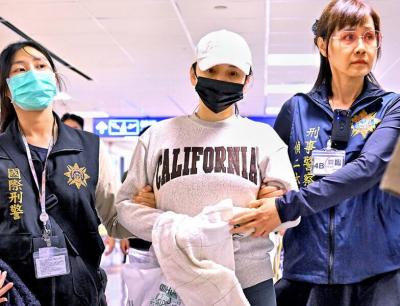
Johanne Liou (劉喬安), a Taiwanese woman who shot to unwanted fame during the Sunflower movement protests in 2014, returned to Taiwan last night after being deported from the US. She is to stand trial in Taiwan for charges involving embezzlement, fraud and drug crimes. The Criminal Investigation Bureau (CIB) said it took her into custody at Taiwan Taoyuan International Airport and would first question her before transferring her to the New Taipei District Prosecutors’ Office. She was arrested upon disembarking a flight from San Francisco that landed shortly before 7pm. Liou absconded to the US in 2019 after jumping bail


 RSS
RSS