


Environmentalists yesterday urged the Environmental Protection Administration (EPA) to establish fine particle pollution safety standards based on guidelines suggested by the WHO.
The group made the call at a public hearing on the discussion of a proposed bill governing air quality standards, with the EPA mulling adopting the same standards as the US and Japan.
The EPA said monitoring work on PM2.5 — particulate matter of less than 2.5 micrometers, about 1/28th the average width of a human hair — began in 2005 and setting a air quality standard for PM2.5 was a policy decided by the government last year.
The EPA drafted a bill in December last year in which it suggested the PM2.5 standard for Taiwan should follow the same standards as that in the US and Japan — a 35μg/m3 daily mean concentration and a 10μg/m3 annual mean concentration.
The draft articles also state that PM2.5 monitoring should occur once every three days using a manual sampling method.
However, doctors from the Changhua Medical Alliance for Public Affairs (MAPA) and environmentalists at the public hearing expressed concerns that the proposed standards are not strict enough to protect public health, that the monitoring method would be unable to cope with instantaneous and extreme cases, and that there would be too few monitoring sites across the nation.
Yeh Guang-peng (葉光芃), a gynecologist at Changhua Christian Hospital, said that although the WHO’s guidelines for PM2.5 and PM10 — particulate matter of less than 10 micrometers — are already very strict, the latest medical studies have shown that the standards are not enough to protect people from the health risks that pollution causes, such as strokes and cardiovascular disease.
“So the ultimate goal is not limited to reaching the WHO’s standards, but to assure the health of our people,” Yeh said, adding that “based on the Department of Health’s statistical data, there are more people joining the sensitive groups threatened by air pollution.”
Changhua Environmental Protection Union secretary-general Shih Yueh-ying (施月英) questioned why the EPA was not considering computer-controlled continuous PM2.5 monitoring.
A member of MAPA said 55 of the current 75 monitoring sites are located in public schools and they do not record conditions in places where air pollution is more serious, such as at crossroads or near factories.
Huang Wei-ming (黃偉鳴), a section chief at the EPA’s Air Quality Protection and Noise Control Department, said: “So far no country has set national air quality standards in correspondence with the WHO’s guidelines.”
Huang said that according to the WHO’s official document on air quality guidelines, there could be three levels of interim targets before reaching the strictest standards and that the standards proposed were within the three levels and that they could be modified and improved in future.
Air Quality Protection and Noise Control Department Director Hsieh Yein-rui (謝燕儒) said the EPA would take all the suggestions into consideration, along with the National Ambient Air Quality Standards for Particle Pollution of the US, and that the national standard for PM2.5 would be announced before June.
Hsieh said tighter air quality regulations would be set for specific industries in the coming months, saying that levels of pollution would likely improve after the new regulations are enforced.

FUKUOKA SITUATION: Japanese media reported that the pathogen is expected to be identified by the summer, while the CDC downplayed the idea that it was hMPV A “mysterious cold-like illness” reported in Japan’s Fukuoka Prefecture does not seem to be a new disease, but Japanese authorities have been asked about the situation, the Centers for Disease Control (CDC) said yesterday. The Fukuoka Prefectural Medical Association on Wednesday told a news conference that a “mystery cold” that has become a hot topic on social media is “highly likely to be caused by some kind of viral infection,” Japan’s KBC News reported. “Many people are experiencing symptoms starting with a sore throat, followed by a runny nose, phlegm and a severe cough,” KBC News reported, citing association officials. Health authorities are

Nvidia Corp CEO Jensen Huang (黃仁勳) arrived in Taiwan yesterday ahead of upcoming AI and technology events, saying he plans to meet with clients and Taiwan Semiconductor Manufacturing Co Chairman C.C. Wei (魏哲家) during his visit. After landing at Taipei Songshan Airport, Huang posed for photos with fans and handed out Yakult drinks to reporters and supporters waiting at the scene, saying he has “a lot to do” during the trip. Asked about reports that Nvidia’s planned headquarters site in Taipei’s Beitou Shilin Technology Park could break ground on May 27, Huang said that if the company holds an event, he would

The Ministry of Finance this afternoon announced the winning numbers for the March-April uniform invoice lottery. The winning number for the NT$10 million (US$318,060) special prize is 19531471, and the winning number for the NT$2 million grand prize is 85941329. Three numbers were drawn for the NT$200,000 first prize: 07225810, 20231230 and 83518781. Those with receipts matching the last seven digits of any of the first-prize numbers will win the NT$40,000 second prize, while those matching the last six digits will win the NT$10,000 third prize. Those whose receipts match the last five digits of the first-prize numbers can claim the NT$4,000 fourth prize,
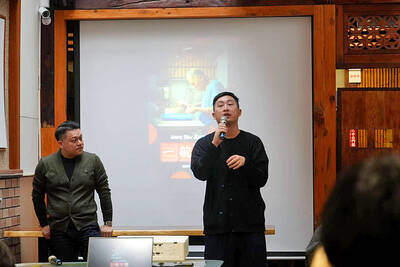
Taiwan Travelogue (臺灣漫遊錄), which earlier this week became the first Taiwanese novel to win the International Booker Prize, is to be adapted into a television series through a Taiwan-Japan coproduction, producer Chang Chen-yu (張辰漁) said yesterday. Chang, a producer at World Softest Production Film Co, wrote on Facebook that the company had been searching for projects with international appeal that retain a strong Taiwanese identity after colleagues and Japanese partners strongly recommended the novel. After reading the book, Chang said he immediately decided to pursue the screen rights. “A great story has the power to transcend time and borders, and connect countless people,”


 RSS
RSS