


The Centers for Disease Control (CDC) said on Thursday that there was no SARS (severe acute respiratory syndrome) outbreak in China, despite unverified reports circulating on the Internet.
The Chinese health authorities have said that there is no SARS outbreak within its territory, CDC Deputy Director-General Chou Jih-haw (周志浩) said on Thursday.
The Chinese authorities were scheduled to provide information to the CDC regarding the rumors yesterday, he said.
SARS is a respiratory disease caused by a virus that infects the lungs and causes difficulty in breathing. Common antibiotics have proven ineffective against the virus and patients are dependent on clinical treatment to recover.
Many Chinese Internet users have voiced concern over a possible SARS pandemic in a military hospital in Hebei Province, -according to a newspaper.
Although the Chinese government has yet to officially deny the rumor, bloggers alleged that hundreds of patients have been hospitalized in isolation wards and at least one has died from the disease, the newspaper report said.
In the past, the Chinese government covered up news about infectious cases.
There are so far no reports from Hong Kong, which was one of the areas hardest hit by the SARS -pandemic from 2002 to 2003, or the rest of the world.
While customs officials are equipped with sensors to detect passengers running a fever, a typical symptom of SARS, Chou said Taiwan had also established more than 1,000 isolation wards and facilities.
SARS resulted in about 70 deaths in Taiwan a decade ago, including a number of medical staff in charge of patients, Chou said.
The CDC late yesterday said that the Chinese health authorities had confirmed that a reported outbreak of SARS was in fact a case of adenovirus infection. China informed the CDC the suspected outbreak in Hebei Province had been confirmed as adenovirus type 55 infection, Chou said.
However, China did not reveal the scale of the epidemic.
Chou said that adenovirus infection was easy to treat and that the CDC did not need to investigate any further.
Adenovirus type 55 infection was first discovered in China’s Shaanxi Province in 2006. Of 254 high school students treated for the infection, only one died.
There is no record of adenovirus type 55 infection in Taiwan, CDC statistics show.


Kenting National Park service technician Yang Jien-fon (楊政峰) won a silver award in World Grand Prix Photography Awards Spring Season for his photograph of two male rat snakes intertwined in combat. Yang’s colleagues at Kenting National Park said he is a master of nature photography who has been held back by his job in civil service. The awards accept entries in all four seasons across six categories: architectural and urban photography, black-and-white and fine art photography, commercial and fashion photography, documentary and people photography, nature and experimental photography, and mobile photography. Awards are ranked according to scores and divided into platinum, gold and

More than half of the bamboo vipers captured in Tainan in the past few years were found in the city’s Sinhua District (新化), while other districts had smaller catches or none at all. Every year, Tainan captures about 6,000 snakes which have made their way into people’s homes. Of the six major venomous snakes in Taiwan, the cobra, the many-banded krait, the brown-spotted pit viper and the bamboo viper are the most frequently captured. The high concentration of bamboo vipers captured in Sinhua District is puzzling. Tainan Agriculture Bureau Forestry and Nature Conservation Division head Chu Chien-ming (朱健明) earlier this week said that the
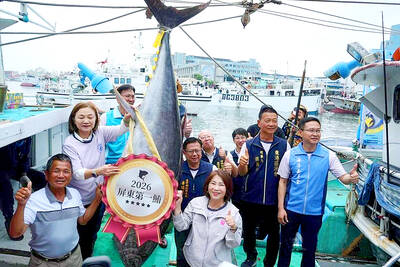
The first bluefin tuna of the season, brought to shore in Pingtung County and weighing 190kg, was yesterday auctioned for NT$10,600 (US$333.5) per kilogram, setting a record high for the local market. The auction was held at the fish market in Donggang Fishing Harbor, where the Siaoliouciou Island-registered fishing vessel Fu Yu Ching No. 2 delivered the “Pingtung First Tuna” it had caught for bidding. Bidding was intense, and the tuna was ultimately jointly purchased by a local restaurant and a local company for NT$10,600 per kilogram — NT$300 ,more than last year — for a total of NT$2.014 million. The 67-year-old skipper
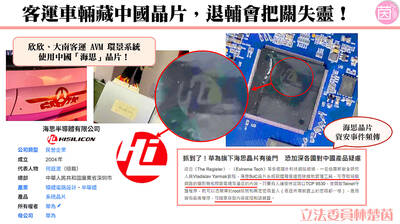
BREACH OF CONTRACT: The bus operators would seek compensation and have demanded that the manufacturer replace the chips with ones that meet regulations Two bus operators found to be using buses with China-made chips are to demand that the original manufacturers replace the systems and provide compensation for breach of contract, the Veterans Affairs Council said yesterday. Democratic Progressive Party Legislator Michelle Lin (林楚茵) yesterday said that Da Nan Bus Co and Shin-Shin Bus Co Ltd have fielded a total of 82 buses that are using Chinese chips. The bus models were made by Tron-E, while the systems provider was CYE Electronics, Lin said. Lin alleged that the buses were using chips manufactured by Huawei subsidiary HiSilicon Co, which presents a national security risk if the


 RSS
RSS