


Livestock and poultry farmers from across the country will stage a protest on March 3 in Taipei against easing restrictions on imports of beef with ractopamine residue from the US, one of the organizers confirmed yesterday.
“More than 10,000 pig, cattle and chicken farmers and workers will join the protest,” said Yang Guan-chang (楊冠章), director of the Republic of China Swine Association.
The protesters will first march to the Legislative Yuan, then to the Council of Agriculture and the Department of Health to voice their opposition to any government attempt to relax its zero-tolerance policy on ractopamine in US beef, Yang said.
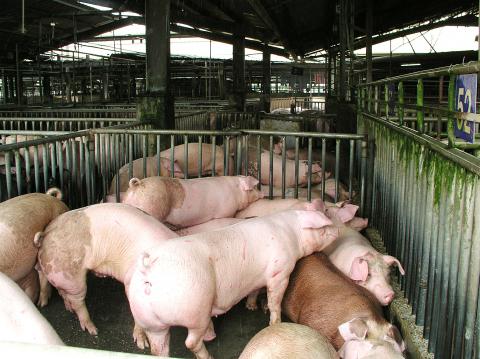
Photo: Liao Shu-ling, Taipei Times
The date of the protest was finalized at a meeting of livestock industry stakeholders and food safety groups in Greater Taichung earlier in the day, Yang said. The groups included the Homemakers’ Union and Foundation and the Taiwan Consumers’ Foundation, he added.
The protest was planned amid rumors that the government might bow to US pressure and allow imports of US beef that contain regulated amounts of the feed additive ractopamine, while maintaining its total ban on the use of the drug by local farmers.
Democratic Progressive Party Legislator Wu Ping-jui (吳秉叡) said yesterday he will submit a legislative proposal for a national referendum on whether to set permissible levels of ractopamine in US beef.
Wu said he will seek the legislature’s approval to petition the Central Election Commission to start the referendum process.
He said that, as a number of domestic experts have warned that opening the market to residue-laden beef would pose health risks, the government should not rush to any decision.
“If the government really wants people to accept US beef containing ractopamine, it should allow the people to have the final say,” Wu said.
However, People First Party caucus whip Thomas Lee (李桐豪) expressed concern that if the referendum failed, it could be used as a tool to open the nation’s doors fully to US beef imports.
Lee said the problem could be resolved by revising legislation, an option that he said would also take the pressure off the government.
The use of ractopamine in livestock farming is allowed in more than 20 countries around the world, besdies the US, but is banned in the EU, China and Taiwan.

NATIONAL SECURITY: Authorities are working to confirm the identities of the military personnel involved and investigating possible illegal conduct and regulatory violations Authorities are probing possible national security implications after Kinmen police and immigration officers on Sunday found a Chinese woman allegedly posing as a tourist while engaging in prostitution involving more than 10 military personnel. The woman, surnamed Chen (陳), has since been deported, authorities said, adding that investigators are still working to confirm the identities of those implicated, as the records only listed code names and aliases. The case stemmed from a report received by the Kinmen District Prosecutors’ Office on Friday last week from the Jinhu Precinct of the Kinmen County Police Bureau. On Sunday, police, along with the National Immigration

GLOBALGIVING: ‘ Caving to external pressure is not acceptable for an organization that has cultivated justice reform and human rights for 30 years,’ one NGO said A slew of non-government organizations (NGOs) have withdrawn from the GlobalGiving fundraising platform after it announced it would use “Chinese Taipei” instead of “Taiwan” from next month. The Taiwan Good Rice Association wrote on Facebook on Friday that it was informed on April 28 via a teleconference call of the change, which was made because the platform wanted to operate in China. Taiwan Good Rice is to terminate all cooperative relationships with GlobalGiving in response to the platform’s “unilateral and non-negotiable” decision to remove references to Taiwan, the NGO said. “Taiwan is in the official name of Taiwan Good Rice Association and the

HEAVY WEATHER: Typhoon Jangmi is due to crash straight into the Ryukyus as airlines look to shift flights to larger aircraft or cancel flights to Okinawa entirely Taiwan’s international air carriers announced flight adjustments over the weekend as Typhoon Jangmi is forecast to hit the Ryukyu Islands today and tomorrow. The Central Weather Administration (CWA) upgraded Jangmi from a tropical storm to a typhoon at 8am yesterday, with the eye located 580km south of Naha city. It was moving north at 19kph. Today, China Airlines’ CI-120, CI-121, CI-122 and CI-123 flights between Taoyuan and Naha, Okinawa, have been canceled as well as CI-132 and CI-133 between Kaohsiung and Naha. EVA Air’s BR-112, BR-113, BR-186 and BR-185 flights between Taoyuan and Naha are also canceled. Low-cost carrier Tigerair Taiwan canceled IT-230,

Chinese Nationalist Party (KMT) Chairwoman Cheng Li-wun (鄭麗文) yesterday briefed her party’s Central Standing Committee regarding her scheduled visit to the US between Monday next week and June 16, saying that her purpose would be to persuade the US that the Republic of China (ROC) Constitution was a “one China” constitution that would foster stable and peaceful cross-strait relations. The ROC Constitution is the most important defense for all Taiwanese citizens, as it upholds our democracy and has contributed to our robust economy, which aligns with international and US interests, she said. “We would not be troublemakers and drag the US under,”


 RSS
RSS