


Legislators across party lines sought yesterday to push for new legislation to protect the environment.
Chinese Nationalist Party (KMT) Legislator Chiu Wen-yen (邱文彥), Democratic Progressive Party Legislator Tien Chiu-chin (田秋堇) and People First Party Legislator Chang Show-foong (張曉風) called for cross-party cooperation on legislation to protect local wetlands and coastlines.
On Feb. 2, World Wetlands Day, the three legislators held a joint public hearing to press for the protection of a wetland area near Wugoushui Village (五溝水), in Pingtung County’s Wanluan Township (萬巒).
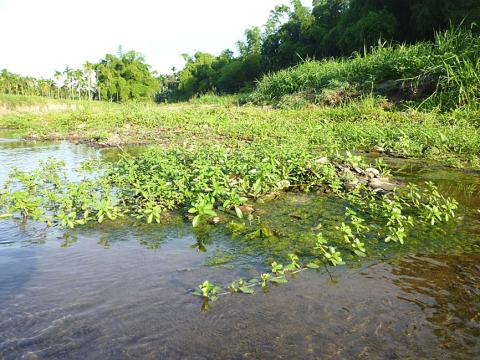
Photo: CNA
The county government has proposed building anti-flood works near the village, a move that is considered likely to damage the eco-system of an area that is rich in springs and rare fish species.
Chiu, a former Environmental Protection Administration deputy minister, said it is essential that local fishermen are better informed about coastline reserves.
“We have to make sure they are aware that setting up a coastline reserve is not the same thing as limiting fishing,” Chiu said. “Instead, setting up a reserve to protect the coastline, where the ecosystem is particularly fragile, facilitates the cultivation of fishery resources.”
Similarly, pushing for new legislation to protect the country’s wetlands is aimed at ensuring sustainable development, Chiu added.
Legislation to protect the wetlands ensures that development projects in such areas strictly adhere to standard procedures, he said. It also has the added benefit of providing guidance on how to conduct research into wetlands and educating the public on how best to protect them, he said.
Chang, a writer and prominent environmental activist, said one of her major goals as a legislator is to push for the passage of bills that protect the nation’s coastlines and wetlands.
Having made a name for herself as a result of her opposition to the building of a biotech research center on wetlands in Taipei’s Nangang District (南港) in 2010, Chang has said she would like to work with legislators from other parties.
Meanwhile, Tien stressed the need for more communication with fishermen’s associations, in the light of an expected backlash from such groups over the designation of coastline reserve areas.

FUKUOKA SITUATION: Japanese media reported that the pathogen is expected to be identified by the summer, while the CDC downplayed the idea that it was hMPV A “mysterious cold-like illness” reported in Japan’s Fukuoka Prefecture does not seem to be a new disease, but Japanese authorities have been asked about the situation, the Centers for Disease Control (CDC) said yesterday. The Fukuoka Prefectural Medical Association on Wednesday told a news conference that a “mystery cold” that has become a hot topic on social media is “highly likely to be caused by some kind of viral infection,” Japan’s KBC News reported. “Many people are experiencing symptoms starting with a sore throat, followed by a runny nose, phlegm and a severe cough,” KBC News reported, citing association officials. Health authorities are

Nvidia Corp CEO Jensen Huang (黃仁勳) arrived in Taiwan yesterday ahead of upcoming AI and technology events, saying he plans to meet with clients and Taiwan Semiconductor Manufacturing Co Chairman C.C. Wei (魏哲家) during his visit. After landing at Taipei Songshan Airport, Huang posed for photos with fans and handed out Yakult drinks to reporters and supporters waiting at the scene, saying he has “a lot to do” during the trip. Asked about reports that Nvidia’s planned headquarters site in Taipei’s Beitou Shilin Technology Park could break ground on May 27, Huang said that if the company holds an event, he would

Carrefour Taiwan is to begin using a new name from the start of July, but it cannot divulge the name until then, the chairman of the supermarket chain's parent company said today. President Chain Store Co chairman Lo Chih-hsien (羅智先) was asked by reporters after a shareholders' meeting to confirm whether the company has settled on a new name for the supermarket brand. In March, the government-registered name of two Carrefour Taiwan branches was quietly changed to "Le Chia Kang" (樂家康) in Chinese, raising speculation that has been selected as the name. Lo said that because of local regulations and contractual obligations, the

The Philippines would likely be involved in any conflict over Taiwan due to its proximity to the democracy claimed by China, President Ferdinand Marcos Jr said, reiterating a stance that risks angering Beijing. “In the Philippines, we do not have a choice because Taiwan is so close to the Philippines and we have almost 200,000 Filipino nationals living and working in Taiwan,” Marcos said in an interview with Japanese media in Manila on Monday. The Philippine leader’s comments come ahead of a state visit to Japan next week, where he is to meet with Japanese Prime Minister Sanae Takaichi to discuss security


 RSS
RSS