


Death is perhaps one of the most most taboo subjects in local culture. However, for some students at a college in Miaoli County, death is not only a topic of daily conversation, but also the focus of every day activities.
Since 2009, teachers from the Department of Funeral Science at Jen-Teh Junior College of Medicine, Nursing and Management in Miaoli County have been teaching their students all they need to know about dealing with the deceased.
The department, established that year and funded by the Ministry of Education, offers courses ranging from anatomy and funeral preparation to embalming, corpse cleansing and makeup techniques to prepare its students for a career in a field that is increasingly in demand.
“Last year, we started a course on ‘experiencing death.’ This year, we are going to promote a course on corpse handling and another on mortuary makeup,” department director Chiu Ta-neng said.
“What we do is combine theory and practice. We teach students the meaning behind funerary rites, why they need to be performed, as well as how to perform them,” he added.
Chiu’s department is the only college-level department in the country that trains professional funeral workers.
In its corpse-handling course, students are split into pairs and take turns playing the corpse and the cleaner.
The “corpse” lies on a specially designed cleaning table, in a swimsuit, while the other person cleans the body with a hose and gently massages it to make it suppler and more manageable, Chiu said.
Students taking the mortuary makeup course are taught to help prepare the dead for funeral services. For example, they learn how to apply makeup, as well as how to dress a corpse, arrange its hair and even reconstruct disfigured faces.
“The purpose of the course is to teach students how to ease the pain of bereaved family members by helping the deceased look their best,” Chiu said.
Students in the department’s two-year program are now required to take the two courses before they can graduate, because they help students “develop sympathy and respect for life,” Chiu said.
Kao Feng-chu, 42, who works in the funeral business during the week and attends the courses on weekends, said her understanding of death changed after she took the courses.
“In the past, whenever I walked past a funeral home, I would say a blessing to protect myself. Now, I offer a blessing to the deceased in the hope that they find paradise in the afterlife,” Kao said.
There are other benefits to taking the courses as well.
On Dec. 14, the legislature passed the revised Funeral Industry Management Act (殯葬管理條例), authorizing the Ministry of the Interior to establish a certification system for funeral directors.
Under the ministry’s preliminary plan, people who wish to become certified morticians have to earn at least 20 course credits in mortuary science, pass a Level B funeral technician examination and have two years of relevant work experience.
Those completing the courses at Jen-Teh’s department would have fulfilled the requirement of 20 course credits, said Chiu, estimating that Taiwan will have its first certified undertaker this year.
So far, 49 students have graduated from the program, which currently has an enrollment of 150 students.
Although not every student who graduates goes on to work in the funeral business, the concepts taught at the department, such as respect for life and death, are universal and applicable in any field, Chiu said.
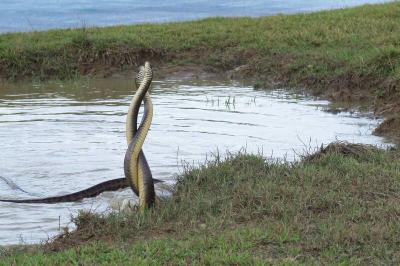
Kenting National Park service technician Yang Jien-fon (楊政峰) won a silver award in World Grand Prix Photography Awards Spring Season for his photograph of two male rat snakes intertwined in combat. Yang’s colleagues at Kenting National Park said he is a master of nature photography who has been held back by his job in civil service. The awards accept entries in all four seasons across six categories: architectural and urban photography, black-and-white and fine art photography, commercial and fashion photography, documentary and people photography, nature and experimental photography, and mobile photography. Awards are ranked according to scores and divided into platinum, gold and
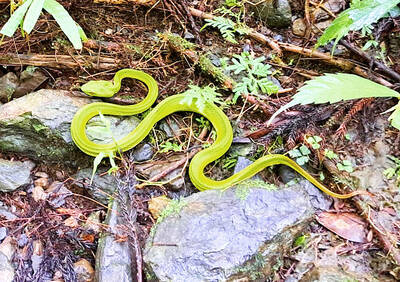
More than half of the bamboo vipers captured in Tainan in the past few years were found in the city’s Sinhua District (新化), while other districts had smaller catches or none at all. Every year, Tainan captures about 6,000 snakes which have made their way into people’s homes. Of the six major venomous snakes in Taiwan, the cobra, the many-banded krait, the brown-spotted pit viper and the bamboo viper are the most frequently captured. The high concentration of bamboo vipers captured in Sinhua District is puzzling. Tainan Agriculture Bureau Forestry and Nature Conservation Division head Chu Chien-ming (朱健明) earlier this week said that the

The Chinese Nationalist Party (KMT) caucus yesterday said it opposes the introduction of migrant workers from India until a mechanism is in place to prevent workers from absconding. Minister of Labor Hung Sun-han (洪申翰) on Thursday told the Legislative Yuan that the first group of migrant workers from India could be introduced as early as this year, as part of a government program. The caucus’ opposition to the policy is based on the assessment that “the risk is too high,” KMT caucus secretary-general Lin Pei-hsiang (林沛祥) said. Taiwan has a serious and long-standing problem of migrant workers absconding from their contracts, indicating that
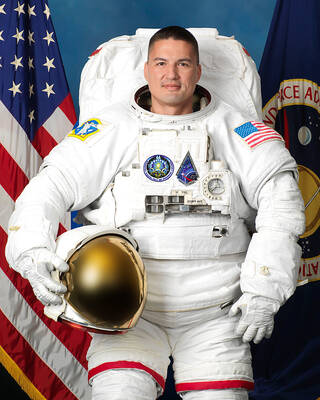
SPACE VETERAN: Kjell N. Lindgren, who helps lead NASA’s human spaceflight missions, has been on two expeditions on the ISS and has spent 311 days in space Taiwan-born US astronaut Kjell N. Lindgren is to visit Taiwan to promote technological partnerships through one of the programs organized by the US for its 250th national anniversary. Lindgren would be in Taiwan from Tuesday to Saturday next week as part of the US Bureau of Educational and Cultural Affairs’ US Speaker Program, organized to celebrate the 250th anniversary of the signing of the Declaration of Independence, the American Institute in Taiwan (AIT) said in a statement yesterday. Lindgren plans to engage with key leaders across the nation “to advance cutting-edge technological partnerships and inspire the next generation of scientists and engineers,”


 RSS
RSS