


The fish farmers on the terraced plains above Taiwan’s west coast are riding a China boom, exporting tonnes of sweet, flaky milkfish across the Taiwan Strait, thanks to import duties Beijing lowered to win over Taiwanese voters.
When Taiwanese choose a president on Saturday, Beijing hopes the people of the farming and fishing town of Syuejia (學甲) and others across Taiwan will think of the benefits China brings.
China is an undeclared but widely acknowledged player in the elections, which pits President Ma Ying-jeou (馬英九) against Tsai Ing-wen (蔡英文) of the Democratic Progressive Party (DPP).
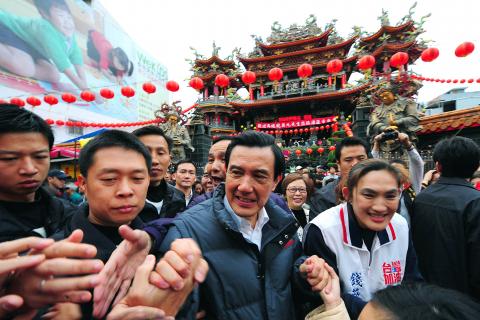
Photo: AARON TAM, AFP
“Of course the Chinese have a political motive. How can they not have?” asked Wang Wen-tsung, 47, a scratchy-voiced former member of the town council and a food exporter who has emerged as the power behind Syuejia ’s growing milkfish trade.
Trading on carefully cultivated contacts in Shanghai, Wang helped land loans last year from a state-run Chinese company to assist 100 Syuejia families seeking to sell their milkfish to China.
After decades of threats including missile launchings and denunciations of pro-independence politicians, Beijing has tried a softer approach in recent years, leveraging trade and investment to show the advantage of closer ties.
Ma’s victory four years ago gave Beijing the partner it needed. Since taking office, he has made economic links with China a centerpiece of his administration, stepping up flights across the 160km-wide Taiwan Strait, lowering barriers to Chinese investment and opening the doors to Chinese tourists, who pumped more than US$2 billion into the economy last year.
China has lowered tariffs on orchids, tropical fruits and other regional specialties as part of a landmark 2010 trade agreement (the Economic Cooperation Framework Agreement), moves that target the farming and fishing communities in the south, a stronghold of Tsai’s DPP.
A major result of Ma’s approach has been reduced tensions in what has long been a potential flash point for conflict. The easing has been welcomed by the US, which remains an important security partner of Taiwan and whose relations with Beijing are often strained by support for Taiwan.
The latest polls show Ma and Tsai running nearly neck and neck, and Ma’s Chinese Nationalist Party (KMT) losing seats in the legislature, but retaining control. Beijing wants to help Ma but realizes that the bombast of the past would alienate the centrist voters he needs to win. So unlike in earlier elections, it is saying little and hoping its economic favors will do the trick instead.
“The Chinese of course are concerned about our elections, but they have carefully tried not to leave an impression that they are canvassing for Ma,” said political scientist Chao Chun-san of Tamkang University.
While hardliners in Ma’s party argue for unification and those in Tsai’s, for formal independence, Taiwan’s political middle is concerned with how best to placate Beijing to preserve Taiwan’s democratic self-rule and raise living standards.
Conscious of that, Ma has downplayed the possibility of a retreat from Taiwan’s de facto independence, while Tsai has forsworn her party’s occasional penchant for anti-China rhetoric.
The battlegrounds are places like Syuejia, a 28,000-strong town of boxy cement buildings surrounded by sugar cane fields, fish farms and rice paddies and just inland from Greater Tainan.
China’s economic largesse is persuading some of its residents to give Ma a close look.
Wang is a card-carrying member of Tsai’s party, but is actively canvassing for Ma. He worries that a Tsai win might cause Chinese buyers to halt the milkfish purchases that last year amounted to US$4.5 million — about US$45,000 for each of the 100 Syuejia families selling to China.
“The Chinese would be most disheartened if the election outcome showed that all their goodwill gestures were ignored by Taiwanese,” he said.
In April, China’s state-run Shanghai Fisheries General Corp placed a trial order with Syuejia fish growers for 1,800 tonnes of milkfish, a local staple that tastes a bit like trout, and until recently, was unknown on the mainland. To sweeten the deal, the company provided the 100 families with loans to buy baby fish from other producers and equipment to -engage in large-scale fish farming.
Fish farmer Hsieh Chin-san, another Ma supporter, said the 25 percent premium that Chinese buyers were paying for milkfish is crucial to his well-being because “it assured a profit during harvesting season no matter how far any oversupply causes prices to fall.”
Even so, Syuejia milkfish farmers said voting for Ma would not soften their opposition to a Chinese takeover of Taiwan.
“Brothers can have different views, and the Chinese still cannot force unification on us,” said Lin Li-chu, a stocky fisherwoman of 50, who is hooked on TV political talk shows and considers herself a strong Taiwanese patriot.
The tariff reductions have come on top of China’s continued major purchases of electronic parts, such as cellphone chips and TV panels, which make up the bulk of Taiwanese exports to China.
For Chinese President Hu Jintao (胡錦濤), who is set to leave office later this year, a defeat for Ma would be a big blow to his legacy and embolden harder-line politicians and military leaders, for whom the Taiwan issue is crucial.
So worried is Beijing that overt favoritism for Ma might backfire that it has tried to keep Chinese media from traveling to Taiwan and prevent academics both from going to Taiwan and talking to reporters.
“The boss says we’re not giving interviews before the election finishes and the results come out. It is too sensitive for us to talk right now,” said Peng Wenxue (彭文學) in the research office of the Institute of Taiwan Studies at the Chinese Academy of Social Sciences in Beijing.
On the broader unification issue, Beijing seems far from winning minds. According to the last government survey on national identity — taken in 2009 — 65 percent of people in Taiwan regard themselves as Taiwanese, against only 11 percent as Chinese. The rest had no opinion or saw themselves as both.
Oyster farmer Wang Chang-hao from Greater Tainan said he wants commercial cooperation with China — and little beyond it.
“We Taiwanese shouldn’t hate the Chinese,” he said, “but rather work together in the global village,” Wang said.
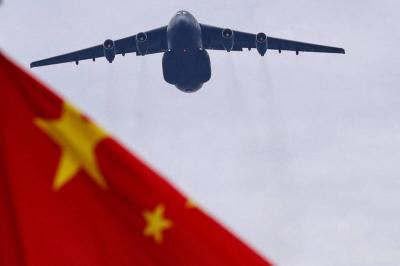
Beijing could eventually see a full amphibious invasion of Taiwan as the only "prudent" way to bring about unification, the US Department of Defense said in a newly released annual report to Congress. The Pentagon's "Annual Report to Congress: Military and Security Developments Involving the People's Republic of China 2025," was in many ways similar to last year’s report but reorganized the analysis of the options China has to take over Taiwan. Generally, according to the report, Chinese leaders view the People's Liberation Army's (PLA) capabilities for a Taiwan campaign as improving, but they remain uncertain about its readiness to successfully seize

Taiwan is getting a day off on Christmas for the first time in 25 years. The change comes after opposition parties passed a law earlier this year to add or restore five public holidays, including Constitution Day, which falls on today, Dec. 25. The day marks the 1947 adoption of the constitution of the Republic of China, as the government in Taipei is formally known. Back then the Chinese Nationalist Party (KMT) governed China from Nanjing. When the KMT, now an opposition party in Taiwan, passed the legislation on holidays, it said that they would help “commemorate the history of national development.” That

Taiwan has overtaken South Korea this year in per capita income for the first time in 23 years, IMF data showed. Per capita income is a nation’s GDP divided by the total population, used to compare average wealth levels across countries. Taiwan also beat Japan this year on per capita income, after surpassing it for the first time last year, US magazine Newsweek reported yesterday. Across Asia, Taiwan ranked fourth for per capita income at US$37,827 this year due to sustained economic growth, the report said. In the top three spots were Singapore, Macau and Hong Kong, it said. South

Snow fell on Yushan (Jade Mountain, 玉山) yesterday morning as a continental cold air mass sent temperatures below freezing on Taiwan’s tallest peak, the Central Weather Administration (CWA) said. Snowflakes were seen on Yushan’s north peak from 6:28am to 6:38am, but they did not fully cover the ground and no accumulation was recorded, the CWA said. As of 7:42am, the lowest temperature recorded across Taiwan was minus-5.5°C at Yushan’s Fengkou observatory and minus-4.7°C at the Yushan observatory, CWA data showed. On Hehuanshan (合歡山) in Nantou County, a low of 1.3°C was recorded at 6:39pm, when ice pellets fell at Songsyue Lodge (松雪樓), a


 RSS
RSS