


Civic representatives yesterday questioned the three presidential candidates in the televised debate about issues ranging from environmental protection, judicial reform, inequitable income distribution and human rights to the welfare of women and children, education and exorbitant housing prices.
Taiwan Healthcare Reform Foundation deputy director Liu Fu-mei (劉芙媺) asked the candidates to propose solutions to reform the National Health Insurance (NHI) program to make its premium contributions more fair and make it more sustainable.
People First Party Chairman James Soong (宋楚瑜) blamed both the Chinese Nationalist Party (KMT) and the Democratic Progressive Party (DPP) for the debt-ridden NHI system because outstanding debts were incurred by Ma during his stint as Taipei mayor and by the DPP-led Kaohsiung City Government, a problem that he said never happened when he served as governor of Taiwan Province.
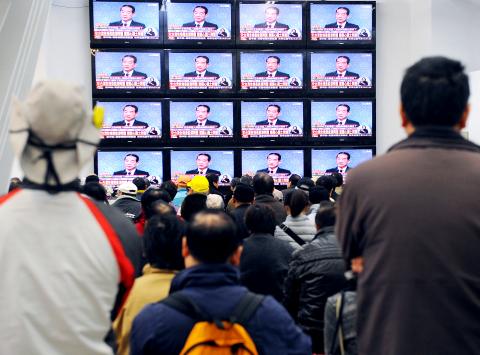
Photo: Wang Min-wei, Taipei Times
The health insurance system faces not only financial problems, but also healthcare quality issues, he said, adding that his administration would not just be a bookkeeper for the NHI system, but would carry out reforms under his personal supervision to safeguard the public’s health under the system.
Ma said he would continue to push reforms of the NHI system that began early this year.
Tsai said the Ma government’s revised program treated the symptoms, but not the root cause of the NHI’s problems because it failed to calculate premiums based on total income per household, adding that she would set up a research agency independent of the government to conduct studies of the NHI system regularly to continuously reform the health plan so that it could adapt to changes in society and the needs of the people.
Consumers’ Foundation chairwoman Joann Su (蘇錦霞) asked the candidates to propose policies to tackle commodity price hikes.
Ma said his administration would continue to adopt policies to address the problem, including imposing a fine on increases in the prices of commodities not in line with market rules, reducing import tariffs on materials, creating jobs to boost salaries and expanding subsidies and social programs.
Tsai said the government must act to buffer the effects of the rise in global commodity prices on importers and keep public utility rates in check to prevent improper increases that could lead to an out-of-control inflationary spiral, adding that the government should also demand that businesses lower prices if the hikes are caused by non-market factors, rather than just levying fines.
Soong highlighted the importance of the government taking precautions to tackle the problem by setting up mechanisms to predict possible price hikes, providing resources to medium and low-income families, and adopting measures to address imbalances in supply and demand.
Asked by Taiwan Association for Human Rights deputy president Lai Chung-chiang (賴中強) about her views on a national human rights commission and on the much-criticized Assembly and Parade Act (集會遊行法) to protect people’s right to protest, Tsai said she fully supported the idea of such a commission, adding it should be independent of the government to monitor government policies, produce national human rights reports and investigate possible infringements of human rights.
Ma said he was satisfied with the work of the Human Rights Commission under the Presidential Office.
Regarding the Assembly and Parade Act, Tsai said she would abolish the system that requires police permission to hold demonstrations and limit the powers given to the police to break up rallies, while Soong said he favored a registration system over the current permit system.
Ma, saying he has proposed replacing the permit system with registration in an amendment to the act pending legislative review, accused the DPP of stalling the amendment.
Yang Ju-men (楊儒門), a farmer activist and organizer of the 248 Farmers’ Market, expressed anger over the recent passage of the Land Expropriation Act (土地徵收條例) in the legislature, saying the government failed to ensure that land seizures are conducted according to the principles of fairness and justice.
Yang asked their views on turning the two parking lots in front of the Presidential Office into farmland to grow organic crops, saying the change can bring people close to farming and the land and that the crops could be served in lunches provided to children to teach them to enjoy locally grown foods.
Soong and Tsai both agreed with Yang on his criticism on the Land Expropriation Act, but Ma avoided questions on the act that was pushed through by the KMT caucus.
While Soong disagreed with the idea of growing crops on the Presidential Office parking lots, he said he would push for comprehensive reform to take care of disadvantaged farmers.
Ma said it was an “innovative idea” to convert the parking plots into farmland and said he would assess its feasibility.
In response to Taiwan Environment Protection Union chairman Wang Chun-hsiu (王俊秀), who said Ma had violated Article 23 of the Environment Basic Act (環境基本法) by continuing the construction of the Fourth Nuclear Power Plant, Ma reiterated his plan to reduce the use of nuclear energy, while Tsai said her energy plan was to increase the percentage of energy provided by alternative energy sources by 1 percent per year to gradually turn Taiwan from a country heavily reliant on energy imports to an energy-independent state.
Answering a question from Judicial Reform Foundation executive director Lin Feng-jeng (林峰正), Ma said it was inappropriate that some retired grand justices voiced support for his re-election and said he would not let that happen again.
Tsai emphasized the importance of promoting the concept of human rights to the judiciary because of insufficient protection of human rights in the judicial system.
Answering a question from Alliance for a Fair Tax Reform spokesman Wang Jung-chang (王榮璋) about the widening income disparity, both Tsai and Soong said they believed the situation could be improved through tax reforms to impose more taxes on the wealthy. Soong said that injustice in taxation is something that most people complain about.
“I’ll call a nationwide financial and taxation meeting once elected, because this is a national security issue,” Soong said.
Tsai echoed Soong’s remarks, and added that, besides imposing taxes on capital gains and security transactions, taxes on selling non-owner-occupied properties should also be increased.
While admitting that the wealth gap was an issue, Ma said the gap became smaller last year and that Taiwan was the country with the smallest wealth gap.
While Taiwan Labour Front Vice-Chairwoman Liao Hui-fang (廖蕙芳) criticized the phenomenon of increasing numbers of seasonal jobs and temporary workers, which provides little protection to workers’ rights, Ma said his administration has paid attention to temporary workers, and would like to protect their rights through legislation, such as limiting the number [of temporary workers in a company], “but it’s not easy to eliminate the phenomenon.”
“Maybe the manufacturing and service industries could give their employees more year-end bonuses as the New Year is approaching. That’s something that’s easier to do,” he added.
Tsai, answering the question after Ma, criticized his attitude.
“Apparently President Ma only has a superficial understanding of the issue, and does not see what’s at the core of labor poverty,” she said. “Without reforms in industries in the country, salary adjustments have been halted, non-traditional employment has increased, wages for temporary workers have gone down and the number of full-time openings has dropped, especially when government-funded businesses are taking the lead in hiring non-conventional workers.”
On the social housing issue, Tsai said that once elected, she would launch government-run urban renewal projects and reserve a certain number of housing units for disadvantaged groups.
“Our long-term goal is to have 800,000 — or 10 percent — of the housing units in the country as social housing,” she said. “And social housing units would not be located in remote areas. Rather, they would be right in the cities, with convenient means of transportation.”
Soong promised to build social housing projects on public lands.
“And before building social housing, I’ll build transportation networks around them and increase public facilities to make them convenient places to live,” he said.
Ma said that under his administration, the Legislative Yuan had adopted housing legislation.
“It may not be perfect, but at least it’s a historic step and it’s a beginning,” Ma said. “What did the DPP do? It did nothing.”

SECURITY: Starlink owner Elon Musk has taken pro-Beijing positions, and allowing pro-China companies to control Taiwan’s critical infrastructure is risky, a legislator said Starlink was reluctant to offer services in Taiwan because of the nation’s extremely high penetration rates in 4G and 5G services, the Ministry of Digital Affairs said yesterday. The ministry made the comments at a meeting of the legislature’s Transportation Committee, which reviewed amendments to Article 36 of the Telecommunications Management Act (電信管理法). Article 36 bans foreigners from holding more than 49 percent of shares in public telecommunications networks, while shares foreigners directly and indirectly hold are also capped at 60 percent of the total, unless specified otherwise by law. The amendments, sponsored by Chinese Nationalist Party (KMT) Legislator Ko
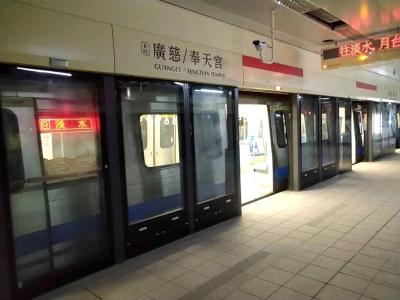
The eastern extension of the Taipei MRT Red Line could begin operations as early as late June, the Taipei Department of Rapid Transit Systems said yesterday. Taipei Rapid Transit Corp said it is considering offering one month of free rides on the new section to mark its opening. Construction progress on the 1.4km extension, which is to run from the current terminal Xiangshan Station to a new eastern terminal, Guangci/Fengtian Temple Station, was 90.6 percent complete by the end of last month, the department said in a report to the Taipei City Council's Transportation Committee. While construction began in October 2016 with an
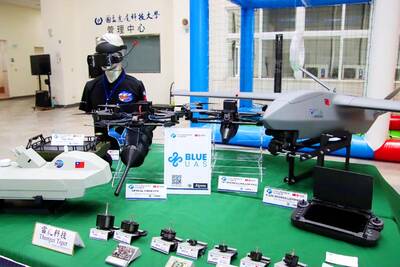
NON-RED SUPPLY: Boosting the nation’s drone industry is becoming increasingly urgent as China’s UAV dominance could become an issue in a crisis, an analyst said Taiwan’s drone exports to Europe grew 41.7-fold from 2024 to last year, with demand from Ukraine’s fight against Russian aggression the most likely driver of growth, a study showed. The Institute for Democracy, Society and Emerging Technology (DSET) in a statement on Wednesday said it found that many of Taiwan’s uncrewed aerial vehicle (UAV) sales were from Poland and the Czech Republic. These countries likely transferred the drones to Ukraine to aid it in its fight against the Russian invasion that started in 2022, it said. Despite the gains, Taiwan is not the dominant drone exporter to these markets, ranking second and fourth
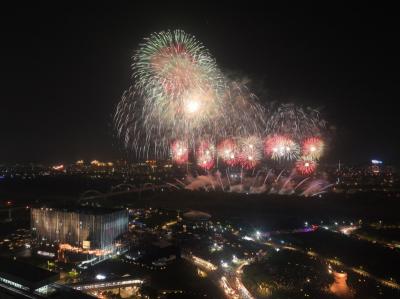
The New Taipei City Art Museum this weekend plans to celebrate its first anniversary with a two-day extravaganza featuring live concerts and a large-scale synchronized fireworks and drone display, the New Taipei City Cultural Affairs Department said. The two-day celebrations are to take place in the museum’s outdoor park, with markets and live performances by singers including Ann Bai (白安), Bii (畢書盡) and the Cosmos People (宇宙人), the department said. The highlight on both evenings would be the "Echoes of Light" show, an aerial spectacle combining fireworks and drone performances designed around the concept of "dual stages in the sky," it


 RSS
RSS