


Signs that Taiwan was preparing for possible war with China were once everywhere: huge posters calling for the “liberation” of China and lengthy schoolyard drills training students to fight the communist enemy. That culture has changed so much since a detente process began in the 1990s that many young Taiwanese are now unwilling to take up arms to protect Taiwan.
A survey published this week by CommonWealth Magazine appears to confirm that Taiwan’s process of demilitarization is rapidly gaining steam. Based on a sample of students aged 12 to 17, it found only 38.7 percent would be ready to see either themselves or a family member fight if a new war broke out, while 44.3 percent would not. The remainder had no opinion.
“It goes without saying that the number of Taiwanese willing to fight has come down significantly in recent years,” former deputy minister of national defense Lin Chong-pin (林中斌) said. “I’m even surprised that the number of pro-defense people cited by the magazine is so high.”
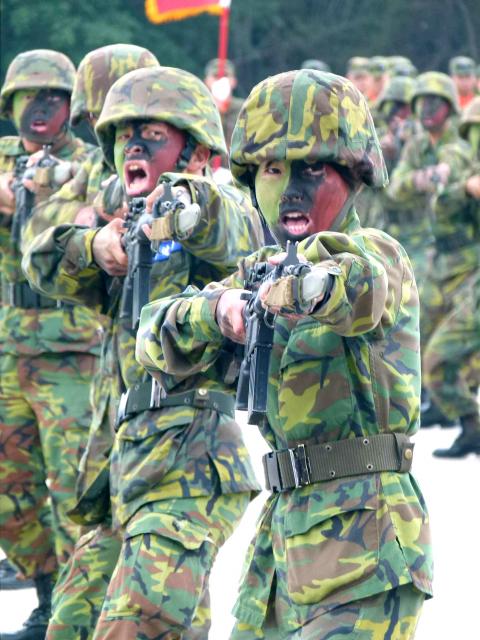
Photo: Wu Cheng-ting, Taipei Times
The Ministry of National Defense declined to comment on the survey, saying it had no information on the way it was conducted.
CommonWealth said it was carried out by mail between Oct. 17 and Nov. 4 and that the 3,715 responses represented a 74 percent return on the 5,054 questionnaires it sent.
Aside from shining a light on the huge changes now taking place in Taiwanese society, the findings offer a big challenge for Taiwan’s military, which is already struggling with a constricted defense budget and the reluctance of the US to supply it with the weapons it says it needs to cope with China’s ambitious military modernization.
While Taiwan plans to end its current system of 11-month mandatory male conscription in favor of an all-volunteer force by 2014, a lack of funds and difficulty in attracting recruits are almost certain to push that date back by several years. That will leave the military dependent on large numbers of apparently unmotivated draftees.
Tamkang University military specialist Alexander Huang (黃介正) says the negative trends in volunteer force recruiting are especially worrying.
“I have been asking university students for several years now whether they would be willing to join an all-volunteer military,” he said. “I get positive responses from no more than 2 or 3 percent.”
Taiwan has been engaged in a gradual program of detente with China over the past two decades, culminating in President Ma Ying-jeou’s (馬英九) efforts to bring the sides ever closer together, mostly through a series of ambitious commercial initiatives.
However, China has never renounced its long-standing threat to take over Taiwan by force should it move to make its de facto independence permanent, or delay unification indefinitely. It currently aims an estimated 1,500 missiles at Taiwanese targets, and conducts frequent drills simulating an invasion across the Taiwan Strait.
Despite the threats and the missiles, present-day Taiwan is a remarkably unmilitarized society, with few signs of a military presence outside of ministry facilities. Uniformed military personnel are rarely seen in major cities, and while highlights of annual war games are shown on television to boost morale, few people outside of the armed forces take them very seriously.
Huang and Lin ascribe the lack of military consciousness to the rapid improvement in relations with China, which they said made it difficult for young Taiwanese to conceive of the possibility of a return to the tension of the past.
“The atmosphere in cross-strait relations is so relaxed now,” Huang said. “It’s difficult to envision a war.”
Additional factors Huang cited for low military consciousness include the aversion of Taiwanese youth to military-style discipline and their belief that a military framework is incompatible with the “cyberlifestyle” many of them covet.
Fifteen-year-old Taipei high school student Gao Yu-kai explained his own lack of willingness to fight an invading Chinese force by saying it made no sense to -participate in a losing effort.
“We could never beat China,” he said. “They are just too strong.”
The pessimism of Taipei students comes against the background of the continuing drop in defense expenditures as a proportion of GDP, and Taiwan’s recent failure to convince the US — its most important strategic partner — to sell it new F-16C/D aircraft, for years the leading item on Taiwan’s military wish list.
Those developments — and Ma’s 2009 announcement that Taiwan’s military should henceforth see disaster relief as its main priority — appear to have done much to deflate whatever military consciousness survived the beginning of detente with China in the early 1990s and the development of a relationship that now includes the arrival of thousands of Chinese tourists in Taiwan every day and the maintenance of hundreds of weekly flights across the Taiwan Strait.

Considering that most countries issue more than five denominations of banknotes, the central bank has decided to redesign all five denominations, the bank said as it prepares for the first major overhaul of the banknotes in more than 24 years. Central bank Governor Yang Chin-lung (楊金龍) is expected to report to the Legislative Yuan today on the bank’s operations and the redesign’s progress. The bank in a report sent to the legislature ahead of today’s meeting said it had commissioned a survey on the public’s preferences. Survey results showed that NT$100 and NT$1,000 banknotes are the most commonly used, while NT$200 and NT$2,000

The Centers for Disease Control (CDC) yesterday reported the first case of a new COVID-19 subvariant — BA.3.2 — in a 10-year-old Singaporean girl who had a fever upon arrival in Taiwan and tested positive for the disease. The girl left Taiwan on March 20 and the case did not have a direct impact on the local community, it said. The WHO added the BA.3.2 strain to its list of Variants Under Monitoring in December last year, but this was the first imported case of the COVID-19 variant in Taiwan, CDC Deputy Director-General Lin Ming-cheng (林明誠) said. The girl arrived in Taiwan on

South Korea is planning to revise its controversial electronic arrival card, a step Taiwanese officials said prompted them to hold off on planned retaliatory measures, a South Korean media report said yesterday. A Yonhap News Agency report said that the South Korean Ministry of Foreign Affairs is planning to remove the “previous departure place” and “next destination” fields from its e-arrival card system. The plan, reached after interagency consultations, is under review and aims to simplify entry procedures and align the electronic form with the paper version, a South Korean ministry official said. The fields — which appeared only on the electronic form

The Ministry of Foreign Affairs (MOFA) is suspending retaliation measures against South Korea that were set to take effect tomorrow, after Seoul said it is updating its e-arrival system, MOFA said today. The measures were to be a new round of retaliation after Taiwan on March 1 changed South Korea's designation on government-issued alien resident certificates held by South Korean nationals to "South Korea” from the "Republic of Korea," the country’s official name. The move came after months of protests to Seoul over its listing of Taiwan as "China (Taiwan)" in dropdown menus on its new online immigration entry system. MOFA last week


 RSS
RSS