


More than 100 people, including residents of the Losheng (Happy Life) Sanatorium, supporters of its preservation as well as engineers, yesterday rallied outside the Control Yuan in Taipei and submitted a petition calling for a probe into the construction of a Mass Rapid Transit (MRT) maintenance depot that has allegedly led to landslides at the sanatorium site.
Shouting slogans urging the Department of Rapid Transit Systems (DORTS) to halt construction and holding placards that read “Losheng SOS,” the demonstraters rallied as their representatives entered the Control Yuan to submit the petition.
“We, the residents of Losheng, worry every day as we see the cracks in the walls grow bigger. We’ve petitioned the Taipei City Government and the Public Construction Commission several times, but we have never received any satisfactory responses from them,” Losheng Sanatorium Self-Help Organization chairwoman Chang Yun-ming (張雲明) told reporters.
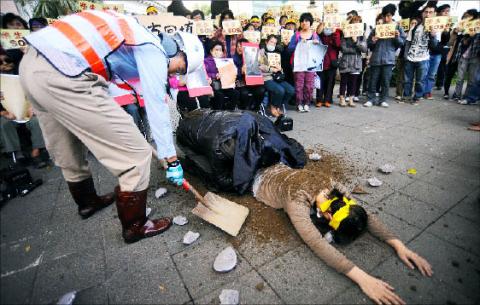
Photo: Lo Pei-der, Taipei Times
“The DORTS always says it will do some reinforcement work to solve the problem, but whatever it does, cracks appear again as soon as construction [of the depot] restarts,” Chang said. “We’re worried that a massive landslide could occur after days of torrential rain.”
Civil engineer Wang Wei-min (王偉民) confirmed Chang’s concerns.
“According to DORTS information, the soil on the hill [on which the sanatorium is located] is constantly sliding,” he said. “A magnitude 4 earthquake or seven to eight days of … torrential rain could cause the hill to collapse under the current conditions.”
If such a massive landslide happens, “it would be a disaster for Losheng residents, Sinjhuang residents and MRT construction workers,” Wang said. “What I propose is that the department refill what has been dug up so far to gain more time to look at what went wrong and how the problem can be remedied.”
The Losheng Sanatorium, located in New Taipei City’s (新北市) Sinjhuang District (新莊), was completed in the 1930s to house people with Hansen’s disease (also known as leprosy) and isolate them from the outside world, as the disease was once believed to be highly contagious and incurable.
In 2002, the government decided to tear down the sanatorium complex to make way for an MRT station and maintenance depot. However, this decision was met with strong opposition from preservationists.
A compromise was struck in 2007 to preserve a small part of the original campus.
However, controversies surrounding the sanatorium continued as construction of the MRT station led to continuous small landslides and cracks forming in buildings.
Although the department allegedly repeatedly promised over the years that the problem could be solved by applying certain engineering techniques, this never happened. Construction was suspended several times in the past year as landslides seemed to occur more often and grew bigger.
Last week the department called another stop to construction at the station until the landslide problem could be solved once and for all.
Former chairpersons of the Association of Engineering Geologists also attended the protest to voice their support for the preservationists.
“As an engineering geologist, I was shocked when I saw the geological data for the Losheng Sanatorium and the engineering methods used by DORTS,” former chairman of the group Chen Kuo-hua (陳國華) said.
“To hold the sliding [soil] layer [in place], a ground anchor has to go through the sliding layer and the fault zone and be hammered into a more stable layer, such as the rock basin or a gravel layer — but this is not the case at the MRT station,” he said.
It is not surprising that landslides would continue to occur, since the ground anchors that DORTS is using are not long enough, Chen said.
“On the other hand, if the ground anchor is too long, it would not be as strong, so it must be specially made,” he said.
Control Yuan member Chen Yung-hsiang (陳永祥) accepted the petition and promised a probe, adding he would soon visit the site for an inspection.

FUKUOKA SITUATION: Japanese media reported that the pathogen is expected to be identified by the summer, while the CDC downplayed the idea that it was hMPV A “mysterious cold-like illness” reported in Japan’s Fukuoka Prefecture does not seem to be a new disease, but Japanese authorities have been asked about the situation, the Centers for Disease Control (CDC) said yesterday. The Fukuoka Prefectural Medical Association on Wednesday told a news conference that a “mystery cold” that has become a hot topic on social media is “highly likely to be caused by some kind of viral infection,” Japan’s KBC News reported. “Many people are experiencing symptoms starting with a sore throat, followed by a runny nose, phlegm and a severe cough,” KBC News reported, citing association officials. Health authorities are

Nvidia Corp CEO Jensen Huang (黃仁勳) arrived in Taiwan yesterday ahead of upcoming AI and technology events, saying he plans to meet with clients and Taiwan Semiconductor Manufacturing Co Chairman C.C. Wei (魏哲家) during his visit. After landing at Taipei Songshan Airport, Huang posed for photos with fans and handed out Yakult drinks to reporters and supporters waiting at the scene, saying he has “a lot to do” during the trip. Asked about reports that Nvidia’s planned headquarters site in Taipei’s Beitou Shilin Technology Park could break ground on May 27, Huang said that if the company holds an event, he would

The Ministry of Finance this afternoon announced the winning numbers for the March-April uniform invoice lottery. The winning number for the NT$10 million (US$318,060) special prize is 19531471, and the winning number for the NT$2 million grand prize is 85941329. Three numbers were drawn for the NT$200,000 first prize: 07225810, 20231230 and 83518781. Those with receipts matching the last seven digits of any of the first-prize numbers will win the NT$40,000 second prize, while those matching the last six digits will win the NT$10,000 third prize. Those whose receipts match the last five digits of the first-prize numbers can claim the NT$4,000 fourth prize,

Former president Ma Ying-jeou (馬英九) yesterday expressed “shock and regret” over a statement issued by his wife without his consent, and rejected her assertion that his eldest sister, Ma Yi-nan (馬以南), would manage his medical care or act as his spokesperson amid an ongoing embezzlement probe into his foundation. Ma Ying-jeou in a statement said he was shocked by a statement by his wife, Chou Mei-ching (周美青), regarding his affairs. Ma Yi-nan “must not” be in charge of his healthcare and other personal affairs, nor can she be allowed to represent the Ma family, the former president said. He said he was also


 RSS
RSS