


A senior military official yesterday denied a media report that the navy would dispatch a fleet to protect Taiwan’s long-line fishing boats off the coast of Somalia by the end of this month, but said the navy was capable and had prepared for such a mission.
Deputy Minister of National Defense Chao Shih-chang (趙世璋) made the remarks at a joint committee meeting at the legislature.
TV station TVBS reported yesterday that following attacks on Taiwanese long-line fishing vessels by pirates, the National Security Council (NSC) had coordinated with the Ministry of National Defense to dispatch a fleet to protect Taiwan’s fishing boats in the Indian Ocean off Somalia by the end of this month.
The TVBS report added that a couple of Lafayette-class warships and a Wu Yi-class fleet oiler would head to the Indian Ocean, and that a Cheng Kung-class guided-missile frigate could also join the fleet.
Asked to comment by legislators across party lines, Chao said the report was not correct.
“The military has the capability and has prepared to carry out such a mission, but the military follows the government’s policy and needs to listen to opinions from the NSC and the Ministry of Foreign Affairs,” Chao said.
Chinese Nationalist Party (KMT) Legislator Lin Yu-fang (林郁方) told the meeting that unlike most merchant vessels sailing fixed routes, fishing vessels moved with groups of fish, therefore guarding fishing boats could be difficult.
Lin asked what the navy would do if countries without diplomatic relations with Taiwan agreed to allow Taiwanese vessels to resupply at their ports, but asked that they lower their national and ship flags while doing so.
Lin said there were questions as to whether returning ships could be replaced by another fleet to ensure year-long protection.
Taiwanese fishing boats were attacked by pirates in 2007 and again in April 2009, when two fishing boats were hijacked.
In October last year, another fishing boat was seized off the coast of Somalia.

SECURITY: Starlink owner Elon Musk has taken pro-Beijing positions, and allowing pro-China companies to control Taiwan’s critical infrastructure is risky, a legislator said Starlink was reluctant to offer services in Taiwan because of the nation’s extremely high penetration rates in 4G and 5G services, the Ministry of Digital Affairs said yesterday. The ministry made the comments at a meeting of the legislature’s Transportation Committee, which reviewed amendments to Article 36 of the Telecommunications Management Act (電信管理法). Article 36 bans foreigners from holding more than 49 percent of shares in public telecommunications networks, while shares foreigners directly and indirectly hold are also capped at 60 percent of the total, unless specified otherwise by law. The amendments, sponsored by Chinese Nationalist Party (KMT) Legislator Ko
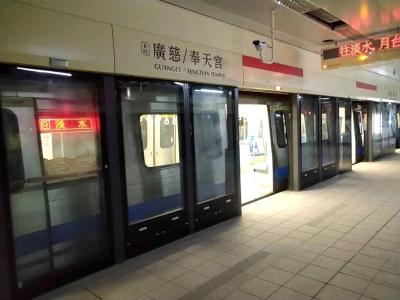
The eastern extension of the Taipei MRT Red Line could begin operations as early as late June, the Taipei Department of Rapid Transit Systems said yesterday. Taipei Rapid Transit Corp said it is considering offering one month of free rides on the new section to mark its opening. Construction progress on the 1.4km extension, which is to run from the current terminal Xiangshan Station to a new eastern terminal, Guangci/Fengtian Temple Station, was 90.6 percent complete by the end of last month, the department said in a report to the Taipei City Council's Transportation Committee. While construction began in October 2016 with an
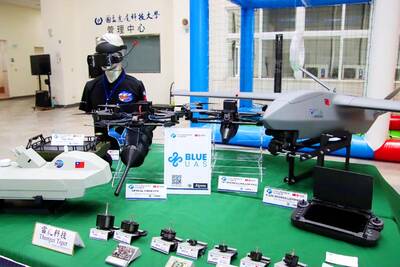
NON-RED SUPPLY: Boosting the nation’s drone industry is becoming increasingly urgent as China’s UAV dominance could become an issue in a crisis, an analyst said Taiwan’s drone exports to Europe grew 41.7-fold from 2024 to last year, with demand from Ukraine’s fight against Russian aggression the most likely driver of growth, a study showed. The Institute for Democracy, Society and Emerging Technology (DSET) in a statement on Wednesday said it found that many of Taiwan’s uncrewed aerial vehicle (UAV) sales were from Poland and the Czech Republic. These countries likely transferred the drones to Ukraine to aid it in its fight against the Russian invasion that started in 2022, it said. Despite the gains, Taiwan is not the dominant drone exporter to these markets, ranking second and fourth

Japanese Prime Minister Sanae Takaichi’s comment last year on Tokyo’s potential reaction to a Taiwan-China conflict has forced Beijing to rewrite its invasion plans, a retired Japanese general said. Takaichi told the Diet on Nov. 7 last year that a Chinese naval blockade or military attack on Taiwan could constitute a “survival-threatening situation” for Japan, potentially allowing Tokyo to exercise its right to collective self-defense. Former Japan Ground Self-Defense Force general Kiyofumi Ogawa said in a recent speech that the remark has been interpreted as meaning Japan could intervene in the early stages of a Taiwan Strait conflict, undermining China’s previous assumptions


 RSS
RSS