


American Institute in Taiwan (AIT) Director William Stanton yesterday called for cooperation with Taiwan in five key areas to build a clean and sustainable environment for future generations.
“We can do more together than either of us can do alone,” Stanton said while addressing government officials and industrial professionals at the second US-Taiwan Clean Energy Forum, held in Taipei.
Stanton said the US and Taiwan should bring their best minds together and use the full force of their technological and scientific capabilities to find breakthrough solutions to the problem of greenhouse gas emissions.
The two countries should also get scientists and engineers together to develop technology for carbon capture and carbon storage to eliminate the damage done by coal-fired power plants, Stanton said. There has been an agreement in place to cooperate in this regard since 2004, but no programs have been conducted under it, he added.
“In the United States, we have challenged our researchers to advance carbon capture and storage technology to the point where widespread, affordable deployment is possible within 10 years. This is a big challenge, but one that we believe is achievable,” he said.
Stanton said the US and Taiwan could also cooperate to develop biofuels based on the Algal Biofuels Research Cooperation Agreement that the US National Alliance for Advanced Biofuels and Bio-products and Taiwan’s Industrial Technology Research Institute signed yesterday.
“This is an excellent example of how our private sector institutions can take a leadership role in advancing clean energy technology,” he said.
The US and Taiwan both rely heavily on fossil fuels, especially coal, to power their economies, and should also look for new ways to collaborate on other renewable technologies, such as wind and solar power, Stanton said.
Both should also pursue initiatives to share best practices in appliance standards, energy efficient buildings, industrial energy efficiency audits and methods that can be used to finance these energy improvements, he said.
Premier Wu Den-yih (吳敦義) told the forum that Taiwan has been working to fulfill its responsibility for sustainable development as a member of the global village and he responded favorably to Stanton’s call for further cooperation.
Taiwan’s economic growth reached 10.88 percent last year, but its carbon emissions increased by just 6.2 percent on an annual basis and its overall energy intensity declined 4.3 percent, Wu said.
Environmental Protection Administration (EPA) Minister Stephen Shen (沈世宏) reiterated the government’s commitment to reduce the nation’s greenhouse gas emissions by at least 30 percent relative to the business-as-usual benchmark before 2020.
The goal was set by President Ma Ying-jeou (馬英九) during his 2008 election campaign.
Bill Wiseman, chairman of the American Chamber of Commerce in Taipei (AmCham), said US businesses in Taiwan supported the objective, but wished the government could map out its strategies to achieve that goal.
US businesses “are not exactly sure what the abatement target Taiwan is striving toward means for business,” Wiseman said, adding that they would like to “make sure of the steps to be taken [by the government] so we don’t get surprised later on.”
US Environmental Protection Agency Administrator Lisa Jackson delivered a videotaped speech to the forum, encouraging the US’ partners in Asia to implement strategies similar to those that the US has adopted to explore clean-energy sources.
The forum, hosted by the AIT, the EPA and AmCham, will be followed by the Taiwan International Green Industry Show (TiGiS) organized by the Ministry of Economic Affairs, which opens today.
The exhibition at Taipei World Trade Center’s Hall 1 features a US pavilion to showcase US green products and will run through Saturday.

The Ministry of Finance this afternoon announced the winning numbers for the March-April uniform invoice lottery. The winning number for the NT$10 million (US$318,060) special prize is 19531471, and the winning number for the NT$2 million grand prize is 85941329. Three numbers were drawn for the NT$200,000 first prize: 07225810, 20231230 and 83518781. Those with receipts matching the last seven digits of any of the first-prize numbers will win the NT$40,000 second prize, while those matching the last six digits will win the NT$10,000 third prize. Those whose receipts match the last five digits of the first-prize numbers can claim the NT$4,000 fourth prize,

SIX SUBSIDIES: The monthly allowance for older farmers is to increase to NT$10,000, and NT$5,000 is to be given to homemakers under the national pension system, Lai said The government is to implement major welfare policies for disadvantaged groups, including raising the monthly allowance for older farmers to NT$10,000 and providing homemakers with NT$5,000 per month, President William Lai (賴清德) said yesterday. Lai made the remarks during a visit to Wangling Temple in Chiayi County, saying that the planned increases were being introduced amid economic growth and an increase in tax revenue. Touting a policy, in which the government plans to provide a monthly allowance of NT$5,000 for every child under the age of 18 in a bid to address Taiwan’s low birthrate, Lai said that if received for the
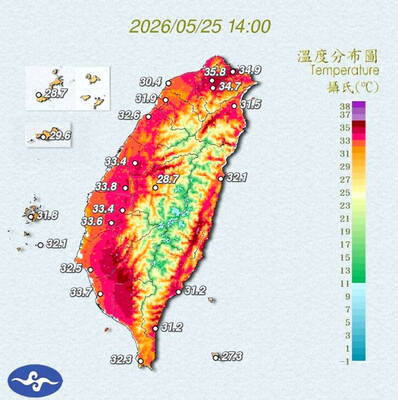
STAY COOL: The HPA recommended that people stay hydrated, use air-conditioning or fans while indoors, wear loose-fitting clothes and walk in the shade while outdoors Employers must implement measures such as installing cooling equipment, and providing drinking water and rest breaks for outdoor workers starting from Monday next week, the Taipei Department of Labor said on Sunday. Employers who fail to comply could face fines of NT$30,000 to NT$300,000 under the Occupational Safety and Health Act (職業安全衛生法), the department said. Businesses in Taipei employing fewer than 100 workers, as well as registered self-employed workers with labor insurance coverage, could receive on-site assessments and guidance from occupational safety consultants to help them apply for central government subsidies to implement or improve heat-protection measures, it said. Under the Ministry of

NATIONAL SECURITY: Authorities are working to confirm the identities of the military personnel involved and investigating possible illegal conduct and regulatory violations Authorities are probing possible national security implications after Kinmen police and immigration officers on Sunday found a Chinese woman allegedly posing as a tourist while engaging in prostitution involving more than 10 military personnel. The woman, surnamed Chen (陳), has since been deported, authorities said, adding that investigators are still working to confirm the identities of those implicated, as the records only listed code names and aliases. The case stemmed from a report received by the Kinmen District Prosecutors’ Office on Friday last week from the Jinhu Precinct of the Kinmen County Police Bureau. On Sunday, police, along with the National Immigration


 RSS
RSS