


Dozens of Aborigines representing various tribes throughout the country yesterday gathered on Ketagalan Boulevard in front of the Presidential Office to voice their anger at the Republic of China (ROC) government’s occupation of Aboriginal land as they performed a traditional ritual to drive away evil spirits.
“Let’s kick the ROC government out of here. Let’s kick the ROC government off the land that our ancestors passed down to us. Let’s drive away the evil spirits that come from this government,” an elder Amis shaman sang in a traditional Amis song, while waving a piece of banana leaf.
Hsiao Shih-huei (蕭世暉), a member of the Association of Taiwan Indigenous Peoples’ Policies explained the meaning of the ritual to reporters.
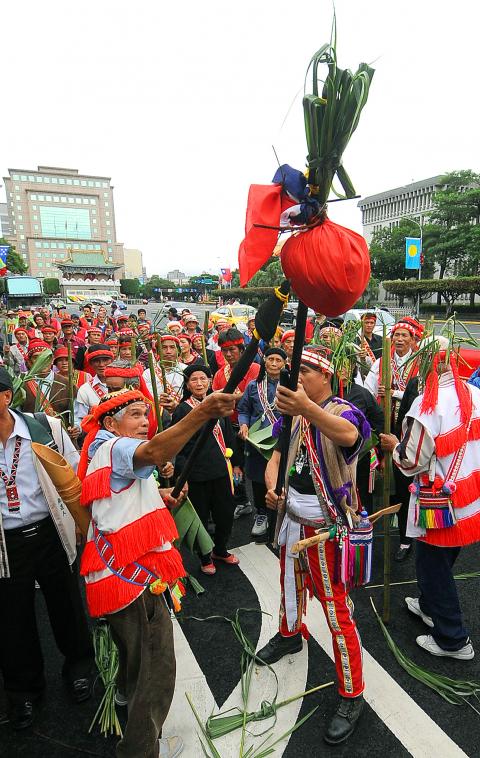
Photo: Wang Min-wei, Taipei Times
“What she is doing is a ritual that proceeds a headhunt to point out to a villages’ warriors where the evil spirits are,” Hsiao said. “For the Aborigines, a headhunt is a way to clear away evil spirits that are causing harm to their village.”
Before the headhunt began, the leader of the warriors prayed to an ancestral spirit and spat millet wine on everyone participating to bless them.
As the shaman pointed to the Presidential Office to indicate the direction from where the evil spirits resided, the warriors ran toward it, shouting, pointing their pikes and miscanthus stems at the building.
Hsiao said the Amis believe miscanthus — a grass — can protect them from the evil spirits.
After repeating the act, the shaman said they had successfully driven away the evil spirits. The men cheered and performed a symbolic headhunt by attacking a ball wrapped with an ROC flag. After taking the “head,” the warriors tied it to a spike with miscanthus.
One by one, warriors poked the flag with miscanthus, a symbolic gesture to vanquish the evil spirit before the head would be taken back to the village as a trophy.
Although several tribes were represented at the event, the ritual was performed according to Amis tradition, as Amis from Hualien and Taitung counties outnumbered other tribes and are impacted more by the government’s handling of Aboriginal land, organizers said.
Indigenous Peoples’ Actions Coalition of Taiwan secretary-general Omi Wilang, an Atayal, said Aborigines were fed up with the ROC government’s disrespect for Taiwan’s first inhabitants.
“We’ve been here for thousands of years and the ROC is only going to celebrate its 100th anniversary — not to mention that the ROC has actually only been on Taiwan for more than 60 years,” Omi said. “The ROC is no different from the Japanese colonial government, as both seized our lands and repressed our cultures and languages.”
A rally was held in the evening for each village that has fallen victim of government-land use policies.
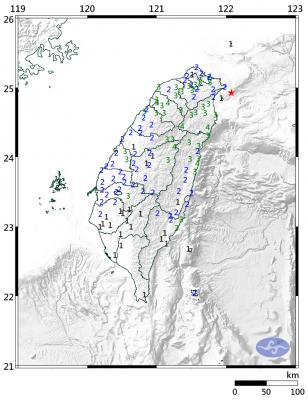
A magnitude 6.1 earthquake struck off the coast of Yilan County at 8:39pm tonight, the Central Weather Administration (CWA) said, with no immediate reports of damage or injuries. The epicenter was 38.7km east-northeast of Yilan County Hall at a focal depth of 98.3km, the CWA’s Seismological Center said. The quake’s maximum intensity, which gauges the actual physical effect of a seismic event, was a level 4 on Taiwan’s 7-tier intensity scale, the center said. That intensity level was recorded in Yilan County’s Nanao Township (南澳), Hsinchu County’s Guansi Township (關西), Nantou County’s Hehuanshan (合歡山) and Hualien County’s Yanliao (鹽寮). An intensity of 3 was
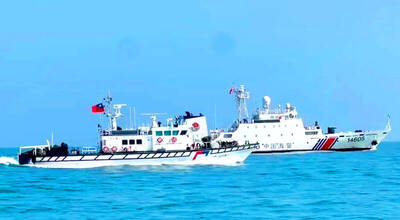
Instead of focusing solely on the threat of a full-scale military invasion, the US and its allies must prepare for a potential Chinese “quarantine” of Taiwan enforced through customs inspections, Stanford University Hoover fellow Eyck Freymann said in a Foreign Affairs article published on Wednesday. China could use various “gray zone” tactics in “reconfiguring the regional and ultimately the global economic order without a war,” said Freymann, who is also a nonresident research fellow at the US Naval War College. China might seize control of Taiwan’s links to the outside world by requiring all flights and ships entering or leaving Taiwan
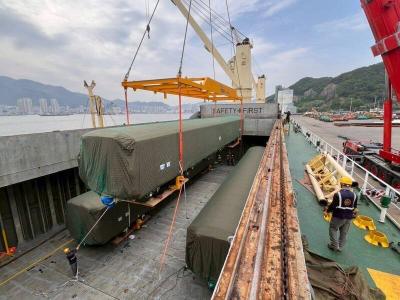
The first of 10 new high-capacity trains purchased from South Korea’s Hyundai Rotem arrived at the Port of Taipei yesterday to meet the demands of an expanding metro network, Taipei Rapid Transit Corp (TRTC) said yesterday. The train completed a three-day, 1,200km voyage from the Port of Masan in South Korea, the company said. Costing NT$590 million (US$18.79 million) each, the new six-carriage trains feature a redesigned interior based on "human-centric" transportation concepts, TRTC said. The design utilizes continuous longitudinal seating to widen the aisles and optimize passenger flow, while also upgrading passenger information displays and driving control systems for a more comfortable
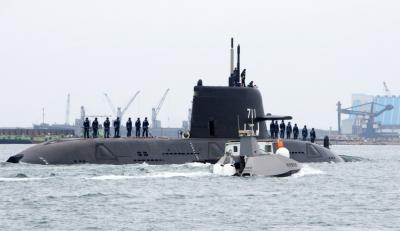
Taiwan's first indigenous defense submarine, the SS-711 Hai Kun (海鯤, or Narwhal), departed for its 13th sea trial at 7am today, marking its seventh submerged test, with delivery to the navy scheduled for July. The outing also marked its first sea deployment since President William Lai (賴清德) boarded the submarine for an inspection on March 19, drawing a crowd of military enthusiasts who gathered to show support. The submarine this morning departed port accompanied by CSBC Corp’s Endeavor Manta (奮進魔鬼魚號) uncrewed surface vessel and a navy M109 assault boat. Amid public interest in key milestones such as torpedo-launching operations and overnight submerged trials,


 RSS
RSS