


Dozens of environmental activists gathered in front of the Commercial Office of Brazil yesterday, urging the Brazilian government to put a stop to the recently approved construction of the Belo Monte Hydroelectric Dam, which they say will destroy much of the Amazon rainforest.
The demonstration was part of a series of simultaneous protests worldwide targeting Brazilian embassies or consulates.
A short play by people wearing hand-painted Aboriginal masks trying to save the earth by fighting off another person wearing a blue monster mask and wielding an ax — symbolizing the construction of the dam — was performed on the sidewalk, while protesters shouted: “Stop the dam construction and protect the rainforest.”
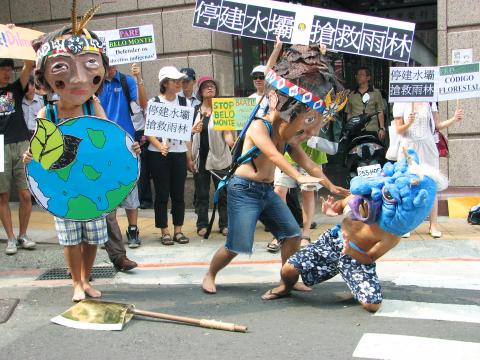
Photo: Lee I-chia, Taipei Times
The project on the Xingu River, one of the Amazon’s main tributaries, was approved by the Brazilian government and passed by the Brazilian Institute of the Environment and Renewable Resources on June 1. The dam will be the world’s third-largest hydroelectric project.
The construction plan triggered several protests from environmental and human rights activists in Brazil, with protest leaders asking for global support through the Internet.
“I started the online petition in Taiwan because I saw a global petition asking for support on Facebook,” said Shamba (Lin Su-ling, 林素綾), who organized the rally.
The dam will divert more than 80 percent of the water from the Xingu, leaving downstream areas short of water, Shamba said, adding that the water supply and power generation efficiency of the dam could be as low as 40 percent because of the three-to-five month annual dry season.
Shamba said that if the “disastrous” dam were built, it would destroy at least 1,500km2 of rainforest land, resulting in the forced displacement of between 20,000 and 40,000 indigenous people and the loss of countless numbers of invaluable animal and plant species.
Green Party Taiwan spokesperson Pan Han-shen (潘翰聲) said that while many people regard hydropower as a renewable and environmentally friendly energy source, it often results in the destruction of the natural environment.
The only way to protect the earth is by saving energy and Taiwanese should take an interest in such issues as similar cases are occurring here.
Yapit-Tali, an Aboriginal representative from the Against Kaotai Reservoir Self-Help Association in Hsinchu City, said many Aboriginal villages in Taiwan were facing similar threats of forced displacement.
Their traditional culture will disappear, as their homeland and natural environment may be sacrificed for economic development, she said.

NATIONAL SECURITY: Authorities are working to confirm the identities of the military personnel involved and investigating possible illegal conduct and regulatory violations Authorities are probing possible national security implications after Kinmen police and immigration officers on Sunday found a Chinese woman allegedly posing as a tourist while engaging in prostitution involving more than 10 military personnel. The woman, surnamed Chen (陳), has since been deported, authorities said, adding that investigators are still working to confirm the identities of those implicated, as the records only listed code names and aliases. The case stemmed from a report received by the Kinmen District Prosecutors’ Office on Friday last week from the Jinhu Precinct of the Kinmen County Police Bureau. On Sunday, police, along with the National Immigration

GLOBALGIVING: ‘ Caving to external pressure is not acceptable for an organization that has cultivated justice reform and human rights for 30 years,’ one NGO said A slew of non-government organizations (NGOs) have withdrawn from the GlobalGiving fundraising platform after it announced it would use “Chinese Taipei” instead of “Taiwan” from next month. The Taiwan Good Rice Association wrote on Facebook on Friday that it was informed on April 28 via a teleconference call of the change, which was made because the platform wanted to operate in China. Taiwan Good Rice is to terminate all cooperative relationships with GlobalGiving in response to the platform’s “unilateral and non-negotiable” decision to remove references to Taiwan, the NGO said. “Taiwan is in the official name of Taiwan Good Rice Association and the

HEAVY WEATHER: Typhoon Jangmi is due to crash straight into the Ryukyus as airlines look to shift flights to larger aircraft or cancel flights to Okinawa entirely Taiwan’s international air carriers announced flight adjustments over the weekend as Typhoon Jangmi is forecast to hit the Ryukyu Islands today and tomorrow. The Central Weather Administration (CWA) upgraded Jangmi from a tropical storm to a typhoon at 8am yesterday, with the eye located 580km south of Naha city. It was moving north at 19kph. Today, China Airlines’ CI-120, CI-121, CI-122 and CI-123 flights between Taoyuan and Naha, Okinawa, have been canceled as well as CI-132 and CI-133 between Kaohsiung and Naha. EVA Air’s BR-112, BR-113, BR-186 and BR-185 flights between Taoyuan and Naha are also canceled. Low-cost carrier Tigerair Taiwan canceled IT-230,

REASONS FOR TRAVEL: An assistant professor said that proposed amendments to penalize drivers if they used drugs overseas would not deter people from traveling People who operate a motor vehicle under the influence of marijuana would have their driver’s license revoked, even if they used the substance while overseas, the Ministry of Transportation and Communications said yesterday, citing proposed amendments to the Road Traffic Management and Penalty Act (道路交通管理處罰條例). The amendments would also authorize the government to revoke the licenses of people determined to have used Category 1 or Category 2 narcotics, even if they were not operating a vehicle while under the influence of drugs, as well as ban them from taking the license test for three years, the ministry said. People aged 18 or


 RSS
RSS