


Taiwanese taekwondo athlete Yang Shu-chun (楊淑君) said yesterday she had decided to withdraw an appeal filed with the Swiss-based Court of Arbitration for Sports (CAS) over her disqualification at the Asian Games in Guangzhou, China, last year over allegations that she placed extra sensors on her electronic socks as a tactic to score points.
The 26-year-old athlete, who earlier this month qualified to compete in the London Olympics next year, said she had decided to focus on training for the Olympics Games instead.
“I thank everyone for their concern and encouragement after the incident,” Yang told a press conference. “I have continued to take part in taekwondo events after taking a brief rest and have qualified to compete in the Olympics. This proves that I have both the potential and the ability to succeed [as a taekwondo athlete]. For the sake of the healthy development of the sport and the futures of other athletes, I am voluntarily withdrawing my appeal. My goal is very clear: I will prepare for the challenges that lay ahead.”
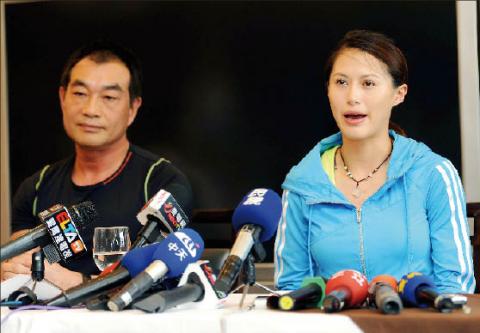
Photo: Chang Chia-ming, Taipei Times
Yang emphasized that terminating the appeal did not mean that she had given up in her efforts to clear her name.
“If I win a gold medal at the Olympics and earn the respect I deserve, then I can forget the fact I was wrongly accused of cheating,” she said
Yang added that she would repay her supporters by doing her very best at the Olympics.
The Sports Affairs Council (SAC) issued a statement, saying it respected Yang’s decision.
“Yang was the one who decided to appeal to the CAS, which had scheduled a two-day session to hear testimony next month,” the council said. “Although we think it is a pity [that Yang decided to drop the appeal], we respect any decision she makes.”
The government had promised to provide any necessary legal assistance to help Yang clear her name after her controversial disqualification last year.
According to the SAC, more than NT$3 million (US$103,811) has been spent on related lawsuits.
Sports Affairs Council Deputy Minister Steven Chen (陳士魁) said the council did not find out about Yang’s decision until yesterday, adding that it would not ask her to repay the cost of the lawsuits to date.
“We can only accept the result, even though it is far from satisfactory,” he said.
Chen said that so far there is no strong evidence proving that either Yang or the World Taekwondo Federation was right and as a result, the lawsuits could lead nowhere if both sides maintained their position.
Meanwhile, Chen confirmed that the Asian Taekwondo Union had recently apologized in a formal notice for calling Yang a liar in one of its press releases issued during the Asian Games.
Yang decided to appeal to the CAS one month after she was disqualified at the Asian Games in November last year. The World Taekwondo Federation ruled in December that Yang should be banned from taking part in any competition for three months. Her coach was banned from attending competitions for 20 months. The Chinese Taipei Taekwondo Association was also fined US$50,000.

Taiwan has received more than US$70 million in royalties as of the end of last year from developing the F-16V jet as countries worldwide purchase or upgrade to this popular model, government and military officials said on Saturday. Taiwan funded the development of the F-16V jet and ended up the sole investor as other countries withdrew from the program. Now the F-16V is increasingly popular and countries must pay Taiwan a percentage in royalties when they purchase new F-16V aircraft or upgrade older F-16 models. The next five years are expected to be the peak for these royalties, with Taiwan potentially earning
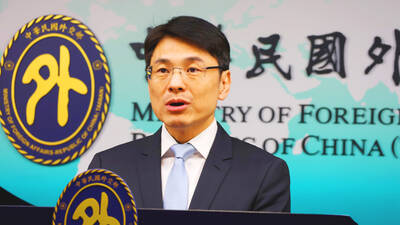
STAY IN YOUR LANE: As the US and Israel attack Iran, the ministry has warned China not to overstep by including Taiwanese citizens in its evacuation orders The Ministry of Foreign Affairs (MOFA) yesterday rebuked a statement by China’s embassy in Israel that it would evacuate Taiwanese holders of Chinese travel documents from Israel amid the latter’s escalating conflict with Iran. Tensions have risen across the Middle East in the wake of US and Israeli airstrikes on Iran beginning Saturday. China subsequently issued an evacuation notice for its citizens. In a news release, the Chinese embassy in Israel said holders of “Taiwan compatriot permits (台胞證)” issued to Taiwanese nationals by Chinese authorities for travel to China — could register for evacuation to Egypt. In Taipei, the ministry yesterday said Taiwan
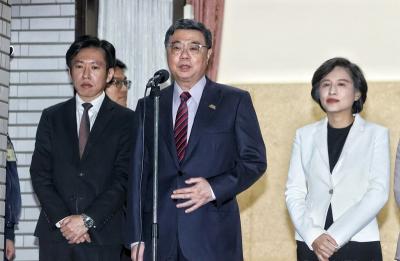
Taiwan is awaiting official notification from the US regarding the status of the Agreement on Reciprocal Trade (ART) after the US Supreme Court ruled US President Donald Trump's global tariffs unconstitutional. Speaking to reporters before a legislative hearing today, Premier Cho Jung-tai (卓榮泰) said that Taiwan's negotiation team remains focused on ensuring that the bilateral trade deal remains intact despite the legal challenge to Trump's tariff policy. "The US has pledged to notify its trade partners once the subsequent administrative and legal processes are finalized, and that certainly includes Taiwan," Cho said when asked about opposition parties’ doubts that the ART was
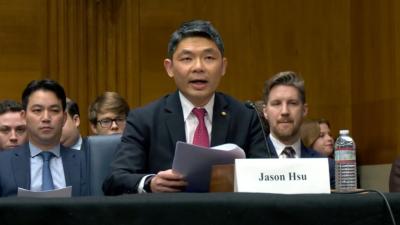
If China chose to invade Taiwan tomorrow, it would only have to sever three undersea fiber-optic cable clusters to cause a data blackout, Jason Hsu (許毓仁), a senior fellow at the Hudson Institute and former Chinese Nationalist Party (KMT) legislator, told a US security panel yesterday. In a Taiwan contingency, cable disruption would be one of the earliest preinvasion actions and the signal that escalation had begun, he said, adding that Taiwan’s current cable repair capabilities are insufficient. The US-China Economic and Security Review Commission (USCC) yesterday held a hearing on US-China Competition Under the Sea, with Hsu speaking on


 RSS
RSS