


Four months after a powerful earthquake and tsunami sparked a crisis at the Fukushima Dai-ichi nuclear power plant in Japan, environmental protection activists yesterday said the Taiwanese government remained flippant about nuclear safety.
During a press conference at the legislature, Democratic Progressive Party (DPP) Legislator Tien Chiu-chin (田秋堇) said that if an earthquake of similar magnitude occurred in Taiwan, the operating power plants might be unable to withstand the impact and catastrophe might ensue at tremendous cost to society.
There are 108 schools located within a 20km radius of the Jinshan, Guosheng and Fourth Nuclear Power Plants in New Taipei City’s (新北市) Shihmen (石門), Wanli (萬里) and Gongliao (貢寮) districts respectively, Tien said.
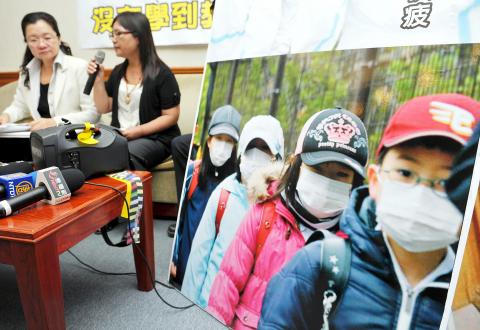
Photo: CNA
“If something goes wrong at any one of the three plants, many schools will face total evacuation,” she said.
The Fourth Nuclear Power Plant, also known as the Longmen plant, is still under construction.
Estimates by the Ministry of Education show that reconstruction of schools affected by a natural catastrophe in the area could cost up to NT$362 billion (US$12.56 billion), Tien said.
However, areas that became contaminated by radiation might have to be abandoned for decades before reconstruction could proceed, she said.
Moreover, Tien said that according to the Council of Agriculture, agricultural losses within a 30km radius of the Jinshan and Guo-sheng plants were estimated at about NT$10.7 billion per year.
However, efforts to amend the Nuclear Liability Act (核子損害賠償法) to lift the cap on state compensation, which is currently set at NT$4.2 billion, were unsuccessful in the legislature.
The Homemakers’ Union and Foundation chairwoman Chen Man-li (陳曼麗) said a growing number of people had access to technical information and the government should stop saying that the nuclear plants are safe without providing supporting evidence.
Chen called on the government to take policy flaws and problems seriously, adding that the public also had a responsibility to learn more about the possible dangers of nuclear power.
Former Yenliao Anti-Nuclear Self-Help Association president Wu Wen-tung (吳文通) said that as most of the initial construction engineers at the Longmen plant had retired, there would not be enough experienced engineers to deal with the problem if an incident occurred.
Green Citizens’ Action Alliance secretary-general Tsuei Su-hsin (崔愫欣) urged the government to allow inspections of the power plants by foreign experts invited by civic groups.
Tsuei also called for the safety evacuation zone to be expanded to at least 20km from the power plants.
Only 19 of the 54 nuclear power plants in Japan are currently operational and about 70 percent of Japanese are against nuclear power, Association for Nuclear-Free Homeland director-general Lin Hsien-shan (林獻山) said, adding that it was difficult to comprehend why, while Japan and Germany, both highly developed countries with advanced technology, were putting a halt to their nuclear activities, Taiwan remained so confident about the safety of its plants.

NATIONAL SECURITY: Authorities are working to confirm the identities of the military personnel involved and investigating possible illegal conduct and regulatory violations Authorities are probing possible national security implications after Kinmen police and immigration officers on Sunday found a Chinese woman allegedly posing as a tourist while engaging in prostitution involving more than 10 military personnel. The woman, surnamed Chen (陳), has since been deported, authorities said, adding that investigators are still working to confirm the identities of those implicated, as the records only listed code names and aliases. The case stemmed from a report received by the Kinmen District Prosecutors’ Office on Friday last week from the Jinhu Precinct of the Kinmen County Police Bureau. On Sunday, police, along with the National Immigration

GLOBALGIVING: ‘ Caving to external pressure is not acceptable for an organization that has cultivated justice reform and human rights for 30 years,’ one NGO said A slew of non-government organizations (NGOs) have withdrawn from the GlobalGiving fundraising platform after it announced it would use “Chinese Taipei” instead of “Taiwan” from next month. The Taiwan Good Rice Association wrote on Facebook on Friday that it was informed on April 28 via a teleconference call of the change, which was made because the platform wanted to operate in China. Taiwan Good Rice is to terminate all cooperative relationships with GlobalGiving in response to the platform’s “unilateral and non-negotiable” decision to remove references to Taiwan, the NGO said. “Taiwan is in the official name of Taiwan Good Rice Association and the

HEAVY WEATHER: Typhoon Jangmi is due to crash straight into the Ryukyus as airlines look to shift flights to larger aircraft or cancel flights to Okinawa entirely Taiwan’s international air carriers announced flight adjustments over the weekend as Typhoon Jangmi is forecast to hit the Ryukyu Islands today and tomorrow. The Central Weather Administration (CWA) upgraded Jangmi from a tropical storm to a typhoon at 8am yesterday, with the eye located 580km south of Naha city. It was moving north at 19kph. Today, China Airlines’ CI-120, CI-121, CI-122 and CI-123 flights between Taoyuan and Naha, Okinawa, have been canceled as well as CI-132 and CI-133 between Kaohsiung and Naha. EVA Air’s BR-112, BR-113, BR-186 and BR-185 flights between Taoyuan and Naha are also canceled. Low-cost carrier Tigerair Taiwan canceled IT-230,

Chinese Nationalist Party (KMT) Chairwoman Cheng Li-wun (鄭麗文) yesterday briefed her party’s Central Standing Committee regarding her scheduled visit to the US between Monday next week and June 16, saying that her purpose would be to persuade the US that the Republic of China (ROC) Constitution was a “one China” constitution that would foster stable and peaceful cross-strait relations. The ROC Constitution is the most important defense for all Taiwanese citizens, as it upholds our democracy and has contributed to our robust economy, which aligns with international and US interests, she said. “We would not be troublemakers and drag the US under,”


 RSS
RSS