


A cluster of three ancient sarcophagi recently discovered in Taitung could give archeologists new insights into a nearby prehistoric site, a researcher from the National Museum of Prehistory said on Thursday.
Parts of the sarcophagi, or stone coffins, have already been unearthed, showing them to be 60cm high and 50cm wide, although their lengths have yet to be determined because the excavation is still underway.
Weathered remains and mortuary objects, such as jade adzes, have been found in the sarcophagi, located on a hill more than 200m above sea level and about 3km from the Peinan archeological site. The prehistoric site, where more than 20,000 ancient objects have been unearthed, is one of the largest archeological sites in Taiwan.
After the discovery was made by construction workers widening a road, the Taitung City Government decided to suspend the road expansion project while an archeological group from the museum, which is located at the Peinan site, began to excavate the sarcophagi.
Yeh Mei-chen (葉美珍), an assistant researcher at the museum, said that although archeologists had discovered sarcophagi in the area a decade ago, they were unearthed individually rather than in a cluster, which she said provides great research value.
Preliminary studies show that the lives of the prehistoric humans who were interred in the sarcophagi were similar to those uncovered at the Peinan site and that the sarcophagi could represent part of a “satellite tribe” or extension of the Peinan site, Yeh said, adding that the discovery could help archeologists gain further understanding of the Peinan site.
It is also significant that the sarcophagi are situated 200m to 300m above sea level, while other archeological sites around the country tend to be located at sea level, said Lee Kun-hsiu (李坤修), another assistant researcher at the museum.
Although much research has been conducted at the Peinan site since 1945, large-scale excavations were not carried out until 1980, when the construction of Taitung Railway Station, which damaged the site, drew the public’s attention.
Anthropology professors Sung Wen-hsun (宋文薰) and Lien Chao-mei (連照美) of National Taiwan University then led a nine-year dig at the site.

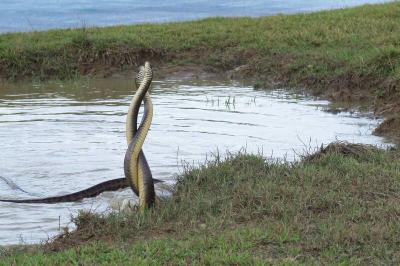
Kenting National Park service technician Yang Jien-fon (楊政峰) won a silver award in World Grand Prix Photography Awards Spring Season for his photograph of two male rat snakes intertwined in combat. Yang’s colleagues at Kenting National Park said he is a master of nature photography who has been held back by his job in civil service. The awards accept entries in all four seasons across six categories: architectural and urban photography, black-and-white and fine art photography, commercial and fashion photography, documentary and people photography, nature and experimental photography, and mobile photography. Awards are ranked according to scores and divided into platinum, gold and
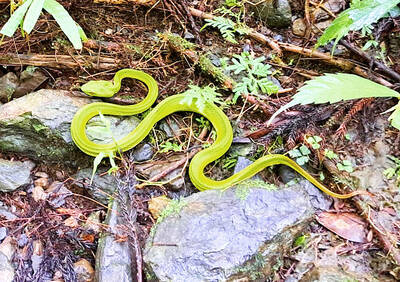
More than half of the bamboo vipers captured in Tainan in the past few years were found in the city’s Sinhua District (新化), while other districts had smaller catches or none at all. Every year, Tainan captures about 6,000 snakes which have made their way into people’s homes. Of the six major venomous snakes in Taiwan, the cobra, the many-banded krait, the brown-spotted pit viper and the bamboo viper are the most frequently captured. The high concentration of bamboo vipers captured in Sinhua District is puzzling. Tainan Agriculture Bureau Forestry and Nature Conservation Division head Chu Chien-ming (朱健明) earlier this week said that the
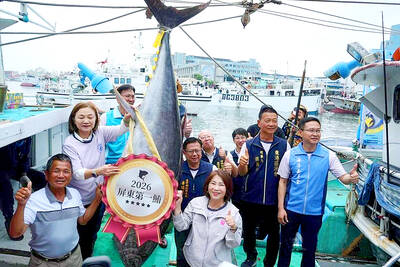
The first bluefin tuna of the season, brought to shore in Pingtung County and weighing 190kg, was yesterday auctioned for NT$10,600 (US$333.5) per kilogram, setting a record high for the local market. The auction was held at the fish market in Donggang Fishing Harbor, where the Siaoliouciou Island-registered fishing vessel Fu Yu Ching No. 2 delivered the “Pingtung First Tuna” it had caught for bidding. Bidding was intense, and the tuna was ultimately jointly purchased by a local restaurant and a local company for NT$10,600 per kilogram — NT$300 ,more than last year — for a total of NT$2.014 million. The 67-year-old skipper
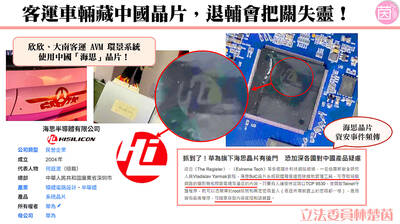
BREACH OF CONTRACT: The bus operators would seek compensation and have demanded that the manufacturer replace the chips with ones that meet regulations Two bus operators found to be using buses with China-made chips are to demand that the original manufacturers replace the systems and provide compensation for breach of contract, the Veterans Affairs Council said yesterday. Democratic Progressive Party Legislator Michelle Lin (林楚茵) yesterday said that Da Nan Bus Co and Shin-Shin Bus Co Ltd have fielded a total of 82 buses that are using Chinese chips. The bus models were made by Tron-E, while the systems provider was CYE Electronics, Lin said. Lin alleged that the buses were using chips manufactured by Huawei subsidiary HiSilicon Co, which presents a national security risk if the


 RSS
RSS