


Despite having joined the Chinese Nationalist Party (KMT) forces to fight the Japanese invasion of China, Lee Li-chun (李力群), a veteran and son of former high-ranking Taiwan-born General Lee Yu-pang (李友邦), yesterday panned the KMT over its abuse of power during the Martial Law era.
“My father was accused of and executed for something he did not do, all because of political divisions within the party [KMT],” Lee told a news conference in Taipei.
Although the news conference was ostensibly held on the eve of the 74th anniversary of the Marco Polo Bridge Incident to call on the government to pay more attention to the struggle of both Chinese and Taiwanese against Japanese imperialism, many of those in attendance chose to vent their criticism on the KMT government of the era.
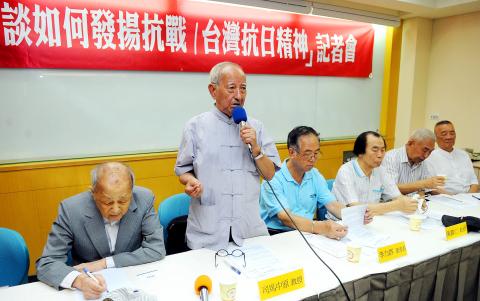
Photo: Wang Min-wei, Taipei Times
Having moved to China from Taiwan in 1924 when Taiwan was still a colony of Japan, Lee Yu-pang quickly joined Nationalist army efforts to fight the Japanese forces in China and had achieved the rank of of lieutenant-general by the end of World War II.
Accused by the KMT government of being a secret member of the Chinese Communist Party (CCP), Lee Yu-pang was arrested and imprisoned for three months in 1947.
After returning to Taiwan, he was arrested again and executed in 1952.
Lee Li-chun said his father was imprisoned and executed as the result of an internal power struggle within the KMT.
While Lee was a little reserved in his criticism of the KMT, air force veteran Hu Yao-fei (胡耀飛) was harsher.
“If you think the CCP is brutal, the KMT is no less so,” Hu said “Chiang Ching-kuo (蔣經國) was very diabolical when he was trying to get rid of his enemies.”
Hu said that during his time in the military he had seen many of his colleagues simply “disappear” in the middle of the night, because they said something wrong, were friends with the “wrong” people, or simply because they were disliked.
Having served in the air force for two decades, “I was never promoted because I never sought promotion, and I never joined the KMT, though I was invited to do so several times,” he said.
Hu said he did not seek promotion because he wanted to keep his head down and avoid becoming a target.
He said he refused to join the KMT, “because once you became a member, you had to spy on your colleagues — and that was against everything I believed in.”
“I retired as a corporal, but I was happy, because I didn’t do anything evil at all,” Hu said.
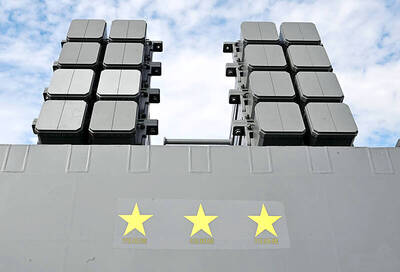
UPGRADE: The Kang Ding-class frigate is replacing its Chaparall missiles with Tien Chien II and Hua Yang VLS, which would provide it with long-range, 360° air defense Taiwan plans to produce 1,200 to 1,376 Hai Chien II missiles (海劍二, Sea Sword II) — also known as TC-2N — to serve as the standard air defense system of the navy’s surface combatant fleet, a source said yesterday. Last week, the Hai Chien II, the naval version of the Tien Kung II missile (天劍二, Sky Sword II), completed a live-fire test in waters off the National Chungshan Institute of Science and Technology’s Jiupeng facility (九鵬) in Pingtung County’s Manjhou Township (滿州). The MIM72 Chaparral and other dated air defense missiles that currently arm Taiwanese ships have inadequate range to combat Chinese

REASONS FOR TRAVEL: An assistant professor said that proposed amendments to penalize drivers if they used drugs overseas would not deter people from traveling People who operate a motor vehicle under the influence of marijuana would have their driver’s license revoked, even if they used the substance while overseas, the Ministry of Transportation and Communications said yesterday, citing proposed amendments to the Road Traffic Management and Penalty Act (道路交通管理處罰條例). The amendments would also authorize the government to revoke the licenses of people determined to have used Category 1 or Category 2 narcotics, even if they were not operating a vehicle while under the influence of drugs, as well as ban them from taking the license test for three years, the ministry said. People aged 18 or

GLOBALGIVING: ‘ Caving to external pressure is not acceptable for an organization that has cultivated justice reform and human rights for 30 years,’ one NGO said A slew of non-government organizations (NGOs) have withdrawn from the GlobalGiving fundraising platform after it announced it would use “Chinese Taipei” instead of “Taiwan” from next month. The Taiwan Good Rice Association wrote on Facebook on Friday that it was informed on April 28 via a teleconference call of the change, which was made because the platform wanted to operate in China. Taiwan Good Rice is to terminate all cooperative relationships with GlobalGiving in response to the platform’s “unilateral and non-negotiable” decision to remove references to Taiwan, the NGO said. “Taiwan is in the official name of Taiwan Good Rice Association and the

HEAVY WEATHER: Typhoon Jangmi is due to crash straight into the Ryukyus as airlines look to shift flights to larger aircraft or cancel flights to Okinawa entirely Taiwan’s international air carriers announced flight adjustments over the weekend as Typhoon Jangmi is forecast to hit the Ryukyu Islands today and tomorrow. The Central Weather Administration (CWA) upgraded Jangmi from a tropical storm to a typhoon at 8am yesterday, with the eye located 580km south of Naha city. It was moving north at 19kph. Today, China Airlines’ CI-120, CI-121, CI-122 and CI-123 flights between Taoyuan and Naha, Okinawa, have been canceled as well as CI-132 and CI-133 between Kaohsiung and Naha. EVA Air’s BR-112, BR-113, BR-186 and BR-185 flights between Taoyuan and Naha are also canceled. Low-cost carrier Tigerair Taiwan canceled IT-230,


 RSS
RSS