

The Jiji Line (集集線), one of the nation’s historical railway routes, is scheduled to reopen on Saturday after the service was suspended more than a year ago, the Taiwan Railway Administration said yesterday.
The railway operator also said it would allow free trips on the line for nine days. Those interested in taking rides on the Jiji line must first obtain free one-way trip passes, which are available at the Taichung, Changhua, Yuanlin (員林), Tianjhung (田中) and Ershuei (二水) train stations.
Return tickets are only available at the Jiji and Checheng (車埕) train stations.
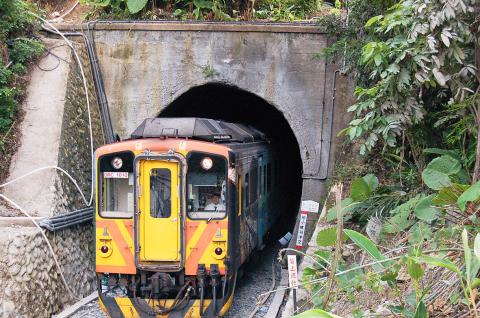
Photo: Tseng Hung-ju, Taipei Times
Built during the Japanese colonial era, the 29.7km line was used to transport construction materials needed to build the power plant at Sun Moon Lake. The line runs from Ershuei Station in Changhua County to Checheng Station in Nantou County.
Among the seven tunnels along the route, six have existed for about 80 years. A relatively new tunnel on the line has also been around for 50 years.
The 921 Earthquake in 1999 caused severe damage to the tunnels. The railway operator decided to suspend operations between Longquan (龍泉) and Checheng in March to reinforce them and expand the width of the railway line. During renovation, trains could only operate between Ershuei and Longquan stations.
Taiwan Railway Administration Director-General Frank Fan (范植谷) said that only diesel rail cars could operate on the line in the past. Other types of cars can run on the line now that the reinforcement project is complete.
The railway operator estimates that the project will help raise the capacity of the Jiji Line from 300,000 to 500,000 passengers per year, adding that the nine days of free rides could attract 90,000 passengers.
The railway operator said it had planned to arrange a total of 26 trips per day between Ershuei and Checheng.

The donation of offshore patrol vessel Kinmen to the Philippines includes provisions that protect Taiwanese fishers and facilitate security cooperation across the First Island Chain, officials said yesterday. The comment was made during the Cabinet’s comprehensive administrative report at the legislature after Chinese Nationalist Party (KMT) Legislator Hsu Yu-chen (許宇甄) expressed concerns about the decision to give a ship to a country whose coast guard had in 2013 fired on a Taiwanese trawler and killed its captain without provocation. The Cabinet should lay out the safeguards that have been established to prevent the Philippine government from using the Kinmen to harass, expel
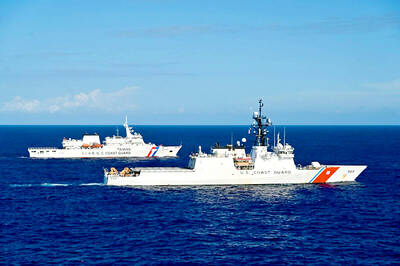
GROWING TIES: The CGA is planning a goodwill mission to the Philippines, in what would be the first time since 1975 a Taiwanese paramilitary vessel has visited the country The Coast Guard Administration (CGA) plans to significantly expand its participation in international security cooperative frameworks and its operational capabilities, a budget proposal for next year showed. The budget indicates a transformation of the CGA from a maritime law enforcement arm into a national defense and intelligence gathering entity capable of tackling larger regional security matters. The proposal showed that personnel from the coast guard’s Intelligence Division and Special Action Support Center are to participate in high-level national security talks with the US. As the CGA has dealt with China’s rising “gray zone” threats around Taiwan, it has become a valuable asset to
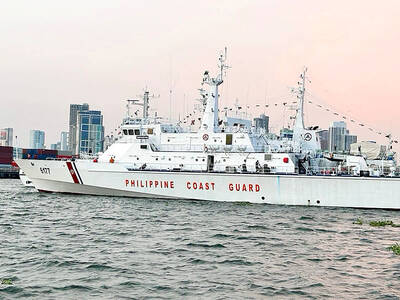
A patrol vessel donated by the Coast Guard Administration (CGA) to the Philippines was commissioned into the Philippine Coast Guard (PCG) on Friday, a Philippine non-governmental organization said. The CGA on Sept. 16 confirmed media reports that Taiwan had donated a retired 500-tonne patrol vessel to the Philippines. The Manila-based We Protect Our Seas (WPS) foundation, which served as an intermediary in the transfer, said that the vessel was formerly the CGA’s 500-tonne petrol vessel Kinmen (CG123). The WPS, in a statement issued on Friday, said the vessel, renamed as the BRP Sarangani, had been commissioned into the PCG the
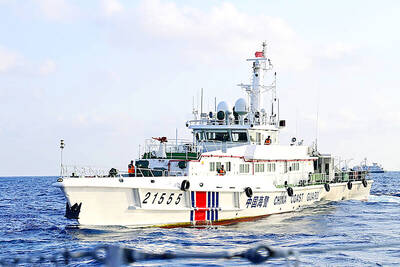
‘GRAY ZONE’ TACTICS: Beijing sent two China Coast Guard vessels to escort a ‘supposedly private research ship,’ a Philippine Coast Guard spokesman said The Coast Guard Administration (CGA) yesterday confirmed that it had recently deployed three patrol vessels to waters in Taiwan’s overlapping exclusive economic zone with the Philippines to monitor three Chinese vessels. CGA Deputy Director-General Hsieh Ching-chin (謝慶欽) said the agency regularly monitors Chinese vessels around Taiwan, and that the deployment south of Oluanpi (鵝鑾鼻), Taiwan proper’s southernmost point, was carried out in accordance with standard procedures. He added that the waters fall within the overlapping exclusive economic zones of Taiwan and the Philippines, which extend 200 nautical miles (370km) from their coastlines. Hsieh made the comments when asked about a


 RSS
RSS