


Ahead of commemorations for the Tiananmen Square Massacre this weekend, the New School for Democracy was officially established in Taiwan on Monday by Chinese, Hong Kong and foreign academics who will give talks on democracy via the Internet with the hope of shattering “one-party rule” in China.
Participants in the project said funding would come from private corporations, non-governmental organizations and public donations, adding that the school would focus on Chinese all over the world as potential “students.”
Its curriculum will include political science, human rights and legal education, international relations and recognition of political spheres.
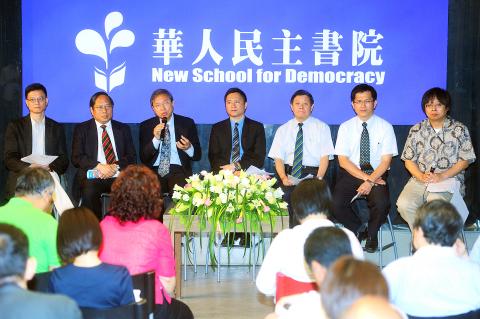
Photo: Liao Chen-huei, Taipei Times
The school will feature both face-to-face teaching and online classes, organizers said.
Members of the school include a number of well-known individuals, with the board including Tiananmen Square student leaders Wang Dan (王丹) and Wang Juntao (王軍濤), head of the Contemporary China Research Center at the City University of Hong Kong Joseph Cheng (鄭宇碩), editor-in-chief of the New York-based Beijing Spring magazine Hu Ping (胡平), former Government Information Office director Lin Chia-lung (林佳龍), Hong Kong Democratic Party Chairman Albert Ho (何俊仁) and National Chengchi University sociology professor Ku Chung-hwa (顧忠華).
During the official launch, the school announced its four primary areas of focus: promoting democratic development in Chinese societies, solidifying the theoretical bases for democratic movements, creating a communications platform for Chinese worldwide and enabling participation in politics beyond the confines of political parties.
Organizers said they hoped to rise above party politics and transnational borders, while respecting the younger generation and allowing democracy to take root through education.
Wang Dan, chairman of the college, said almost a year of planning had gone into the project and that it was very moving to finally see it come into being.
He said it was the first joint effort from civil society in Taiwan, Hong Kong and China, which gave the project special significance.
“Though we each have our own political inclinations, the fact that we wish to work together as academics is truly rare,” Wang Dan said.
He also called on the pan-blue camp and the Chinese Nationalist Party (KMT) government to -participate in the project, adding that the college was also considering the possibility of inviting President Ma Ying-jeou (馬英九) to give a lecture.
Lin, one of the representatives from Taiwan, said that as long as China was not a democracy, the whole world — and especially Taiwan — would not be at peace, adding that the promotion of democracy in China was becoming more urgent.
Although the “Jasmine Revolution” has marked calls for democratization in the Arab world that have reached China, it does not seem to have bloomed there quite yet, Lin said, adding that continued effort would eventually “topple the high walls.”
Lin said that since China was trying to unify Taiwan through its “Strait-West Special District” (海西特區), why not make it a “Democracy Special District?” Lin added that China only had semi--democratic mechanisms at the village level and should promote democratization through elections at higher administrative levels.
The school will be registered in Hong Kong, with offices in Taiwan and Hong Kong, Wang Dan said, adding that courses would begin in September.
Ho, who has long been concerned with democracy in China, said the decision to register the college in Hong Kong had special significance.
Hong Kong played a special role in the Xinhai Revolution (辛亥革命), which led to the formation of the Republic of China 100 years ago, Ho said, adding that Hong Kong had always been the place where revolutionary and reformist ideas in China came from.
The demands for democracy and constitutional government that emerged from the Xinhai Revolution a century ago have yet to be met and Hong Kong’s duty to history is not yet finished, Ho said.
Ku said that with the Chinese government’s hold on independent thought growing tighter and tighter, China had yet to become a major nation in the normal sense.
TRANSLATED BY JAKE CHUNG, STAFF WRITER
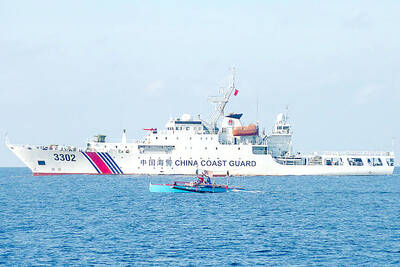
EXPANSIONIST: China deploys an average of 40 to 50 warships and coast guard vessels daily in the South China Sea, despite pledges not to militarize the region, an official said China is attempting to expand its influence across the First Island Chain and increase pressure on Japan by sending coast guard vessels into waters off of Taiwan under the pretext of maritime negotiations with Japan and the Philippines, a national security official said yesterday. China’s recent actions in the waters east of Taiwan and Japan and the Philippines’ exclusive economic zones (EEZ) are attempts to establish dominance in First Island Chain waters, said the official who declined to be named, adding that this is “expansion disguised as law enforcement.” Framing China’s actions solely as a cross-strait issue is a serious misjudgment that
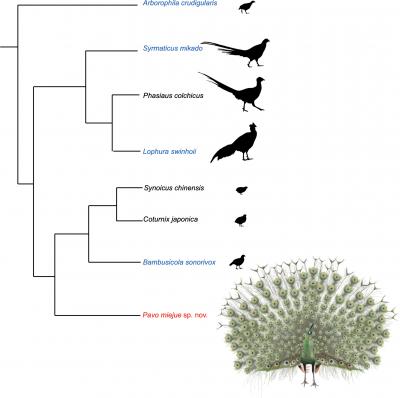
Through analyzing fossil evidence, a research team at National Taiwan University (NTU) discovered the largest endemic bird to have lived in Taiwan, naming it Pavo miejue, or extinct peafowl (滅絕孔雀). The Mikado pheasant, which is printed on the back of the NT$1,000 bank note, was previously believed to be the biggest endemic bird to Taiwan. The research team’s findings suggest that Pavo miejue lived during the Pleistocene epoch tens of thousands of years ago. It is the first endemic extinct bird species discovered and formally named in Taiwan. The study was coauthored by NTU Institute of Ecology and Evolutionary Biology professor Tsai Cheng-hsiu (蔡政修),
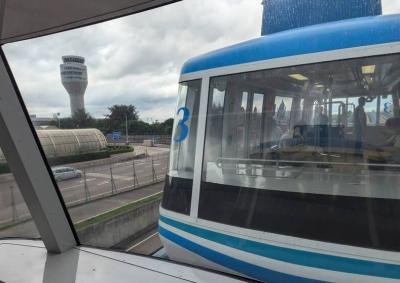
Taiwan Taoyuan International Airport is to suspend its automated Skytrain service connecting Terminal 1 and Terminal 2 starting on July 1 to facilitate connection works for the upcoming Terminal 3, the airport operator said today. Passengers and staff who need to travel between the two terminals after the suspension can instead use the Taoyuan MRT or the airport's 24-hour shuttle bus service, Taoyuan International Airport Corp said. The Taoyuan MRT Airport Line directly links the two terminals, while the shuttle buses are to operate around the clock, the company added. The Skytrain provides free transportation between the airport’s two terminals for travelers and
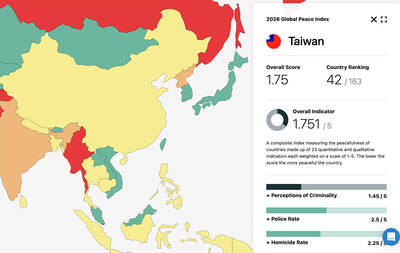
Taiwan ranked 42nd in terms of peacefulness among 163 countries, down five places from last year, according to this year’s Global Peace Index. With an overall score of 1.751, Taiwan dropped from 37th last year, the report published by the global Institute for Economics and Peace showed. The overall score measures a country’s level of peacefulness using 23 quantitative and qualitative indicators across three domains — ongoing domestic and international conflict, societal safety and security, and militarization. While Taiwan ranked 42nd worldwide, it was listed in ninth place among the 19 Asian-Pacific countries in the report, after New Zealand, Singapore, Japan, Malaysia,


 RSS
RSS