


Democratic Progressive Party (DPP) lawmakers expressed anger yesterday at what they said was the government’s slow response in quashing a “doomsday prediction” that passed without incident.
“It’s completely irresponsible,” DPP Legislator Gao Jyh-peng (高志鵬) said. “The government allowed these fallacies to spread instead of vigorously handling them from the outset.”
Gao and other members of the DPP caucus held a press conference two hours before Wang Chao-hung (王超弘), a self-styled prophet who calls himself “Teacher Wang,” predicted that a magnitude 14.0 earthquake was to hit Taiwan at 10:42:am yesterday and that it would “rip the island in half.”
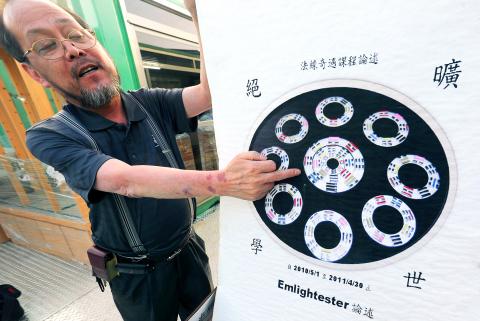
Photo: AFP
The DPP lawmakers charged that the rumor, publicized through TV and newspaper reports, harmed society and incited public panic. One elderly man jumped to his death on Thursday last week, apparently affected by the news.
“Taiwanese society loves spreading these kinds of gossip and rumors and regardless of whether it is taken seriously or as a joke, it reflects poorly on society,” DPP Legislator Lee Chun-yee (李俊毅) said.
Government officials, from Premier Wu Den-yih (吳敦義) to the National Science Council and researchers from Academia Sinica, sought to dismiss the rumors.
DPP lawmakers suggested that agencies needed to better enforce laws on issuing unauthorized forecasts on earthquakes and inciting social panic, punishable by fines of up to NT$1 million (US$35,000).
The Central Weather Bureau has ruled out fines for Wang.
“The government should have investigated these fallacies before they were given a chance to spread,” DPP Legislator Twu Shiing-jer (涂醒哲) said.
Asked about the issue, Chinese Nationalist Party (KMT) lawmakers said that more discussion on the issue seemed unnecessary and expressed optimism that Wang would be the last “teacher.”
The subject, however, appeared to have taken center stage at the legislature’s Internal Administration Committee yesterday, with lawmakers from across party lines urging the Ministry of the Interior (MOI) to penalize Wang over his “omen.”
“Spreading rumors that cause social instability is punishable by fines in the Social Order Maintenance Act (社會秩序維護法). Spreading information about disaster prevention without authorization from the Central Emergency Operation Center is also punishable according to the Disaster Prevention and Protection Act (災害防救法),”KMT Legislator Wu Yu-sheng (吳育昇) said. “If the MOI doesn’t do or say anything, it would just create more panic.”
DPP Legislator Huang Jen-chu (黃仁杼) held similar views.
“Rumors that Wang spread have caused so many people to panic — even the military is moving helicopters to safe locations and the Keelung City Government has published a tsunami escape route map,” Huang said. “How can the MOI do nothing about it?”
In response, Minister of the Interior Jiang Yi-huah (江宜樺) said the ministry has asked the Nantou County Government to monitor the situation and conducted safety and fire inspections on shelters that Wang built, and he denied any military response to the rumors.
“I don’t think what Wang said has caused the public to panic,” Jiang said. “Although it has triggered wild public discussions, most of the people looked at the rumors as something funny and talked about it in a satirical way.”

Considering that most countries issue more than five denominations of banknotes, the central bank has decided to redesign all five denominations, the bank said as it prepares for the first major overhaul of the banknotes in more than 24 years. Central bank Governor Yang Chin-lung (楊金龍) is expected to report to the Legislative Yuan today on the bank’s operations and the redesign’s progress. The bank in a report sent to the legislature ahead of today’s meeting said it had commissioned a survey on the public’s preferences. Survey results showed that NT$100 and NT$1,000 banknotes are the most commonly used, while NT$200 and NT$2,000

The Centers for Disease Control (CDC) yesterday reported the first case of a new COVID-19 subvariant — BA.3.2 — in a 10-year-old Singaporean girl who had a fever upon arrival in Taiwan and tested positive for the disease. The girl left Taiwan on March 20 and the case did not have a direct impact on the local community, it said. The WHO added the BA.3.2 strain to its list of Variants Under Monitoring in December last year, but this was the first imported case of the COVID-19 variant in Taiwan, CDC Deputy Director-General Lin Ming-cheng (林明誠) said. The girl arrived in Taiwan on

South Korea is planning to revise its controversial electronic arrival card, a step Taiwanese officials said prompted them to hold off on planned retaliatory measures, a South Korean media report said yesterday. A Yonhap News Agency report said that the South Korean Ministry of Foreign Affairs is planning to remove the “previous departure place” and “next destination” fields from its e-arrival card system. The plan, reached after interagency consultations, is under review and aims to simplify entry procedures and align the electronic form with the paper version, a South Korean ministry official said. The fields — which appeared only on the electronic form

The Ministry of Foreign Affairs (MOFA) is suspending retaliation measures against South Korea that were set to take effect tomorrow, after Seoul said it is updating its e-arrival system, MOFA said today. The measures were to be a new round of retaliation after Taiwan on March 1 changed South Korea's designation on government-issued alien resident certificates held by South Korean nationals to "South Korea” from the "Republic of Korea," the country’s official name. The move came after months of protests to Seoul over its listing of Taiwan as "China (Taiwan)" in dropdown menus on its new online immigration entry system. MOFA last week


 RSS
RSS